


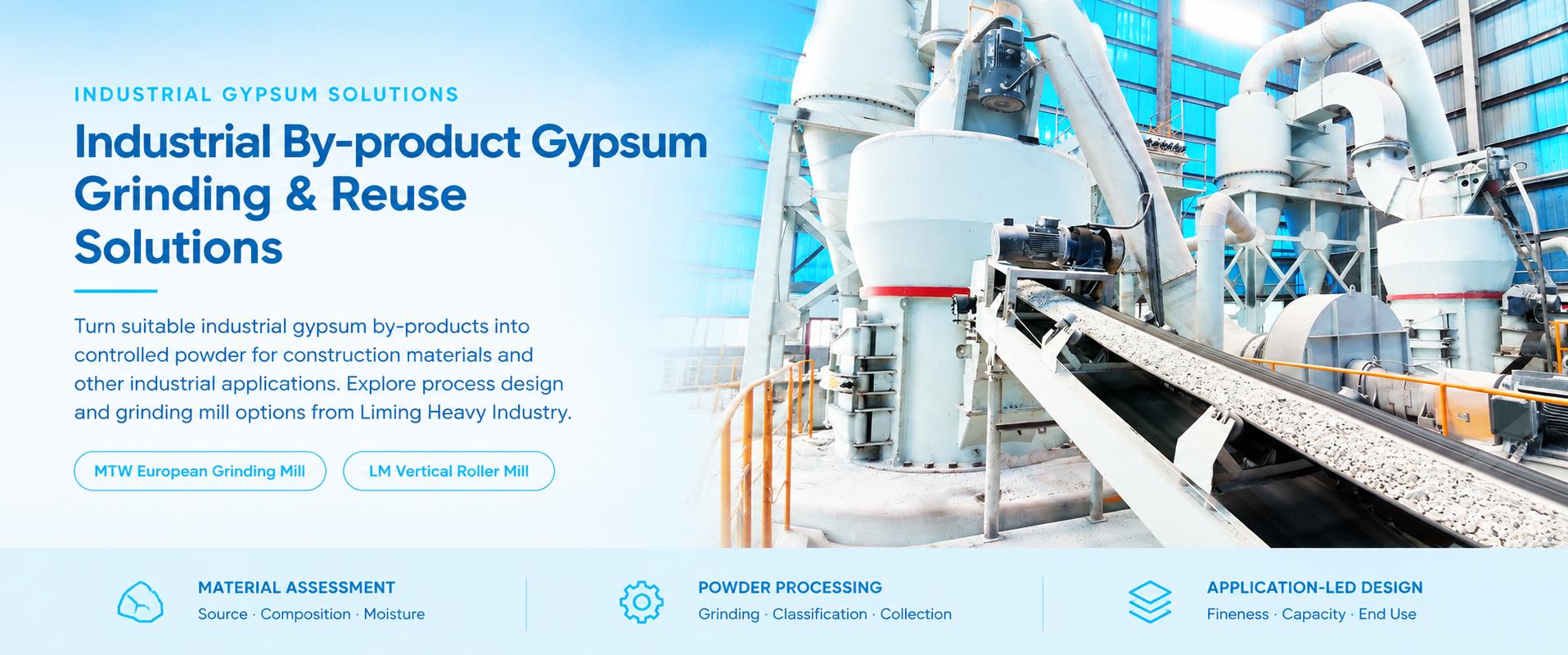
Phosphogypsum can potentially be reused, but its suitability depends on the source material, impurity profile, radiological characteristics, local regulations and the requirements of the final application. Grinding can improve particle size, powder uniformity and handling performance, but it does not by itself remove impurities or confirm that phosphogypsum is suitable for cement, building materials, agriculture or another end use.
A responsible phosphogypsum reuse project begins with representative sampling, laboratory analysis and regulatory review. Only after the material has been evaluated should the project team select pre-treatment, drying, grinding, classification and final-product handling equipment.
What Is Phosphogypsum?
Phosphogypsum is a calcium sulfate-containing industrial by-product generated during wet-process phosphoric acid production. Phosphoric acid is an important raw material for phosphate fertilizers, and the process produces phosphogypsum in significant quantities.
The main mineral component of phosphogypsum is generally calcium sulfate dihydrate. However, the material may also contain residual phosphate, fluoride-related compounds, soluble salts, organic matter, trace elements, heavy metals and naturally occurring radionuclides. The actual composition varies according to the phosphate rock source, acid-production route, process control, filtration conditions and storage history.
Because phosphate ore can contain uranium, radium and other naturally occurring radioactive elements, phosphogypsum may retain radionuclides from the original ore. Radium-226 is often a major consideration because it decays to radon gas. The required evaluation and permitted uses therefore differ widely among countries and regions.
Can Phosphogypsum Be Reused?
Yes, phosphogypsum may be reused in certain applications when it meets technical, environmental and regulatory requirements. However, it should not be assumed that every phosphogypsum source is suitable for reuse or that every reuse route is permitted in every market.
Reuse feasibility depends on more than gypsum content. A material with high calcium sulfate dihydrate content may still require treatment or may be restricted from certain applications because of soluble impurities, fluoride, phosphorus, heavy metals, radionuclides or local regulatory conditions.
The correct engineering question is therefore:
Can this specific phosphogypsum source, after suitable treatment and quality control, meet the requirements for a defined application in the intended market?
This question should be answered through chemical analysis, physical testing, radiological characterization where applicable, end-use trials and local compliance review.
Why Is Phosphogypsum Reuse More Complex Than Natural Gypsum Use?
Natural gypsum is generally mined and processed as a mineral raw material. Phosphogypsum is generated in a chemical process, and its composition can be influenced by the original phosphate rock and the operating conditions of the fertilizer plant.
For this reason, phosphogypsum may show greater variation in moisture, particle size, soluble phosphorus, fluorine-related compounds, acidity, organic content and trace-element concentration. These factors can affect powder flow, grinding efficiency, setting behavior, product color, compatibility with binders and long-term performance in the final application.
In addition, the radiological profile of phosphogypsum may require specialized testing and regulatory assessment. The International Atomic Energy Agency identifies the phosphate industry as a sector in which naturally occurring radioactive materials require appropriate characterization, management and radiation-protection consideration.
Key Tests Before Phosphogypsum Processing
Before designing a phosphogypsum grinding line, collect representative samples from the actual storage area, filter system or production stream. One sample is often not enough when material quality changes over time. Sampling should reflect normal production variation, different storage zones and potential changes in raw phosphate rock.
A preliminary evaluation may include the following tests:
Calcium sulfate dihydrate content
Free moisture and total moisture
Particle-size distribution and feed condition
Soluble phosphorus and phosphate-related impurities
Fluoride-related compounds
pH and acidity
Soluble salts and chloride where relevant
Organic matter and residual process chemicals
Heavy metals and trace elements where required
Radionuclide content and radiological characteristics where required
Bulk density, flowability and tendency to compact
Target product fineness and intended final application
Phosphogypsum can contain phosphorus, fluorine, organic matter, heavy-metal impurities and radionuclides in addition to its gypsum component. Reviews of phosphogypsum reuse emphasize that impurity control and appropriate pretreatment are important before it is incorporated into construction materials, road materials or other applications.
Common Phosphogypsum Reuse Applications
Potential applications depend on local legislation, material quality and the performance requirements of the end user. The following routes are examples that may be evaluated; they should not be interpreted as automatic approval for any phosphogypsum source.
Cement production
Gypsum is commonly used in cement production to help control setting time. Suitable phosphogypsum may be considered as a gypsum source for cement grinding or cementitious materials when its composition and impurity content are compatible with the cement producer’s process and product requirements.
For cement use, the project should evaluate gypsum content, moisture, soluble phosphorus, fluoride-related compounds, acidity, chlorides, trace elements and the effect of the material on cement setting and strength development. Grinding improves dosing consistency, but product trials are required before routine use.
Gypsum-based building materials
In some markets, treated phosphogypsum may be evaluated for gypsum plaster, blocks, panels, boards and other building materials. These applications generally require strict control of chemical composition, moisture, particle size, setting characteristics and safety-related parameters.
Building-material use may require more than grinding. Depending on the source material and target product, the process may include washing, neutralization, impurity reduction, calcination, blending or other treatment steps before or after grinding. The final product must meet the relevant local building-material and radiological requirements.
Road and civil-engineering materials
Phosphogypsum has been studied for use in road materials, soil stabilization and civil-engineering applications. These routes can consume significant volumes of material, but they also require careful evaluation of mechanical performance, leaching behavior, environmental exposure and regulatory approval.
Research reviews note that phosphogypsum used in road-related materials can contain radionuclides and heavy-metal impurities, and that physical, chemical or thermal pretreatment may be needed before reuse.
Agricultural and soil-related applications
In certain regions, phosphogypsum may be considered as a calcium and sulfur source or as a soil amendment. This route is highly dependent on local rules, material chemistry, radionuclide levels, soil conditions, crop requirements and application rates.
It is important not to assume that phosphogypsum approved for agricultural use in one country is approved in another. For example, the United States Environmental Protection Agency states that phosphogypsum removal from stacks is allowed under specified conditions for outdoor agricultural purposes and indoor research and development, while other uses require prior approval.
Other industrial uses
Other potential pathways include landfill cover, sulfur recovery, specialized chemical processing, ceramic and glass-related applications, rare-earth recovery and engineered materials. These uses require their own technical and regulatory evaluation. The appropriate reuse route should be selected by matching the actual material profile with the performance requirements and legal conditions of the target market.
Typical Phosphogypsum Processing Route
A phosphogypsum processing system should be designed around the source material and final application. There is no single process flow that fits every project. Some sources may require only moisture reduction and controlled grinding, while others may require washing, neutralization, impurity reduction or thermal treatment before they can be considered for a defined use.
1. Receiving, stockpile management and sampling
Phosphogypsum may be received from filter systems, wet storage areas, transport vehicles or stockpiles. The first task is to identify whether the material is fresh, aged, blended, compacted or exposed to weather. Storage conditions can affect moisture distribution, lump formation, surface contamination and feed consistency.
Representative sampling should be performed before the processing route is finalized. If different stockpile zones have different properties, they may need to be separated or blended under controlled conditions.
2. Pre-treatment
Pre-treatment is selected according to the material’s impurity profile and target use. Possible measures may include screening, deagglomeration, washing, filtration, neutralization, physical separation, chemical treatment or thermal treatment. The purpose is to improve suitability for the final application, not merely to make the material easier to grind.
Physical pretreatment approaches reported in phosphogypsum reuse studies include washing, flotation and screening. Chemical and thermal methods may also be considered where the project requires more extensive impurity management.
3. Dewatering and drying
Phosphogypsum can have high moisture content, particularly when it is recovered from wet process streams or exposed storage areas. Excess moisture may cause sticking, bridging, buildup in hoppers, unstable feeding and reduced grinding efficiency.
Dewatering may be completed through filtration or mechanical separation. If the material remains too wet for stable milling or finished-product requirements, drying may be added as a separate stage or integrated into the grinding system where appropriate. The required moisture target depends on the mill, downstream application, transport method and storage conditions.
4. Crushing and deagglomeration
Even when the original phosphogypsum particles are fine, stored material can form lumps and compacted masses. Crushing or deagglomeration creates a more uniform feed and helps prevent blockage in the drying and grinding stages.
The purpose of this stage is to prepare a stable feed, not necessarily to achieve final product fineness. Final particle-size reduction is completed in the grinding and classification system.
5. Grinding and classification
Grinding produces a more uniform phosphogypsum powder and helps meet the particle-size requirements of the intended application. Classification controls the final powder distribution by separating fine product from oversized particles for return grinding.
The required fineness should be specified by the end use. Cement, plaster, composite materials and specialized industrial products can require different particle-size distributions. Over-grinding increases energy use and may affect powder behavior, while insufficient grinding can reduce blending uniformity and downstream product consistency.
6. Collection, storage and quality control
After grinding and classification, the powder is collected through a dust-control system and transferred to silos, bulk-loading facilities or packing equipment. The storage system should protect the powder from water absorption, contamination and uncontrolled blending with other materials.
Quality control should continue after grinding. Finished powder should be checked against the agreed specifications for fineness, moisture, chemical composition and any required environmental or radiological parameters. For sensitive applications, product testing should be performed regularly rather than only during initial commissioning.
Grinding Mills for Phosphogypsum Powder
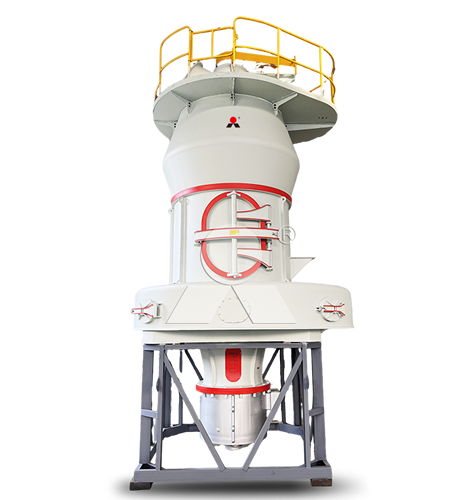
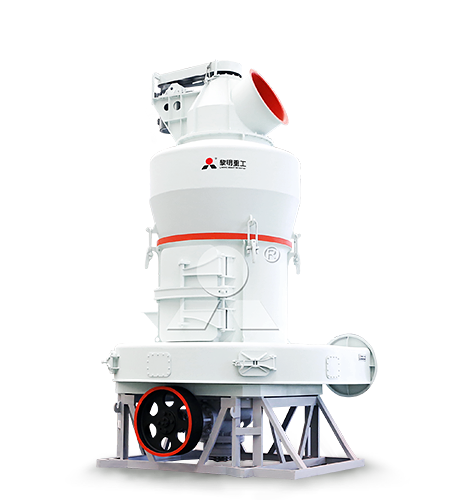
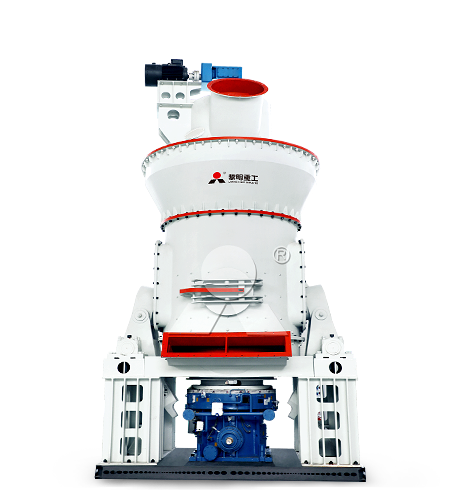
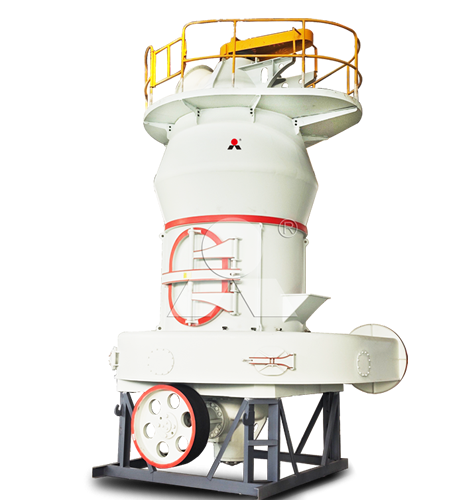
The grinding mill should be selected after the project team confirms the feed moisture, degree of agglomeration, required fineness, production capacity, pretreatment route and final application. For phosphogypsum projects, MTW European Grinding Mill, LM Vertical Roller Mill and Raymond mill can be considered for suitable prepared material.
MTW European Grinding Mill
MTW European Grinding Mill can be considered for small-to-medium capacity phosphogypsum powder projects that require controlled fineness and stable classification. It is generally suitable when the feed has been prepared, moisture has been controlled and the material can be fed consistently.
For phosphogypsum with significant free moisture, upstream dewatering or drying may be required before MTW grinding. If the feed remains sticky or highly variable, the project should first improve material conditioning rather than relying on the grinding mill to solve handling problems.
LM Vertical Roller Mill
LM Vertical Roller Mill is suitable for larger-capacity phosphogypsum grinding systems. It can be considered where the project requires continuous production, compact process layout and potential integration of drying, grinding and classification.
An LM Vertical Roller Mill configuration should be based on actual feed data. The design needs to consider moisture variation, evaporation demand, available heat source, feed condition, target fineness, capacity and the behavior of impurities during drying and grinding.
Raymond Mill
Raymond mill can be considered for conventional phosphogypsum powder production with moderate output requirements and relatively stable, prepared feed. It is generally more appropriate when the material has already been dewatered, dried as necessary and deagglomerated before entering the mill.
Before selecting a Raymond mill, confirm the feed size, moisture, required powder fineness, hourly production requirement and collection system. Stable feed conditions are important for reliable operation and consistent product quality.
How to Select a Phosphogypsum Grinding Process
Equipment selection should follow material evaluation and end-use confirmation. A practical project sequence is shown below.
Identify the phosphate rock source and phosphoric acid production route.
Collect representative phosphogypsum samples from the intended supply stream or stockpile.
Complete chemical, physical, moisture and application-related testing.
Perform radiological characterization and regulatory review where required.
Define the intended final application and its acceptance criteria.
Select pretreatment measures for moisture, acidity, soluble impurities or other source-specific issues.
Determine the required powder fineness, capacity and finished-product moisture.
Select MTW European Grinding Mill, LM Vertical Roller Mill or Raymond mill based on the prepared feed and required production conditions.
Validate the finished material through end-use testing before commercial-scale supply.
Common Problems During Phosphogypsum Processing
High and variable moisture
Wet phosphogypsum can compact, bridge in hoppers and adhere to conveying equipment. This can lead to unstable mill feed and inconsistent powder quality. The solution may involve improved stockpile management, controlled feeding, dewatering, drying or blending of materials with different moisture levels.
Powder caking during storage
Even after grinding, phosphogypsum powder can absorb moisture and cake during storage. Proper drying, sealed storage, controlled powder temperature and reliable conveying are important for maintaining powder flowability.
Impurities that affect end-use performance
Residual phosphorus, fluorine, soluble salts, acidity and other impurities can influence setting behavior, product durability or compatibility with downstream formulations. If the material does not meet the final specification, finer grinding alone may not solve the problem. The project may need different pretreatment, blending, a different application or a revised material source.
Regulatory restrictions
Phosphogypsum regulation is location-specific. In the United States, the Environmental Protection Agency explains that phosphogypsum is regulated because it can contain radium, which decays to radon gas, and that uses outside specified agricultural and research conditions require prior approval.
Project developers should consult the competent local environmental, radiation-protection and product-standard authorities before investing in a reuse plant. Technical feasibility and legal permission must both be confirmed.
Information Needed for Preliminary Process Design
For a preliminary phosphogypsum processing and grinding evaluation, the following information is useful:
Phosphogypsum source and phosphoric acid production process
Current chemical analysis and gypsum content
Moisture content and expected variation
Available radiological and environmental test data
Feed form, feed size and degree of agglomeration
Required final powder fineness
Required production capacity
Intended final application and target-market location
Available heat source if drying is required
Required product storage, packing or bulk-delivery method
Applicable environmental, occupational and product regulations
Conclusion
Phosphogypsum can potentially be reused, but its reuse is a material-quality and compliance challenge before it becomes a grinding challenge. The material must first be tested for gypsum content, moisture, soluble impurities, trace constituents and radiological characteristics where required. The intended use must then be evaluated against local regulations and end-user specifications.
After suitable pre-treatment and moisture control, grinding can produce a more uniform phosphogypsum powder for qualified cement, building-material, agricultural, civil-engineering or other industrial applications. MTW European Grinding Mill can be considered for prepared small-to-medium capacity powder projects, LM Vertical Roller Mill for large-capacity systems and projects that may require drying integration, and Raymond mill for conventional processing with stable, adequately conditioned feed.
Final process design should always be based on representative material analysis, application trials and verified regulatory requirements. Grinding improves particle control and handling performance, but responsible phosphogypsum reuse depends on the complete route from source evaluation to finished-product acceptance.
Related Industrial By-product Gypsum Solutions


LIMING at MiningMetals Uzbekistan 2026 | Booth B94
2026-10-22

LIMING Heavy Industry at MINEXPO Africa 2026 | Booth 133
2026-10-22
Liming Heavy Industry to Exhibit at bauma CHINA 2026 – Visit Us at Booth E6.510
2026-10-15
Meet Liming Heavy Industry at the 140th Canton Fair 2026
2026-10-13
Liming Heavy Industry to Attend the 140th Canton Fair
2026-09-25
Complete Mineral Processing Solutions
Convenient Reliable Professional Efficient Get Your Quote
Please feel free to submit your inquiry information to us. We will contact with you as soon as possible.
Our team will contact you as soon as possible.