


In today's lime industry, rotary kilns rarely operate continuously at their design capacity. Market fluctuations, maintenance schedules, fuel supply variations, raw material changes, and seasonal demand often require producers to run kilns at 60%–85% of rated capacity for extended periods.
Many operators associate low-load operation with increased risks of ring formation, underburning, overburning, unstable lime reactivity, elevated CO emissions, and thermal inefficiency. However, practical experience from lime plants around the world shows that these problems are rarely caused by reduced production itself. In most cases, they occur because operators continue applying full-load operating philosophies to low-load conditions.
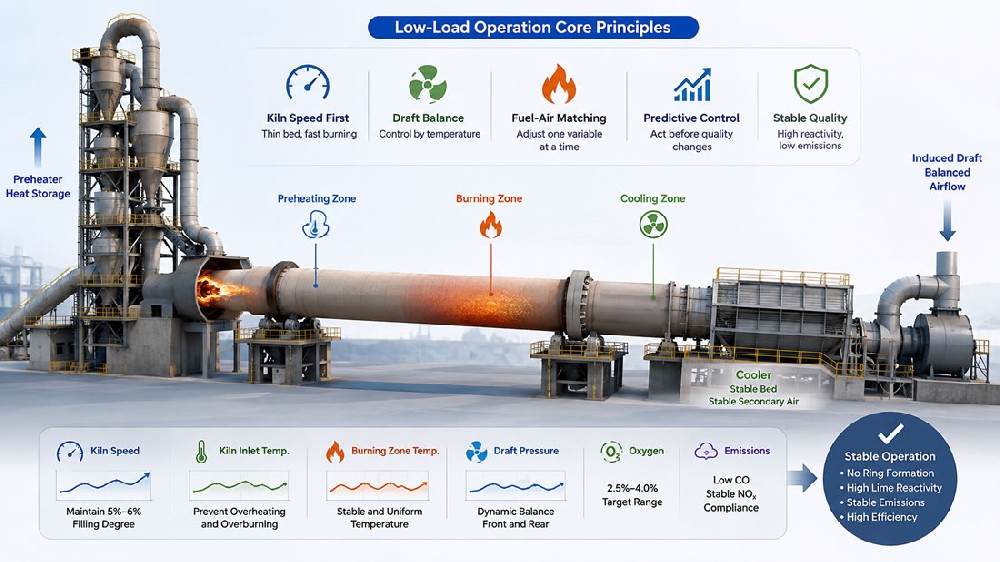
A lime rotary kiln operating at 75% capacity behaves fundamentally differently from one running at 100% capacity. Thermal inertia decreases, process sensitivity increases, and disturbances spread through the system much faster. Parameters that have little impact during full-load production can trigger significant thermal instability under reduced throughput.
This article explores the thermal characteristics of low-load kiln operation and provides practical strategies for achieving stable production, high lime quality, low emissions, and long equipment life.
Why Low-Load Kiln Operation Requires a Different Operating Philosophy
One of the most common mistakes in the lime industry is treating low-load operation as simply a scaled-down version of full-load production. Many plants reduce feed rates while keeping kiln speed, draft settings, and burner adjustments largely unchanged.
Others reduce kiln speed in direct proportion to production reductions. Although these approaches appear logical, they often create serious process problems.
At full capacity, a rotary kiln contains substantial thermal energy. Material movement, combustion dynamics, and heat transfer processes are relatively forgiving. Small disturbances are often absorbed by the system without significant consequences.
Under low-load conditions, however, the situation changes dramatically:
Thermal inertia decreases.
Material residence time increases.
Heat accumulation in the preheater becomes more pronounced.
Secondary air temperature becomes less stable.
Combustion becomes more sensitive to airflow changes.
Product quality responds more rapidly to process variations.
In many modern lime kilns, a change in fuel rate, draft pressure, or primary air flow can influence burning zone conditions within 5–15 minutes during low-load operation.
Therefore, low-load operation should not be considered a degraded production mode. Instead, it should be viewed as a precision thermal control mode requiring more disciplined process management.
Understanding the Thermal Differences Between Full Load and Low Load
Characteristics of Full-Load Operation
Under design-capacity conditions, the kiln operates with:
Maximum feed throughput.
Stable kiln filling degree, typically between 6% and 8%.
Uniform material movement.
Consistent flame shape and combustion conditions.
Stable secondary air supply.
Well-balanced temperature distribution throughout the system.
The large thermal inventory creates a broad operating window. Small fluctuations in fuel quality, raw material properties, or airflow usually have limited short-term consequences.
Characteristics of Low-Load Operation
When production drops to 60%–80% of rated capacity, several important changes occur.
Longer Material Residence Time
If kiln speed is not adjusted correctly, material remains inside the kiln significantly longer than intended.
Residence time can increase from approximately two hours to more than three hours depending on kiln dimensions and operating conditions.
This can result in:
Excessive preheating.
Increased kiln inlet temperatures.
Higher risk of overburning.
Reduced lime reactivity.
Greater tendency for ring formation.
Reduced Thermal Load
As fuel consumption decreases:
Flame stiffness weakens.
Thermal momentum declines.
Process sensitivity increases.
Combustion stability becomes more dependent on precise control.
Small changes in fuel rate, draft, or airflow can rapidly affect burning zone temperature and lime quality.
Unstable Cooler Performance
Lower lime discharge rates often produce thinner material beds in the cooler.
This can lead to:
Fluctuating secondary air temperatures.
Variable flame conditions.
Combustion instability.
Thermal oscillations throughout the kiln system.
Industry experience shows that low-load operation is not inherently problematic. With proper thermal management, plants can maintain smooth kiln coating, eliminate ring formation, achieve high lime reactivity, and maintain stable emissions.
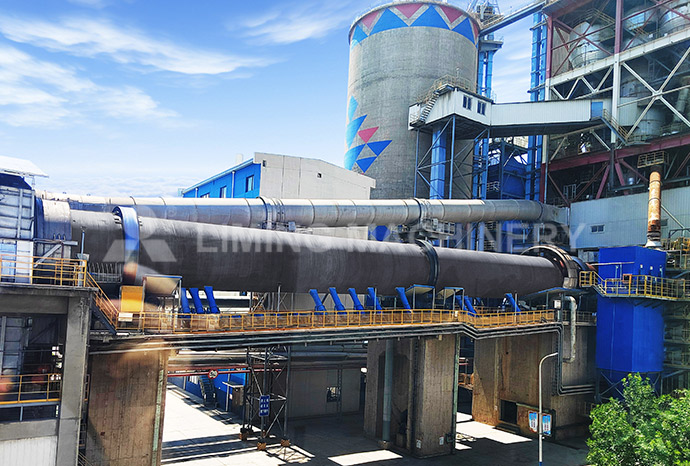
The Most Important Principle: Kiln Speed Comes First
The Most Common Operational Mistake
One of the most widespread errors in lime kiln operation is reducing kiln speed in direct proportion to production.
For example:
Design capacity: 800 t/d.
Design kiln speed: 1.8 rpm.
Production reduced to 600 t/d.
Many operators automatically reduce kiln speed to approximately 1.35 rpm.
Although this appears reasonable, it often creates severe process instability.
The Correct Approach: Thin Bed, Faster Burning
Low-load operation should follow the principle of maintaining a relatively thin material bed while preserving sufficient material movement.
The objective is to maintain:
Appropriate kiln filling degree.
Continuous material turnover.
Effective shell-cleaning action.
Controlled residence time.
In the previous example, kiln speed should typically remain around 1.4–1.5 rpm rather than dropping proportionally to production.
This approach provides several important benefits:
Prevents material stagnation.
Reduces ring formation.
Avoids excessive residence time.
Improves heat transfer consistency.
Maintains lime reactivity.
Years of field experience consistently demonstrate that most low-load ring formation problems are caused by improper kiln speed matching and excessive material retention rather than reduced production itself.
Airflow Management: Control Temperature, Not Fan Frequency
The Risks of Excessive Draft
Many plants continue using high-load draft settings after reducing production.
This often creates significant thermal imbalance.
Under low-load conditions, excessive induced draft can:
Remove heat from the burning zone too rapidly.
Increase heat accumulation in the preheater.
Raise kiln inlet temperatures.
Promote overburning.
Increase dust circulation.
The result is frequently a hotter preheater and a cooler burning zone, which reduces overall thermal efficiency.
Temperature-Based Draft Control
Instead of targeting fixed fan frequencies, operators should use thermal indicators as primary references.
Key monitoring points include:
Preheater outlet temperature.
Kiln inlet temperature.
Dust collector inlet temperature.
Oxygen concentration.
The objective is to maintain thermal balance across the entire system rather than maximizing airflow.
In many lime plants, induced draft fan frequency under low-load conditions can be 8%–15% lower than during full-load production.
Fuel and Air Coordination: Adjust One Variable at a Time
Avoid Frequent Burner Modifications
When production decreases, some operators immediately begin changing burner insertion depth, swirl settings, and airflow distribution.
These adjustments often introduce additional instability.
Unless serious flame abnormalities exist, burner geometry should remain largely unchanged during routine low-load operation.
Recommended Control Strategy
When fuel rate is reduced:
Reduce primary air proportionally.
Maintain fuel injection momentum balance.
Preserve established burner settings.
A moderate fuel reduction may require a small reduction in primary air pressure or fan frequency. Larger fuel reductions may require airflow adjustments while maintaining the original burner design parameters.
The goal is to create:
A longer flame.
A softer flame profile.
Stable combustion.
Balanced heat release.
Reduced localized overheating.
Successful low-load kiln operation is often achieved by adjusting airflow and fuel flow while avoiding unnecessary changes to burner geometry.
Maintaining Stable Emissions During Low-Load Operation
Many operators assume that lower production automatically results in poorer environmental performance. In reality, stable low-load operation can often improve emissions performance.
Carbon Monoxide Control
Properly controlled low-load operation typically provides:
Longer gas residence time.
More complete combustion.
Lower CO generation.
Sudden CO increases usually indicate:
Excessive draft.
Poor fuel-air balance.
Combustion instability.
Oxygen Control
Stable kiln operation generally maintains oxygen concentrations between approximately 2.5% and 4.0%.
Excessively high oxygen levels often indicate:
Overdrafting.
Heat loss.
Reduced combustion efficiency.
NOx Control
Thermal NOx formation is closely related to peak flame temperature.
A properly adjusted low-load flame is typically:
Longer.
Softer.
More thermally uniform.
As a result, NOx generation can remain stable or even decrease compared with poorly controlled full-load operation.
Different Strategies for Increasing and Decreasing Production
Increasing Production
Increasing throughput requires patience because thermal systems respond more slowly than material flow.
Recommended procedure:
Slightly increase kiln speed.
Verify stable mechanical conditions.
Gradually increase feed rate.
Adjust fuel accordingly.
Allow temperatures to stabilize before proceeding further.
Production increases should be implemented in stages rather than through a single large adjustment.
Decreasing Production
Production reductions are generally easier because thermal energy already exists within the system.
Operators can typically:
Reduce feed rate.
Adjust kiln speed accordingly.
Reduce fuel input.
Fine-tune airflow.
The key is to monitor temperature trends rather than waiting for product quality indicators, which may lag process changes by 30–60 minutes.
Modern kiln control should be predictive rather than reactive.
Equipment Maintenance During Low-Load Operation
Full-Load Maintenance Focus
At maximum production, maintenance personnel should closely monitor:
Drive motor loading.
Gear temperatures.
Roller bearing conditions.
Hydraulic thrust systems.
Kiln seal performance.
Low-Load Maintenance Opportunities
When production decreases, mechanical stresses decline significantly.
This period should be used for:
Lubrication optimization.
Fastener inspections.
Seal maintenance.
Roller load verification.
Instrument calibration.
Preventive maintenance activities.
Many successful lime plants follow a simple principle: high production emphasizes monitoring, while low production emphasizes maintenance.
Building a Predictive Operations Culture
The best kiln operators no longer rely solely on visual flame observation.
Traditional methods such as judging kiln conditions by flame color or discharged lime appearance often introduce significant delays into decision-making.
Modern operators combine:
Process data analysis.
Thermal engineering knowledge.
Historical operating experience.
Predictive trend interpretation.
Examples include:
Recognizing that rising kiln inlet temperature may indicate future product quality changes.
Understanding that primary air pressure changes will alter flame characteristics within minutes.
Knowing that draft adjustments immediately influence oxygen levels and upper-stage temperatures.
A predictive operating culture enables corrective action before process instability develops.
Conclusion
Low-load operation is no longer an occasional condition in the global lime industry. It has become a routine production reality for many plants.
The industry's most persistent low-load challenges—including ring formation, overburning, unstable lime reactivity, temperature excursions, and emission fluctuations—are rarely caused by reduced production itself.
Instead, they are usually the result of:
Incorrect parameter matching.
Inconsistent operating philosophies.
Reactive process control.
Failure to adapt thermal management strategies to reduced load conditions.
Plants that successfully implement the principles of kiln-speed-first operation, thin-bed fast burning, fuel-air matching, balanced thermal distribution, predictive process control, and condition-based maintenance can achieve the same level of product quality, energy efficiency, environmental compliance, and equipment reliability at 70% capacity as they do at full production.
Low-load operation should not be viewed as a compromise. When managed correctly, it becomes a demonstration of operational excellence and advanced thermal control in modern lime rotary kiln production.
Previous: Stable Production, Cost Reduction, and Environmental Compliance in Lime Rotary Kilns — Practical Control Strategies Based on Air–Heat–Material System Coordination
Next: Light Calcium Carbonate vs Activated Calcium Carbonate: Production Process, Properties, Applications, and Key Differences
Related Industry News


Liming Heavy Industry to Exhibit at bauma CHINA 2026 – Visit Us at Booth E6.510
2026-10-15

Meet Liming Heavy Industry at the 140th Canton Fair 2026
2026-10-13
Liming Heavy Industry to Attend the 140th Canton Fair
2026-09-25
Liming Heavy Industry at bauma CONEXPO INDIA 2026 | Booth 5-C6
2026-09-07
Turnkey Raw Mill Cement Plant in Saudi Arabia: Design and Installation
2026-09-03
Complete Mineral Processing Solutions
Convenient Reliable Professional Efficient Get Your Quote
Please feel free to submit your inquiry information to us. We will contact with you as soon as possible.
Our team will contact you as soon as possible.