


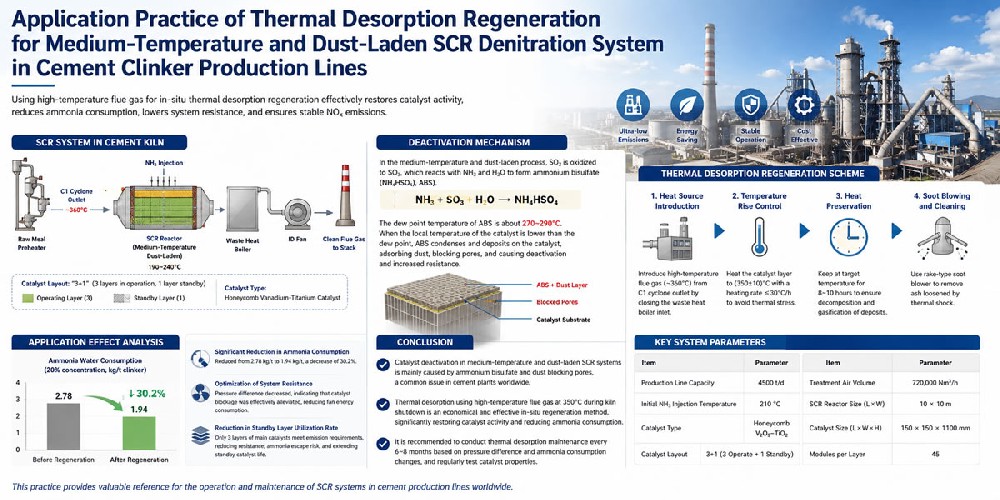
Abstract: Aiming at the problems such as decreased denitration efficiency and increased ammonia water consumption in the later operation period of the medium-temperature and dust-laden selective catalytic reduction (SCR) denitration system in cement clinker production lines, a 4500 t/d production line was taken as the research object to analyze the main causes of catalyst deactivation. By introducing high-temperature flue gas from the outlet of the preheater C1 stage to conduct thermal desorption regeneration treatment on the catalyst during the kiln shutdown maintenance period, the effective recovery of catalyst activity was realized. The operation data show that after thermal desorption, without putting the standby layer catalyst into use, the ammonia water consumption per ton of clinker decreased from 2.78 kg to 1.94 kg, and the NOx emission stably met the emission standards. This study can provide a reference for the operation and maintenance of SCR systems in similar production lines worldwide.
Keywords: Cement Kiln; Medium-Temperature and Dust-Laden; SCR Denitration; Ammonium Bisulfate; Thermal Desorption; Catalyst Regeneration
0 Introduction
With the increasing stringency of global cement industry air pollutant emission standards, ultra-low emission of nitrogen oxides (NOx) has become a rigid requirement for the cement industry worldwide. Selective Catalytic Reduction (SCR) technology, due to its high denitration efficiency and mature technology, is gradually becoming the mainstream configuration for cement clinker production lines globally. Among them, the medium-temperature and dust-laden process is widely used in renovation projects due to its flexible layout and relatively low investment. However, the medium-temperature section (190~240 ℃) is prone to the formation and condensation of ammonium bisulfate (ABS), leading to catalyst deactivation. Combined with the actual operation of a 4500 t/d cement clinker production line, this paper explores the feasibility and implementation effect of in-situ thermal desorption regeneration using high-temperature flue gas, which is applicable to similar production lines around the world.
1 Project Overview
The project is a 4500 t/d new dry-process cement clinker production line, equipped with a medium-temperature and dust-laden SCR denitration system. The designed flue gas treatment capacity of the system is 720,000 Nm³/h, the initial ammonia injection temperature is 210 ℃, and the reactor is arranged between the outlet of the C1 cyclone preheater and the waste heat boiler. The system adopts a "3+1" layer arrangement mode (3 layers in operation, 1 layer standby), and the catalyst type is honeycomb vanadium-titanium catalyst.
The main design parameters are shown in Table 1.
| Item | Parameter |
|---|---|
| Treatment Air Volume / (Nm³·h⁻¹) | 720,000 |
| Initial Ammonia Injection Temperature / ℃ | 210 |
| Reactor Specification / m | 10 × 10 |
| Catalyst Specification / mm | 150 × 150 × 1100 |
| Number of Modules per Layer / Unit | 45 |
2 Operation Problems and Mechanism Analysis
2.1 Operation Status
Since the system was put into operation in June 2024, the NOx emission concentration could be stably controlled below 50 mg/Nm³ in the initial operation period. However, after 7 months of operation, the denitration efficiency decreased significantly. On the premise of maintaining NOx emission up to standard, the consumption of ammonia water (20% concentration) per ton of clinker increased from the initial 2.78 kg/t to a higher level, and the pressure difference at the ammonia injection grid gradually increased, indicating an increase in system resistance. This phenomenon is common in medium-temperature and dust-laden SCR systems of cement production lines in various regions.
2.2 Deactivation Mechanism
In the medium-temperature and dust-laden process, the flue gas contains high concentrations of SO₂ and dust. Under the action of the catalyst, part of SO₂ is oxidized to SO₃, which reacts with escaped NH₃ and water vapor in the flue gas to generate ammonium bisulfate (NH₄HSO₄, referred to as ABS).
The dew point temperature of ABS is about 270~290 ℃. When the local temperature of the catalyst is lower than this dew point, ABS changes from gaseous state to liquid state. Liquid ABS has strong viscosity, which is easy to adsorb dust in the flue gas, forming a dense coating, blocking the catalyst pores, hindering the diffusion of reactants, and leading to catalyst deactivation and increased system resistance. This deactivation mechanism is universal in medium-temperature SCR denitration systems globally.
3 Thermal Desorption Regeneration Scheme
3.1 Technical Principle
ABS sublimes significantly when the temperature exceeds 300 ℃ and starts to decompose above 345 ℃. Taking advantage of this characteristic, by raising the temperature of the catalyst bed to the ABS decomposition range, the deposits attached to the catalyst surface can be gasified and separated, thereby restoring the specific surface area and activity of the catalyst. This principle is applicable to vanadium-titanium catalysts commonly used in global cement industry SCR systems.
3.2 Implementation Plan
In-situ thermal desorption operation was carried out during the planned kiln shutdown maintenance window of the production line, which is compatible with the routine maintenance schedule of most cement production lines around the world:
Heat Source Introduction: Close the inlet valve of the waste heat boiler and directly introduce the high-temperature flue gas (about 360 ℃) from the outlet of the C1 cyclone preheater into the SCR reactor.
Temperature Rise Control: Open the reactor bypass damper, strictly control the temperature of the catalyst layer at (350±10) ℃, and control the heating rate within 30 ℃/h to prevent catalyst damage due to thermal stress. This temperature control standard is in line with the material properties of mainstream catalysts in the global market.
Heat Preservation: Keep the constant temperature at the target temperature for 8~10 hours to ensure full decomposition and gasification of deposits.
Soot Blowing and Cleaning: After the thermal desorption, start the rake-type soot blower to remove the ash loosened by thermal shock.
4 Application Effect Analysis
After the completion of the thermal desorption operation, with the normal operation of the kiln system, the operation data before and after regeneration were compared. The results are universal and can provide reference for similar projects globally:
Significant Reduction in Ammonia Consumption: Under the condition that the composition and feeding amount of the raw meal into the furnace are basically stable, the NOx emission concentration is still controlled below 50 mg/Nm³. At this time, the ammonia water consumption per ton of clinker decreased from 2.78 kg/t before regeneration to 1.94 kg/t, with a reduction rate of 30.2%.
Optimization of System Resistance: The pressure difference between the inlet and outlet of the reactor decreased compared with that before treatment, indicating that the blockage of catalyst pores was effectively alleviated, which is conducive to reducing the energy consumption of the fan.
Reduction in Standby Layer Utilization Rate: Previously, it was necessary to put the standby layer catalyst into use to ensure up-to-standard emission. After thermal desorption, only 3 layers of main catalysts can meet the emission requirements, which reduces the system ventilation resistance and the risk of ammonia escape, and extends the service life of the standby catalyst.
5 Conclusion
The decrease in efficiency of the medium-temperature and dust-laden SCR system in cement kilns in the later operation period is mainly caused by the blockage of catalyst pores by ammonium bisulfate and adsorbed dust, which is a common problem in global cement production lines.
Using high-temperature flue gas from the C1 outlet during kiln shutdown for thermal desorption at 350 ℃ is an economical and effective in-situ regeneration method, which can significantly restore catalyst activity and reduce ammonia water consumption. This method has strong operability and low cost, and is suitable for popularization and application in cement plants around the world.
It is recommended to conduct thermal desorption maintenance every 6~8 months according to the changes in pressure difference and ammonia consumption. At the same time, attention should be paid to the impact of long-term high temperature on catalyst thermal aging, and regular sampling and testing of catalyst physical and chemical properties should be carried out.
6 About Liming Heavy Industry
Liming Heavy Industry is a global supplier of industrial grinding, calcination, and material processing solutions, providing integrated equipment and engineering services for the cement, mining, metallurgy, solid waste recycling, and industrial minerals industries.
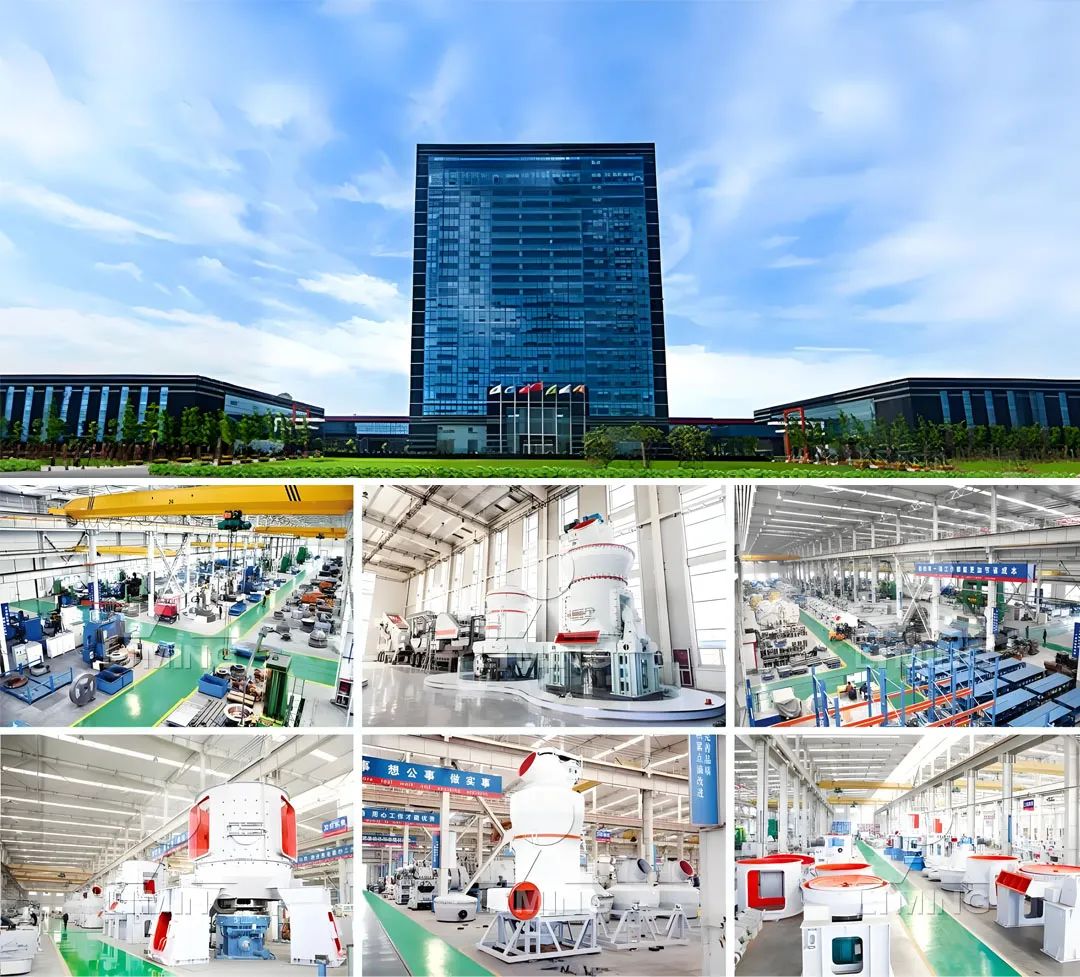
The company offers a wide range of products and solutions including grinding mills, crushers, rotary kilns, powder classification systems, dust collection systems, and intelligent control technologies. In the cement and lime industries, Liming Heavy Industry provides complete process solutions covering raw material crushing, grinding, calcination, fuel preparation, desulfurization, denitration support systems, and solid waste utilization.
With extensive experience in large-scale industrial projects and global market service capabilities, Liming Heavy Industry has served customers in more than 180 countries and regions worldwide.
Related Industry News


Liming Heavy Industry to Attend the 140th Canton Fair
2026-09-25

Liming Heavy Industry at bauma CONEXPO INDIA 2026 | Booth 5-C6
2026-09-07
Turnkey Raw Mill Cement Plant in Saudi Arabia: Design and Installation
2026-09-03
Cement Raw Mill Supplier in Indonesia: Cost and Configuration Analysis
2026-09-01
Liming Heavy Industry to Exhibit at the 24th Global Gypsum Conference & Exhibition in Turkey
2026-08-31
Complete Mineral Processing Solutions
Convenient Reliable Professional Efficient Get Your Quote
Please feel free to submit your inquiry information to us. We will contact with you as soon as possible.
Our team will contact you as soon as possible.