


Introduction: From Low-Cost Filler to Functional Performance Additive
Calcium carbonate is one of the most widely used mineral fillers in the plastics and rubber industries. It can be found in everyday products such as plastic pipes, automotive sealing strips, cable compounds, packaging films, and rubber soles. Thanks to its abundant reserves, stable chemical properties, high whiteness, and relatively low cost, calcium carbonate has long been considered an economical solution for reducing raw material costs.
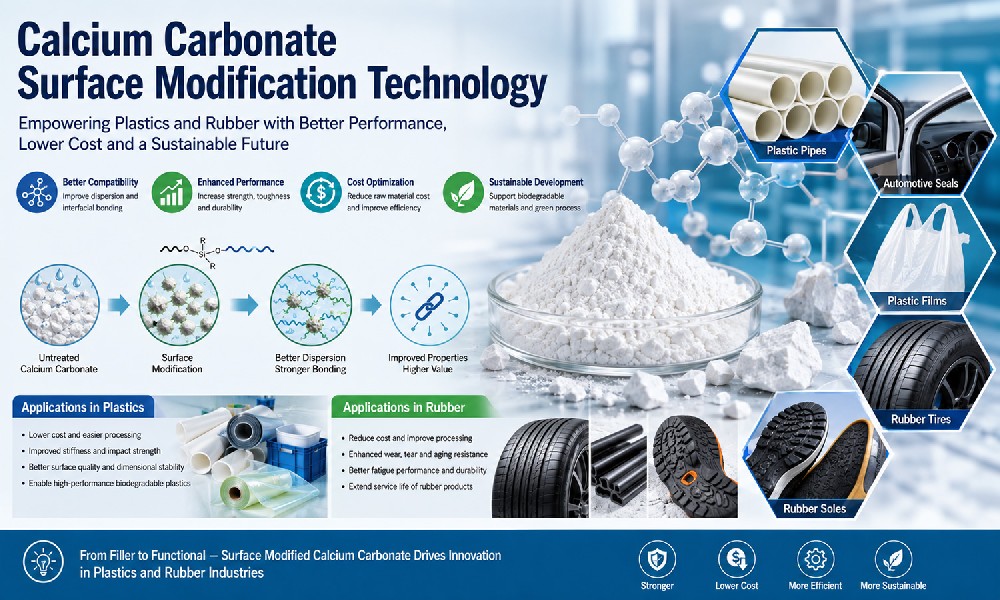
However, untreated calcium carbonate has an inherent limitation: its surface is hydrophilic, while most polymers such as polyethylene (PE), polypropylene (PP), and synthetic rubber are hydrophobic. In practical terms, this incompatibility causes calcium carbonate particles to agglomerate inside the polymer matrix instead of dispersing evenly.
Poor dispersion can reduce mechanical strength, increase brittleness, and negatively affect processing stability and surface quality. Surface modification technology addresses this challenge by altering the surface characteristics of calcium carbonate particles, allowing them to disperse more uniformly and bond more effectively with polymers.
Today, surface-modified calcium carbonate is no longer viewed as a simple filler. It has become an important functional material for improving product performance, optimizing processing efficiency, and supporting sustainable material development.
1. The Core Objective of Surface Modification
The primary goal of calcium carbonate modification is to improve compatibility between inorganic mineral particles and organic polymer systems.
A properly modified particle should:
Disperse uniformly in plastics or rubber
Interact effectively with polymer chains
Transfer stress efficiently
Improve overall product performance
1.1 Surface Chemical Modification
This is the most widely adopted industrial solution because of its effectiveness and relatively low cost.
Coupling Agent Treatment
Coupling agents such as silanes and titanates act as molecular bridges between calcium carbonate and polymers. One end bonds to the calcium carbonate surface, while the other interacts with the polymer matrix. This significantly improves interfacial adhesion and filler dispersion.
For example, modified calcium carbonate used in polypropylene applications can improve toughness and impact resistance while reducing brittleness under low-temperature conditions.
Fatty Acid and Surfactant Treatment
Stearic acid treatment remains one of the most economical modification methods in the market. The treatment forms a hydrophobic layer on the particle surface, reducing moisture affinity and improving compatibility with non-polar polymers.
This method is widely used in cost-sensitive applications such as shopping bags, packaging films, and general-purpose plastic products.
1.2 Particle Size and Crystal Structure Engineering
Another important strategy involves controlling particle morphology and particle size distribution.
Nano Calcium Carbonate
Nano calcium carbonate typically refers to particles in the 1–100 nm range. At this scale, the material can significantly improve tensile strength, impact resistance, rigidity, and dimensional stability due to its large specific surface area and nano-scale reinforcement effect.
However, nano particles tend to agglomerate easily, making surface treatment essential for stable dispersion.
Special Crystal Morphologies
Needle-shaped, chain-like, or porous calcium carbonate structures can provide reinforcement effects similar to microfibers. In rubber applications, these structures improve abrasion resistance, tear resistance, and fatigue resistance.
1.3 Functional and Composite Modification
Modern modification technology increasingly combines multiple treatment methods to create multifunctional fillers.
Examples include calcium carbonate systems that provide:
Flame retardancy
Antibacterial performance
Antistatic properties
Improved thermal stability
These multifunctional materials are attracting growing demand in medical materials, household appliances, automotive polymers, and consumer electronics.
2. Applications in the Plastics Industry
Historically, calcium carbonate was mainly used to reduce polymer consumption and lower production costs. Today, modified calcium carbonate plays a much broader role by simultaneously improving processability and product performance.
2.1 Cost Reduction and Processing Optimization
Compared with common polymers such as PE and PP, calcium carbonate is significantly less expensive. In products such as plastic pipes, profiles, and injection-molded components, adding 30%–40% modified calcium carbonate can substantially reduce raw material costs.
At the same time, surface-modified particles improve melt flow behavior during extrusion, injection molding, and blow molding. This contributes to faster production rates, reduced shrinkage, improved dimensional stability, and better surface finish.
2.2 Mechanical Reinforcement
Properly modified calcium carbonate can improve both stiffness and toughness in polymer systems.
Polypropylene (PP)
PP is widely used in food containers, household products, and automotive components, but it tends to become brittle at low temperatures. Incorporating modified nano calcium carbonate can significantly improve flexural strength, impact resistance, and low-temperature toughness.
Polyethylene (PE) Films
Ultrafine modified calcium carbonate is widely used in shopping bags, agricultural films, and packaging materials. The filler can improve tear resistance, puncture resistance, film opening performance, and anti-blocking behavior.
2.3 Supporting Biodegradable Plastics
Biodegradable polymers such as PLA and PBS continue to gain global attention due to sustainability goals and environmental regulations. However, these materials often suffer from high production costs, brittleness, and limited heat resistance.
Modified calcium carbonate helps address these challenges by reducing material costs, improving mechanical strength, and enhancing thermal stability. As a result, it plays an increasingly important role in biodegradable shopping bags, disposable tableware, and compostable packaging materials.
3. Applications in the Rubber Industry
In rubber processing, calcium carbonate is one of the most commonly used fillers after carbon black and silica. Surface modification transforms it from a simple extender into an effective reinforcing material.
3.1 Cost Optimization and Improved Processing
Rubber products such as tires, seals, hoses, and conveyor belts face constant pressure to balance performance and production cost. Modified calcium carbonate offers competitive pricing, suitable density, good processability, and high loading capacity.
In many rubber formulations, filler loading levels of 30%–50% are achievable without severely compromising performance. The material also improves mixing efficiency, extrusion behavior, and dimensional consistency.
3.2 Enhanced Durability and Wear Resistance
Surface-treated calcium carbonate improves interaction between filler particles and rubber molecular chains, enhancing reinforcement.
Nitrile Rubber (NBR)
In oil-resistant rubber products such as industrial seals and rubber soles, modified calcium carbonate combined with carbon black can improve tear strength, abrasion resistance, oil resistance, and aging resistance.
EPDM Rubber
EPDM is widely used in automotive sealing systems and construction applications. Modified calcium carbonate improves weather resistance, surface smoothness, wear resistance, and dimensional stability.
Special porous or chain-structured calcium carbonate grades can even achieve reinforcement performance approaching that of traditional carbon black in certain applications.
4. Future Trends in Calcium Carbonate Modification
As polymer materials continue evolving toward higher performance and sustainability, calcium carbonate modification technology is also becoming more specialized.
4.1 Customized Product Development
The market is shifting away from universal filler grades toward application-specific solutions. Examples include automotive-grade calcium carbonate, medical polymer filler systems, high-transparency film grades, and high-impact engineering plastic grades.
4.2 Multifunctional Materials
Future modified calcium carbonate products are expected to integrate multiple functionalities simultaneously, including reinforcement, flame retardancy, antibacterial properties, and conductivity control.
4.3 Sustainable and Low-Carbon Processing
Environmental pressure is driving the development of greener modification agents, lower-energy production technologies, reduced VOC emissions, and better compatibility with biodegradable polymers.
4.4 Expansion into Advanced Applications
Modified calcium carbonate is increasingly entering high-value sectors beyond conventional plastics and rubber. Emerging applications include lithium battery separator coatings, 3D printing materials, functional coatings, and pharmaceutical carrier systems.
Conclusion
The essence of calcium carbonate surface modification is straightforward: improving compatibility between mineral fillers and polymer systems.
What was once considered a low-cost filler has evolved into a critical functional material capable of reducing production costs, enhancing product performance, improving processing efficiency, and supporting sustainable material development.
Today, modified calcium carbonate plays an important role in advancing the plastics and rubber industries toward lighter, stronger, more functional, and more environmentally responsible products.
In modern polymer manufacturing, it is no longer just a filler — it has become a key enabling technology.
Related Industry News


Liming Heavy Industry to Attend the 140th Canton Fair
2026-09-25

Liming Heavy Industry at bauma CONEXPO INDIA 2026 | Booth 5-C6
2026-09-07
Turnkey Raw Mill Cement Plant in Saudi Arabia: Design and Installation
2026-09-03
Cement Raw Mill Supplier in Indonesia: Cost and Configuration Analysis
2026-09-01
Liming Heavy Industry to Exhibit at the 24th Global Gypsum Conference & Exhibition in Turkey
2026-08-31
Complete Mineral Processing Solutions
Convenient Reliable Professional Efficient Get Your Quote
Please feel free to submit your inquiry information to us. We will contact with you as soon as possible.
Our team will contact you as soon as possible.