


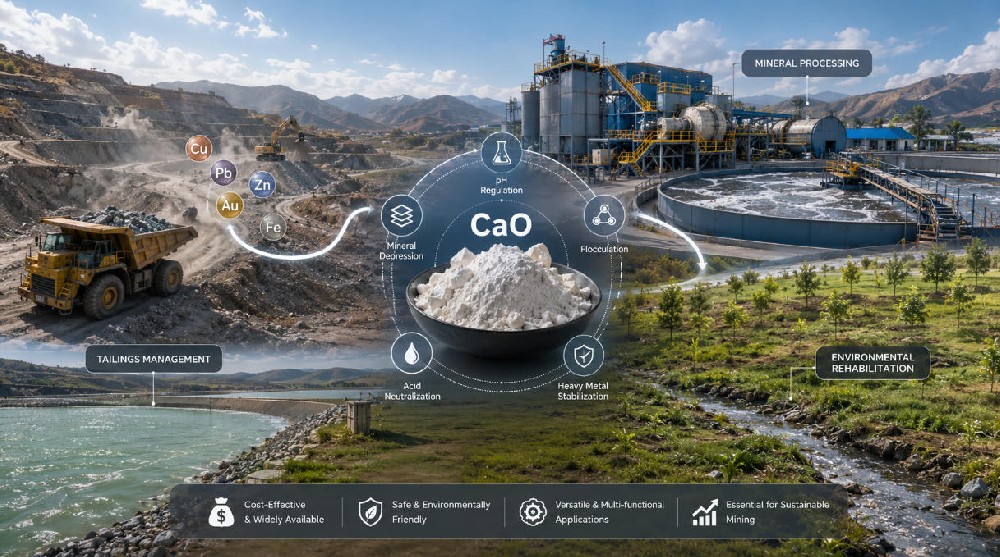
Executive Summary: Quicklime (CaO) is one of the most cost-effective and indispensable reagents in modern mining operations. Beyond its traditional role as a construction material, quicklime is extensively used as a pH regulator, depressant, flocculant, and neutralizing agent in mineral flotation, tailings treatment, acid mine drainage control, heavy metal stabilization, and mine site rehabilitation. From ore beneficiation to environmental restoration, quicklime supports the entire life cycle of mining operations and remains a cornerstone of sustainable and intelligent mining worldwide.
1. Introduction: Why Quicklime Remains Essential in Modern Mining
Over the past several decades, the mining industry has undergone major transformations driven by declining ore grades, stricter environmental regulations, and increasing demands for sustainable resource utilization. Despite the development of various advanced flotation reagents and synthetic chemicals, quicklime remains one of the most widely used inorganic reagents across the mining value chain.
Its popularity stems from three fundamental functions:
Acid-base neutralization
Formation of depressant films on mineral surfaces
Flocculation and aggregation of fine particles
These properties make quicklime indispensable not only in mineral processing plants but also in tailings management, acid mine drainage prevention, and ecological restoration projects.
2. Chemical Properties and Working Mechanism of Quicklime
The primary component of quicklime is calcium oxide (CaO). When mixed with water, it reacts to form calcium hydroxide, commonly known as hydrated lime or lime milk.
CaO + H₂O → Ca(OH)₂
Calcium hydroxide subsequently dissociates into hydroxide ions (OH⁻) and calcium ions (Ca²⁺):
Ca(OH)₂ → Ca²⁺ + 2OH⁻
These ions play several important roles:
Adjusting pulp pH
Depressing gangue minerals
Promoting particle flocculation
Neutralizing acidic solutions
Immobilizing heavy metals
It is important to note that quicklime itself is not a collector. Instead, it modifies the chemical environment of the pulp and influences the behavior of minerals and flotation reagents.
3. Quicklime in Mineral Flotation: The Regulator of Pulp Chemistry
3.1 Copper Sulfide Flotation
In copper sulfide flotation, especially in copper-pyrite separation, quicklime is primarily used to depress pyrite (FeS₂) and improve copper concentrate grade.
By increasing the pulp pH to approximately 10–12, quicklime promotes the formation of hydrophilic oxidation films such as FeOOH and Fe(OH)₃ on pyrite surfaces. At the same time, Ca²⁺ ions adsorb onto pyrite surfaces, further enhancing hydrophilicity.
In contrast, copper sulfide minerals such as chalcopyrite remain floatable within this alkaline range.
Typical lime consumption ranges from 1 to 5 kg per ton of ore, depending on pyrite content and natural pulp alkalinity.
This practice is widely adopted in large copper mines worldwide, particularly in China, Chile, Peru, and Kazakhstan.
3.2 Lead-Zinc Ore Flotation
Lead-zinc beneficiation generally follows a preferential flotation process:
Lead flotation first
Zinc flotation afterward
Quicklime is used to maintain pulp pH around 9–10, where sphalerite and pyrite are depressed while galena remains floatable with xanthate collectors.
For complex lead-zinc ores, sphalerite can later be selectively activated using copper sulfate under alkaline conditions, enabling efficient zinc recovery.
3.3 Molybdenum Flotation
Molybdenite (MoS₂) possesses natural hydrophobicity and can float over a broad pH range.
However, molybdenum ores are often associated with pyrite and chalcopyrite, which require selective depression.
Quicklime is typically used to maintain pulp pH between 8 and 9.5 to suppress pyrite flotation.
Nevertheless, excessive Ca²⁺ may adsorb on molybdenite edge surfaces and slightly reduce molybdenum recovery. Therefore, precise dosage control is essential, and lime is often combined with sodium sulfide or cyanide-based depressants.
3.4 Gold Extraction
Quicklime plays different roles in various gold extraction processes.
| Process | Main Function of Quicklime |
|---|---|
| Gold flotation | pH adjustment and gangue depression |
| Cyanide leaching | Maintaining pH 10–11 to prevent HCN volatilization and reduce interference from Fe and Cu ions |
| CIP/CIL | Preventing scale formation on activated carbon and maintaining adsorption efficiency |
In cyanidation plants, lime consumption is directly related to cyanide efficiency and operational safety, making it one of the most important auxiliary reagents.
3.5 Iron Ore Flotation and Dephosphorization
In reverse flotation of iron ore, quicklime is widely used to maintain pulp pH between 10 and 11.
Under alkaline conditions:
Quartz can be selectively floated using cationic collectors.
Calcium ions may react with phosphate species, reducing phosphorus content in iron concentrates.
This is particularly important for high-phosphorus iron ores in China, Africa, and parts of Southeast Asia.
_1761355701094.jpg)
4. Quicklime in Tailings Management: Flocculation, Neutralization, and Stabilization
4.1 Thickening and Dewatering
Tailings and concentrate slurries often contain large amounts of ultrafine particles that settle slowly under natural conditions.
Adding lime milk releases Ca²⁺ ions, which compress the electrical double layer surrounding particles and promote flocculation.
The resulting aggregates settle faster, improving:
Thickener throughput
Filtration efficiency
Water recovery rates
Overall plant productivity
This practice is widely applied in gold, iron ore, phosphate, and copper concentrators.
4.2 Neutralization of Acidic Tailings
Sulfide tailings can oxidize when exposed to air and water, generating sulfuric acid and leading to acid mine drainage (AMD).
Acidic tailings may:
Corrode pipelines and equipment
Contaminate groundwater
Mobilize toxic heavy metals
Threaten ecosystem health
Quicklime neutralizes acidity by increasing pH to approximately 6–9.
At the same time, it promotes flocculation and improves the quality of recycled water.
4.3 Acidification Control and Heavy Metal Immobilization
Quicklime is widely used for long-term management of tailings storage facilities.
Common applications include:
Applying lime on tailings surfaces to neutralize acidity
Suppressing sulfide oxidation
Treating acidic pond water
Precipitating dissolved heavy metals
Calcium hydroxide can precipitate metals such as:
Cadmium (Cd)
Lead (Pb)
Zinc (Zn)
Copper (Cu)
Nickel (Ni)
This reduces metal mobility and minimizes environmental risks.
5. Quicklime in Mine Site Rehabilitation and Soil Remediation
Soil Improvement of Acidic Mine Waste
Waste rock containing sulfide minerals often oxidizes after mine closure, causing soil pH to decrease to 2–4.
Applying quicklime can:
Increase soil pH
Neutralize acidity
Replace exchangeable aluminum ions
Reduce aluminum toxicity
Promote vegetation growth
Depending on soil properties, lime application rates may vary considerably and are typically optimized through field testing.
_1761355927036.jpg)
In-Situ Stabilization of Heavy Metal Contaminated Soil
Quicklime is also widely used for stabilizing heavy metal-contaminated soils around abandoned mines and smelting sites.
By increasing soil pH, heavy metals form insoluble hydroxides or carbonates, significantly reducing their:
Solubility
Mobility
Bioavailability
Environmental risks
This technology has become an important component of sustainable mine closure and ecological restoration programs worldwide.
6. Key Considerations When Using Quicklime
| Key Factor | Description |
|---|---|
| Product Quality | Variations in available CaO content and reactivity can significantly affect flotation performance and neutralization efficiency. |
| Dosage Control | Excessive lime may over-depress valuable minerals or cause excessively high pH in treated water. |
| Operational Safety | Lime dust may irritate the respiratory system and eyes. Lime slurry can cause skin burns and requires appropriate protective equipment. |
| Scaling Prevention | Calcium ions can form CaCO₃ deposits on pipelines, pumps, and tanks, requiring periodic cleaning. |
7. Future Trends: Smart Lime Systems for Sustainable Mining
Although new polymer modifiers and specialty reagents continue to emerge, quicklime remains one of the most economical and versatile reagents in mining.
Looking ahead, the industry is moving toward more intelligent and sustainable lime utilization technologies, including:
Lime-reagent hybrid systems
Automatic lime dosing systems
Online lime reactivity monitoring
AI-based flotation process optimization
Digital control of tailings neutralization systems
These innovations are helping mines improve mineral recovery, reduce reagent consumption, minimize environmental impacts, and accelerate the transition toward green and intelligent mining.
8. Conclusion
Quicklime may appear to be a simple and inexpensive chemical, but its importance in modern mining cannot be overstated.
From flotation and hydrometallurgy to tailings treatment and ecological restoration, quicklime provides a unique combination of:
Acid neutralization
Mineral depression
Particle flocculation
Heavy metal stabilization
Environmental protection
As mining operations worldwide continue to pursue higher efficiency, lower carbon emissions, and more sustainable development, quicklime will remain a fundamental reagent supporting the entire mining life cycle—from ore extraction to environmental rehabilitation.
Related Industry News


Liming Heavy Industry at bauma CONEXPO INDIA 2026 | Booth 5-C6
2026-09-07

Turnkey Raw Mill Cement Plant in Saudi Arabia: Design and Installation
2026-09-03
Cement Raw Mill Supplier in Indonesia: Cost and Configuration Analysis
2026-09-01
Liming Heavy Industry to Exhibit at the 24th Global Gypsum Conference & Exhibition in Turkey
2026-08-31
Complete Calcium Carbonate Grinding and Coating Plant Solution
2026-08-29
Complete Mineral Processing Solutions
Convenient Reliable Professional Efficient Get Your Quote
Please feel free to submit your inquiry information to us. We will contact with you as soon as possible.
Our team will contact you as soon as possible.