


Summary:
For mainstream 80–325 mesh calcite powder, the MTW European Grinding Mill is usually the most balanced choice because it combines stable throughput, controlled classification, and moderate operating cost; for powder finer than 400 mesh, the LUM Ultrafine Vertical Roller Mill or MW Micro Powder Mill is generally more suitable.
Details:
The best mill for calcite depends on the required finished fineness and production capacity. For mainstream 80–325 mesh calcite powder, the MTW European Grinding Mill is usually the most balanced choice because it combines stable throughput, controlled classification, and moderate operating cost; for powder finer than 400 mesh, the LUM Ultrafine Vertical Roller Mill or MW Micro Powder Mill is generally more suitable.
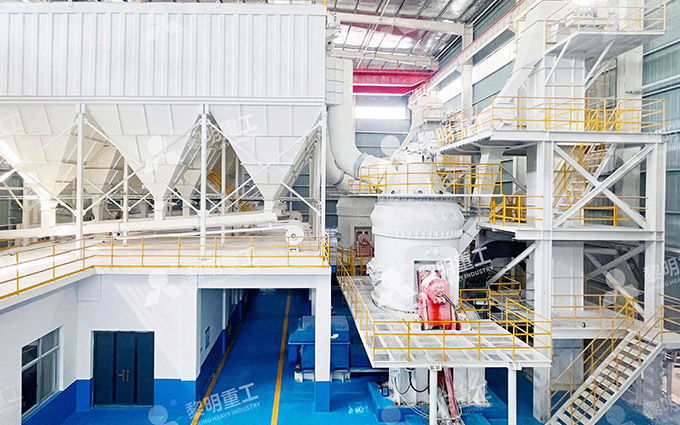
A Raymond Mill remains practical for smaller, cost-sensitive projects producing 80–325 mesh powder, while an LM Vertical Roller Mill becomes attractive when the plant requires higher output and lower specific energy consumption. The correct selection should be based on the required D97, production rate, calcite purity and whiteness, feed moisture, downstream application, and allowable operating cost rather than on mill type alone.
Calcite Product Requirement Determines the Mill
Calcite is calcium carbonate, and its value increases as particle size distribution, whiteness, purity, and particle shape are controlled more precisely. A coarse powder used in construction filler has different requirements from a 1250-mesh calcium carbonate product used in plastics, coatings, paper, rubber, sealants, or masterbatch.
| Finished Powder Requirement | Typical Fineness | Recommended Mill Type | Common Application |
|---|---|---|---|
| Coarse calcite powder | 80–150 mesh, approximately 180–100 μm | Raymond Mill or MTW European Grinding Mill | Construction materials, mortar, putty, general fillers |
| Fine calcite powder | 200–325 mesh, approximately 75–45 μm | MTW European Grinding Mill or LM Vertical Roller Mill | Coatings, rubber, plastics, paint filler, PVC compounds |
| Ultrafine calcite powder | 400–1250 mesh, approximately 38–10 μm | LUM Ultrafine Vertical Roller Mill or MW Micro Powder Mill | High-value plastics, paper, coatings, adhesives, sealants |
| Microfine calcite powder | 1250–2500 mesh, approximately 10–5 μm | LUM Ultrafine Vertical Roller Mill or MW Micro Powder Mill | Premium coatings, engineered polymers, specialty calcium carbonate products |
MTW Mill Is Often Best for 80–325 Mesh
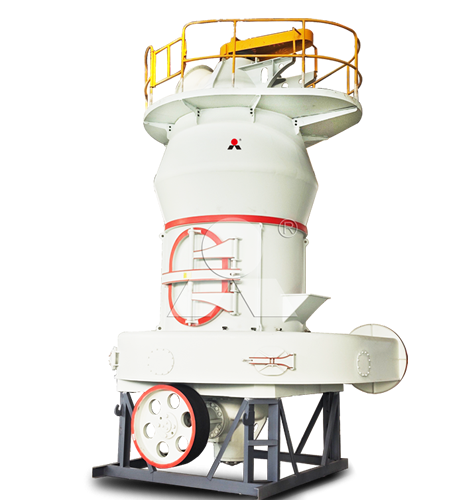
For most medium-fine calcite powder plants, an MTW European Grinding Mill is the most practical all-round solution because it covers the 80–325 mesh range with integrated grinding, air classification, conveying, and dust collection. It is particularly suitable for commercial calcite powder lines supplying several grades of filler powder without moving into the higher capital and operating complexity of ultrafine processing.
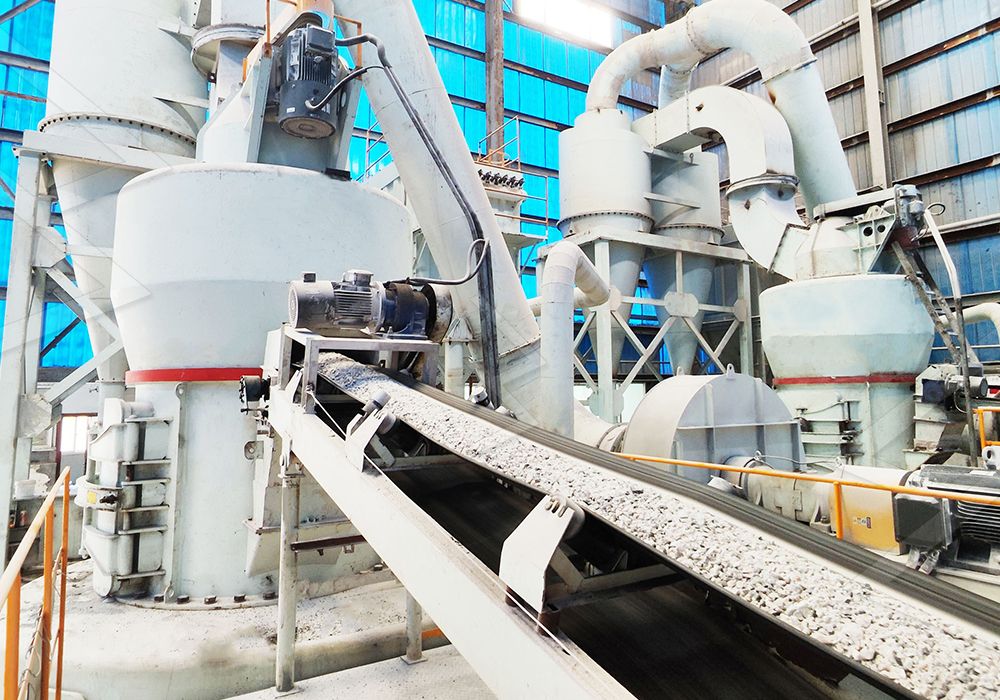
Calcite is relatively soft, normally around Mohs hardness 3, so roller-and-ring grinding is efficient when feed size is controlled below approximately 20–35 mm. The mill’s classifier separates qualified particles from oversize material, returning coarse particles to the grinding zone until the target cut point is reached.
Raymond Mill Fits Small-Scale Production
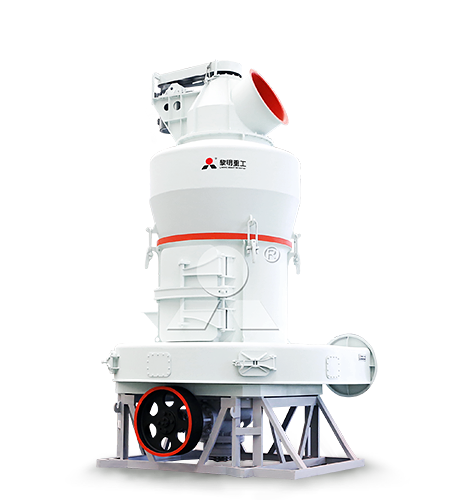
A Raymond Mill is often the best choice for small calcite powder plants where the required fineness is 80–325 mesh and investment cost is more important than maximum production efficiency. It is suitable for plants producing approximately 1–8 t/h, although actual output at 325 mesh is lower than at 100 or 200 mesh because a finer classifier setting increases the circulating load.
Raymond mills are commonly selected for regional powder suppliers, small putty-powder plants, and construction-material producers. Their main limitation is that they are not the preferred solution for stable 400-mesh-plus production, where classifier precision, energy consumption, and powder recovery become more demanding.
LM Vertical Roller Mill Suits Higher Output
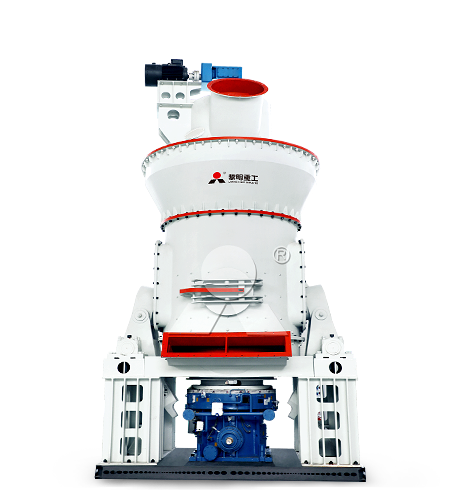
An LM Vertical Roller Mill is usually the better choice when a calcite grinding plant requires higher capacity, continuous operation, and lower energy consumption per ton. It combines grinding, classification, conveying, and, where necessary, limited drying in one enclosed system, reducing the number of transfer points and the plant footprint per ton of output.
For 200–325 mesh calcite, an LM Vertical Roller Mill can be suitable for plants operating above approximately 15–20 t/h, subject to the actual feed characteristics and required product distribution. Its higher initial investment is justified when annual production volume is large enough for lower specific operating cost and reduced labor demand to offset the capital difference.
Ultrafine Mills Are Required Above 400 Mesh
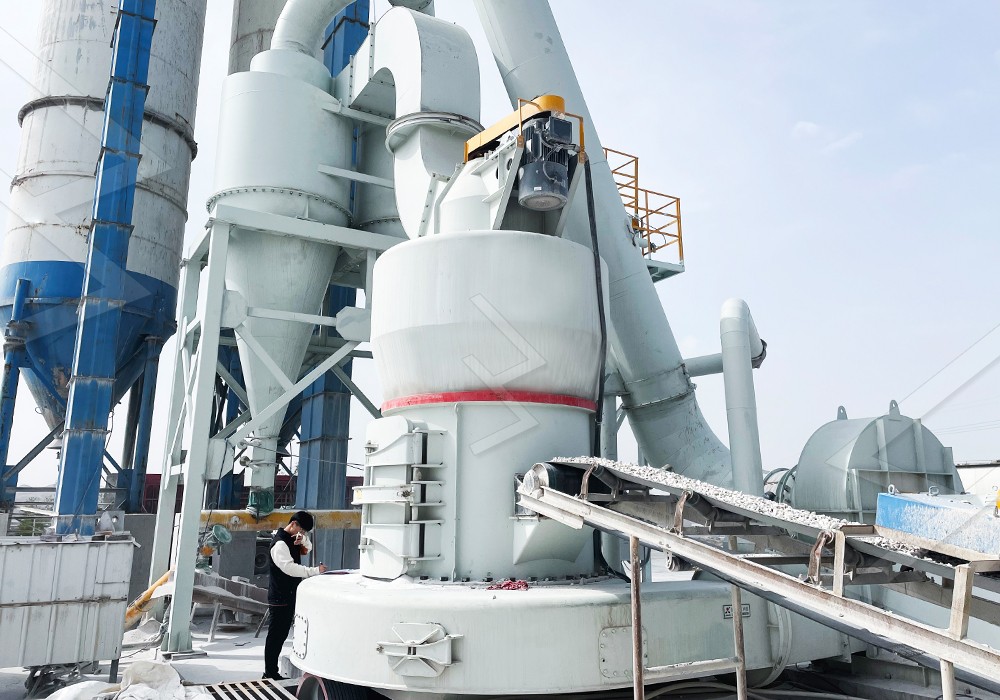
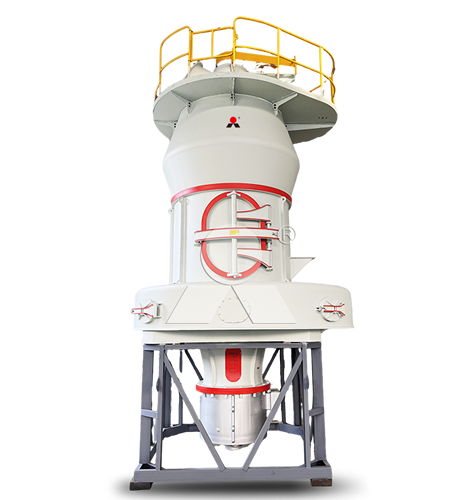
For calcite finer than 400 mesh, an ultrafine mill is normally required because conventional Raymond and MTW mills cannot consistently maintain a narrow particle size distribution at very fine cut points. The LUM Ultrafine Vertical Roller Mill and MW Micro Powder Mill are designed for fine classification and multiple grinding passes, making them appropriate for 400–2500 mesh calcite powder.
Ultrafine processing must be evaluated carefully because the energy consumption per ton rises as particle size decreases. The plant should therefore be designed around a confirmed market for the finer grade, such as coated calcium carbonate feedstock, premium coatings, plastic masterbatch, paper filler, silicone sealants, or specialty polymer compounds.
Complete Calcite Grinding Process
A typical dry calcite powder production line follows the sequence: crushing → storage → controlled feeding → grinding → air classification → cyclone collection → bag-filter dust collection → finished-product storage → packing or bulk loading. The mill is only one part of the system; poor feeder stability, inadequate air balance, or an undersized bag filter can limit output even when the main grinding mill is correctly selected.
Crushing and Feed Preparation
Run-of-mine calcite is normally crushed from 200–500 mm lumps to a mill feed size of approximately 15–35 mm. A jaw crusher is commonly used for primary reduction, while a hammer crusher or impact crusher can provide secondary crushing where tighter feed size control is required.
Grinding and Classification
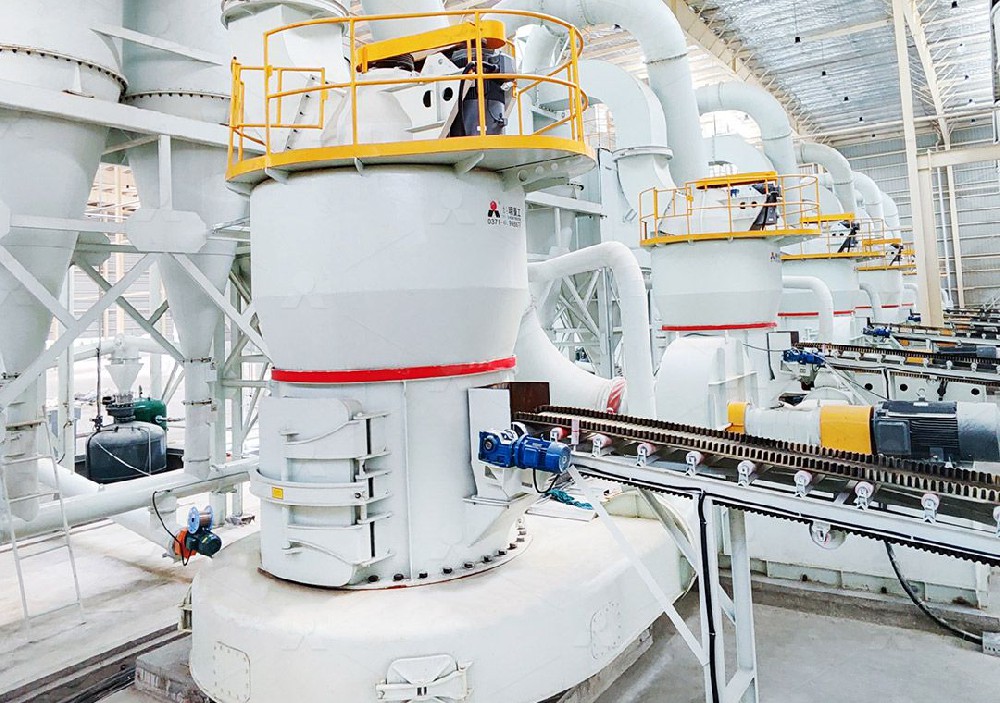
The industrial grinding mill reduces calcite through compression and shear between grinding rollers and a grinding ring or grinding table. Airflow carries the ground material into the classifier, where fine particles pass to collection and oversize particles return to the grinding zone for further reduction.
Collection and Packing
Qualified powder is collected by a cyclone separator and pulse-jet bag filter before transfer to a finished-product silo. The packing system may use valve bags, open-mouth bags, big bags, or bulk tanker loading, depending on whether the customer is a local construction-material producer or a high-volume polymer and coating manufacturer.
Key Selection Factors
The correct calcite mill cannot be selected from fineness alone. Engineers should confirm the following conditions before specifying equipment.
Required product fineness expressed as mesh, D50, D97, or sieve residue.
Required finished capacity in t/h at the specified fineness, rather than the mill’s maximum catalog capacity.
Calcite purity, whiteness, moisture, hardness, quartz content, and abrasive impurity level.
Whether the product will be used in construction filler, paint, plastics, rubber, paper, coating, adhesive, or sealant applications.
Required particle size distribution consistency between production batches.
Available electrical load and the target energy consumption in kWh/t.
Dust-emission requirement, since fine calcium carbonate powder needs an enclosed conveying and bag-filter system.
Wear-part replacement cost, particularly where the calcite contains quartz, silicate gangue, or other abrasive minerals.
Practical Selection Example
A plant producing 10 t/h of 325 mesh calcite for plastic filler should normally evaluate an MTW European Grinding Mill against an LM Vertical Roller Mill. The MTW option may have lower initial capital cost and simpler maintenance, while the LM option may offer a lower kWh/t figure and more compact layout if the plant runs for long annual operating hours.
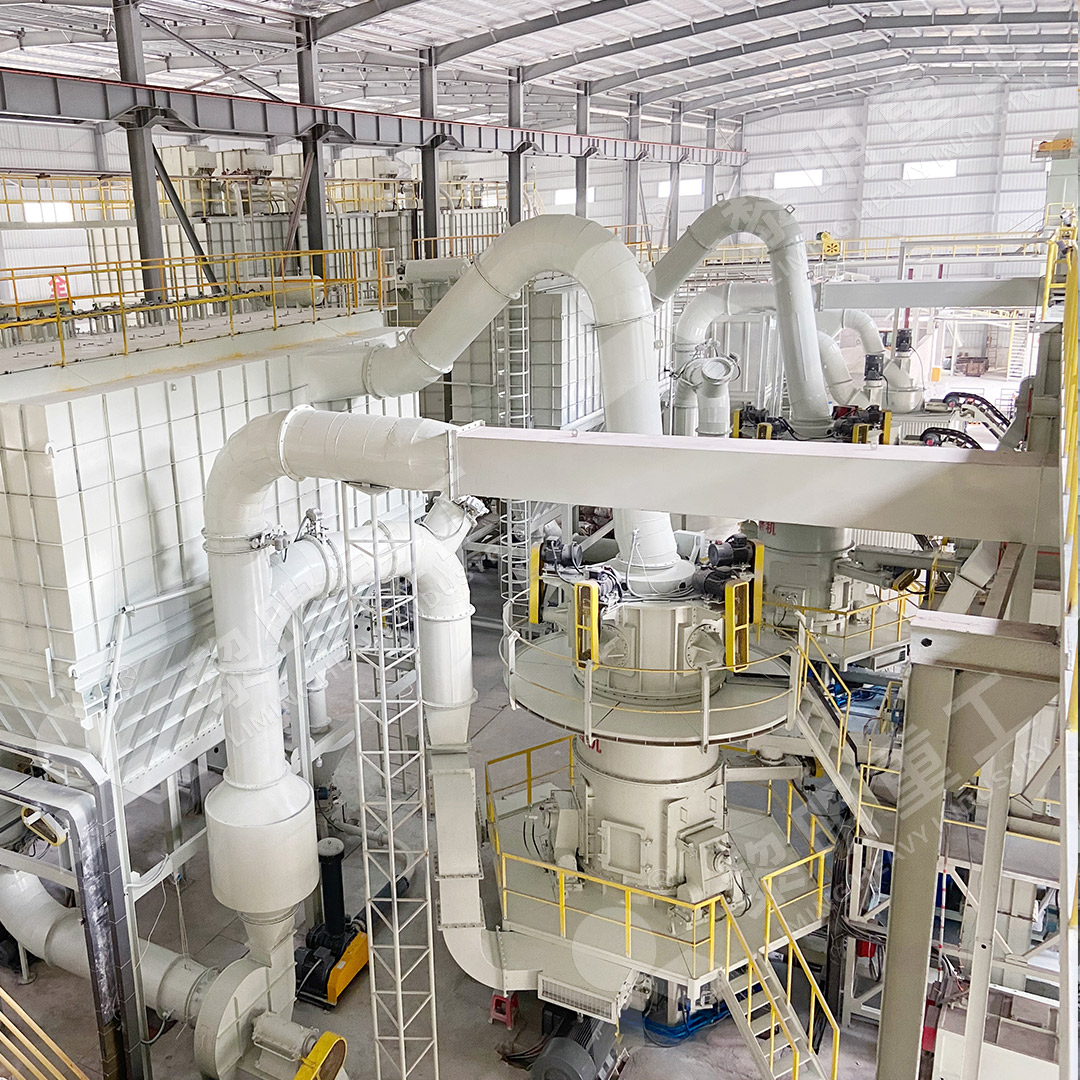
If the same producer plans to add 800-mesh or 1250-mesh grades for masterbatch, coatings, or premium PVC applications, the existing medium-fine mill should not simply be forced to operate beyond its efficient range. A separate LUM Ultrafine Vertical Roller Mill or MW Micro Powder Mill line with a suitable high-efficiency classifier is the more reliable engineering solution.
Recommended Selection Guide
Choose a Raymond Mill for low-capacity, 80–325 mesh calcite production where capital cost is the main concern. Choose an MTW European Grinding Mill for the broadest range of standard fine calcite products and balanced operating economics. Choose an LM Vertical Roller Mill for higher-capacity 200–325 mesh plants where annual output and energy consumption justify the investment. Choose a LUM Ultrafine Vertical Roller Mill or MW Micro Powder Mill for 400–2500 mesh products where fine particle size control creates enough added product value.
Liming Heavy Industry offers Raymond Mill, MTW European Grinding Mill, LM Vertical Roller Mill, LUM Ultrafine Vertical Roller Mill, and MW Micro Powder Mill solutions for calcite powder processing. Final model selection should be confirmed through feedstock testing and a guaranteed performance basis covering capacity, D97, energy consumption, wear cost, and dust-collection performance.
Related FAQ


LIMING Heavy Industry to Participate in SIREXE 2026 in Abidjan, Côte d'Ivoire
2026-10-26

LIMING at MiningMetals Uzbekistan 2026 | Booth B94
2026-10-22
LIMING Heavy Industry at MINEXPO Africa 2026 | Booth 133
2026-10-22
Liming Heavy Industry to Exhibit at bauma CHINA 2026 – Visit Us at Booth E6.510
2026-10-15
Meet Liming Heavy Industry at the 140th Canton Fair 2026
2026-10-13
Complete Mineral Processing Solutions
Convenient Reliable Professional Efficient Get Your Quote
Please feel free to submit your inquiry information to us. We will contact with you as soon as possible.
Our team will contact you as soon as possible.