


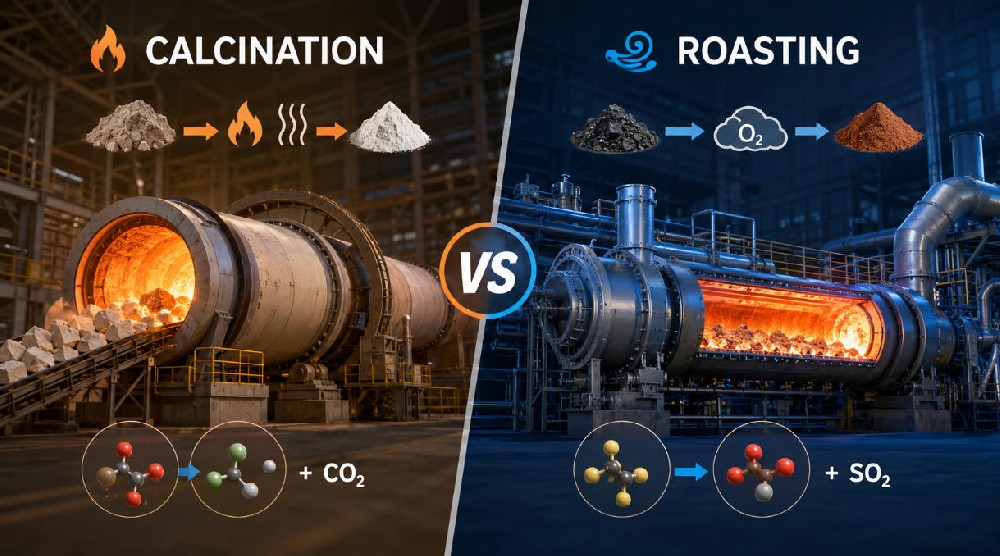
Executive Summary: Calcination and roasting are two essential thermal treatment technologies used in mining, metallurgy, chemicals, and advanced materials industries worldwide. Although both involve heating solid materials at high temperatures, they differ fundamentally in reaction mechanisms, process objectives, atmosphere requirements, and furnace design. In simple terms, calcination focuses on thermal decomposition and removal of volatile components, while roasting emphasizes atmosphere-controlled chemical reactions that alter material composition and oxidation states. Understanding these differences is essential for optimizing production efficiency, reducing energy consumption, and selecting the most suitable industrial furnace.
1. Introduction: Why Calcination and Roasting Matter
Industrial thermal processing plays a critical role in mineral processing, metallurgy, chemicals, building materials, and emerging energy industries. As global manufacturers pursue higher efficiency, lower carbon emissions, and more sustainable production methods, the choice of thermal treatment technology has become increasingly important.
Among all thermal processes, calcination and roasting are the two most widely used methods. While they share certain characteristics, their purposes and operating principles are fundamentally different. Selecting the wrong process or furnace type may lead to lower product quality, increased operating costs, and inefficient energy utilization.
From a global perspective, understanding the distinctions between calcination and roasting is becoming increasingly important as industries transition toward intelligent manufacturing and green technologies.
2. What Is Calcination?
Calcination is a thermal treatment process in which solid materials are heated to high temperatures to induce thermal decomposition, remove volatile substances, or promote crystal phase transformations.
During calcination, materials remain in a solid or semi-solid state and do not undergo complete melting.
Main Objectives of Calcination
Remove chemically bound water
Release carbon dioxide (CO₂)
Eliminate organic matter and volatile impurities
Promote crystal phase transformation
Increase material activity and reactivity
Typical Calcination Reaction
Limestone calcination is one of the most common examples:
CaCO₃ → CaO + CO₂
This process forms the basis of global lime production and is widely used in steelmaking, environmental protection, chemical manufacturing, and construction materials industries.
3. What Is Roasting?
Roasting is a thermal treatment process in which solid materials are heated under a controlled atmosphere to trigger chemical reactions that alter their chemical composition or oxidation state.
Roasting is primarily used for metal ores, catalysts, battery materials, and advanced functional materials.
Common Roasting Reactions
Oxidation
Reduction
Sulfidation
Chlorination
Magnetization
Typical Roasting Reaction
Oxidation roasting of zinc sulfide:
2ZnS + 3O₂ → 2ZnO + 2SO₂
After roasting, zinc oxide can be further processed through leaching and refining to produce metallic zinc.
Roasting is widely applied in copper extraction, zinc metallurgy, iron ore beneficiation, nickel processing, rare earth production, and lithium battery material manufacturing.
4. Calcination vs. Roasting: Key Differences
| Aspect | Calcination | Roasting |
|---|---|---|
| Primary Purpose | Thermal decomposition and removal of volatile components | Controlled chemical reactions |
| Main Reactions | Dehydration, decarbonization, phase transformation | Oxidation, reduction, sulfidation, chlorination |
| Atmosphere | Air or inert gas | Strictly controlled atmosphere |
| Temperature Range | Usually above 800°C | 300–1200°C |
| Materials | Non-metallic minerals | Metal ores, catalysts, advanced materials |
| Process Focus | Heat transfer and temperature uniformity | Atmosphere control and reaction kinetics |
| Typical Products | Lime, calcined kaolin, alumina | Metal oxides, magnetized ores, battery materials |
A simple way to remember the difference is:
Calcination = Thermal decomposition and impurity removal
Roasting = Atmosphere-controlled chemical transformation
The process objective ultimately determines the furnace type.
5. Temperature and Atmosphere Requirements
Calcination Furnaces
Calcination typically operates at relatively high temperatures.
| Application | Temperature |
|---|---|
| Limestone calcination | 900–1200°C |
| Kaolin calcination | 700–1000°C |
| Dolomite calcination | 900–1100°C |
| Alumina calcination | 1200–1400°C |
Atmosphere requirements are generally less stringent. Most systems operate under:
Air atmosphere
Nitrogen (N₂)
Argon (Ar)
The primary concerns are heat transfer efficiency, temperature uniformity, residence time, and product quality consistency.
Roasting Furnaces
Roasting requires precise atmosphere control. Depending on the application, the furnace may operate under:
Oxidizing atmosphere (O₂)
Reducing atmosphere (H₂ or CO)
Inert atmosphere
Chlorinating atmosphere
Sulfur-containing atmosphere
Typical roasting temperatures include:
| Application | Temperature |
|---|---|
| Catalyst roasting | 300–500°C |
| Iron ore magnetization roasting | 700–900°C |
| Copper sulfide roasting | 800–1000°C |
| Lithium battery precursor roasting | 600–900°C |
Therefore, roasting furnaces often require advanced sealing systems, gas flow control, multi-zone heating, and intelligent automation.
6. Common Types of Calcination Furnaces
Rotary Kiln
Rotary kilns are the most widely used calcination equipment worldwide.
They are suitable for:
Limestone
Dolomite
Kaolin
Alumina
Industrial solid waste
Lithium and battery materials
Main advantages include:
Large production capacity
Continuous operation
Flexible fuel options
High thermal efficiency
Mature and reliable technology
Modern rotary lime kilns can exceed 3,000 tons per day production capacity.
Shaft Kiln
Shaft kilns are widely used in active lime production, metallurgical lime manufacturing, and calcium carbide industries.
Main advantages include:
Low energy consumption
Compact footprint
High thermal efficiency
Lower investment cost
They are particularly suitable for lump materials and medium-scale production lines.
7. Common Types of Roasting Furnaces
Fluidized Bed Roaster
Fluidized bed roasters are widely used in sulfide ore roasting and concentrate pretreatment.
Main advantages include:
Excellent gas-solid contact
Fast reaction rates
Uniform temperature distribution
High automation levels
Multiple Hearth Furnace
Multiple hearth furnaces are commonly used for:
Catalysts
Fine chemicals
Battery materials
Rare earth compounds
They offer adjustable residence time, precise temperature control, and stable product quality.
Rotary Roasting Furnace
Rotary roasting furnaces are increasingly used in:
Lithium battery materials
Nickel laterite ore processing
Rare earth materials
Magnetic materials
Their flexibility and scalability make them attractive for emerging industries.
8. Global Trends in Industrial Thermal Processing
Driven by carbon neutrality goals, energy efficiency requirements, and circular economy initiatives, industrial furnace technology is evolving rapidly.
Integrated Multi-Function Furnaces
Modern furnace systems increasingly integrate multiple thermal processes, including:
Drying
Roasting
Calcination
Cooling
This integration reduces equipment investment, heat loss, material handling costs, and plant footprint.
Waste Heat Recovery
Advanced furnace systems maximize thermal efficiency through:
Solid-solid heat exchange
Flue gas recirculation
Multi-stage heat recovery
Intelligent energy management
Many modern systems achieve overall thermal efficiencies of 70% to 85%.
Low-Carbon Technologies
Industrial furnaces are increasingly adopting:
Natural gas combustion
Hydrogen combustion
Electric heating
Oxygen-enriched combustion
Carbon capture, utilization, and storage technologies
These technologies help manufacturers reduce carbon emissions, sulfur dioxide emissions, nitrogen oxides emissions, and environmental treatment costs.
Intelligent Process Control
The integration of artificial intelligence, digital twins, real-time monitoring, predictive maintenance, and advanced process control is enabling:
Higher production stability
Lower energy consumption
Improved product consistency
Reduced operating costs
9. Emerging Technology: Integrated Drying, Roasting and Calcination Shaft Furnaces
One of the most promising developments in industrial thermal processing is the integrated shaft furnace, which combines drying, roasting, calcination, and cooling into a single continuous system.
Key Features
Multi-stage structure with drying, roasting, and cooling zones
Independent or combined operation of each process unit
Capability to process high-moisture pellets and industrial waste
Independent exhaust gas collection and treatment
Full utilization of waste heat throughout the process
Typical Applications
Active lime production from limestone and industrial waste
Phosphate tailings and phosphogypsum recycling
Hydrogen-based direct reduction pellets
Extraction of aluminum and vanadium from fly ash
Production of high-calcium active lime from carbide slag
Pyrolysis of organic sludge into biomass fuel pellets
This integrated technology improves resource utilization, reduces energy consumption, and lowers environmental treatment costs, making it an important direction for future industrial furnace development.
10. Conclusion
Calcination and roasting are not competing technologies. Instead, they represent two distinct approaches to industrial thermal processing.
Calcination focuses on thermal decomposition, impurity removal, and crystal phase transformation.
Roasting focuses on atmosphere-controlled chemical reactions that modify material composition and oxidation states.
As mining, metallurgy, chemicals, and advanced materials industries continue to evolve, industrial furnaces are becoming larger, more energy-efficient, more intelligent, and more environmentally friendly.
The future of industrial thermal processing will belong to technologies capable of delivering higher thermal efficiency, lower carbon emissions, precise process control, and greater resource utilization efficiency.
Related Industry News


Liming Heavy Industry at bauma CONEXPO INDIA 2026 | Booth 5-C6
2026-09-07

Turnkey Raw Mill Cement Plant in Saudi Arabia: Design and Installation
2026-09-03
Cement Raw Mill Supplier in Indonesia: Cost and Configuration Analysis
2026-09-01
Liming Heavy Industry to Exhibit at the 24th Global Gypsum Conference & Exhibition in Turkey
2026-08-31
Complete Calcium Carbonate Grinding and Coating Plant Solution
2026-08-29
Complete Mineral Processing Solutions
Convenient Reliable Professional Efficient Get Your Quote
Please feel free to submit your inquiry information to us. We will contact with you as soon as possible.
Our team will contact you as soon as possible.