


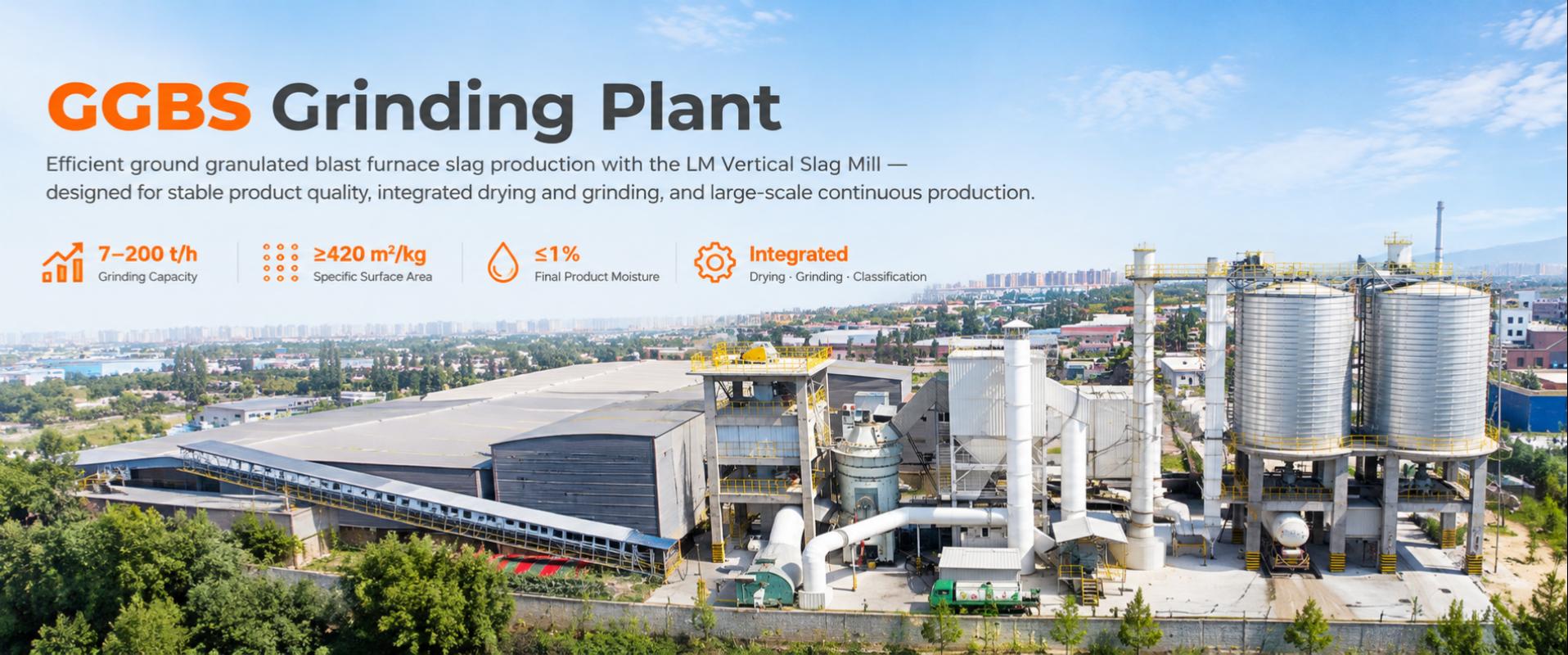
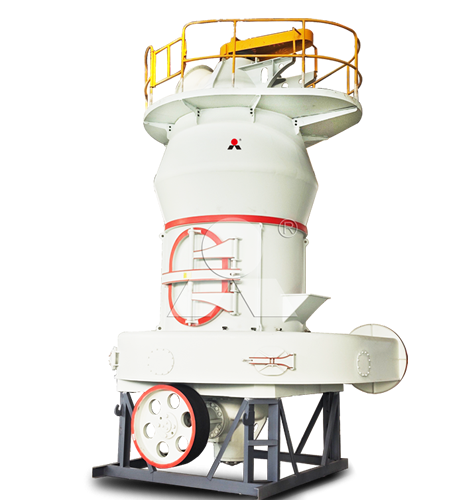
A vertical roller mill produces GGBS by drying wet granulated blast-furnace slag, grinding it in a compressed material bed, separating fine powder from coarse particles, and conveying qualified material to collection equipment. For dedicated slag-powder production, the LM Vertical Slag Mill from Liming Heavy Industry integrates these functions within one coordinated system.
This arrangement is especially suitable for granulated slag because the material often arrives with moisture from the water-quenching process. Instead of relying on separate drying and grinding units, the vertical mill uses hot gas inside the mill to remove moisture while grinding and classifying the slag at the same time.
How a Vertical Roller Mill Works
The vertical roller mill operates through material-bed grinding. Granulated slag is fed to the center of a horizontal grinding table. As the table rotates, centrifugal force moves the material outward beneath hydraulically loaded grinding rollers. The rollers apply pressure to the layer of slag, reducing particle size mainly through compression and inter-particle grinding.
The complete material flow is as follows:
Wet granulated slag → controlled feeding → hot-air drying → grinding-table distribution → roller-pressure grinding → upward gas transport → dynamic classification → coarse-material return → fine-powder collection → GGBS storage
Feeding and Distribution
Granulated blast-furnace slag enters the mill through a controlled feeding device and falls onto the center of the grinding table. Even feed distribution is important because the mill requires a stable material bed for efficient grinding. An inconsistent feed can lead to higher vibration, variable pressure drop, and changes in final-product fineness.
Grinding Under Roller Pressure
The main motor drives the grinding table through a reducer. Material moves across the table and passes beneath the grinding rollers. Hydraulic pressure pushes the rollers onto the slag bed, creating a concentrated compressive force. The material is ground progressively as it travels toward the outer edge of the table.
This principle differs from grinding systems that depend primarily on impact between balls and material. In a vertical roller mill, energy is applied directly to the material bed, which supports efficient fine grinding of slag. The European Commission’s cement-production reference document notes that vertical roller mills commonly use two to four rollers on a horizontal grinding table or bowl and are particularly suited to simultaneous grinding and drying of slag-bearing feeds.
Hot-Air Drying
Hot gas enters the lower part of the mill and rises through the grinding zone. The gas performs two functions: it evaporates water from the granulated slag and transports fine particles upward toward the classifier.
This is important for GGBS production because water-granulated slag may contain approximately 10–15% moisture, depending on dewatering efficiency, storage conditions, and weather. Liming Heavy Industry states that the LM Vertical Slag Mill can process slag with moisture up to about 15% through integrated hot-air drying, subject to the actual thermal conditions and process design.
Dynamic Classification
Above the grinding zone, the internal classifier separates particles by size. Fine particles that meet the selected cut point pass with the airflow toward the powder-collection system. Coarser particles are rejected by the classifier and fall back onto the grinding table for further grinding.
This internal circulation keeps the process efficient: coarse particles are not discharged as finished product, and material does not need to travel through an external return circuit before being reground. The separator speed can be adjusted to change the product fineness. A higher speed usually produces a finer powder, while a lower speed generally allows a coarser product and potentially higher throughput.
Powder Collection and Storage
Fine GGBS leaving the mill with the gas stream is collected by a high-efficiency dust-collection system. The powder is then conveyed to finished-product silos, where it should be kept dry until bulk loading or packing. Coarse particles remain in the internal grinding loop until they reach the required size.
LM Vertical Slag Mill Configuration
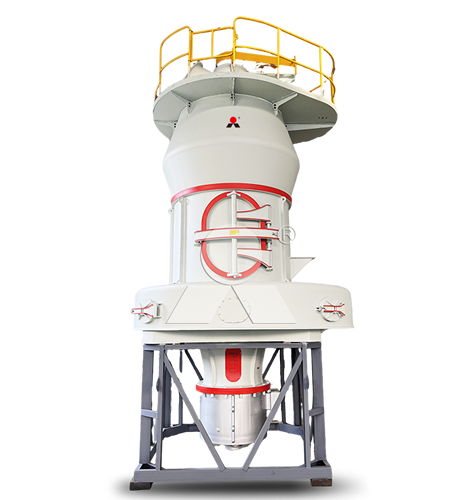
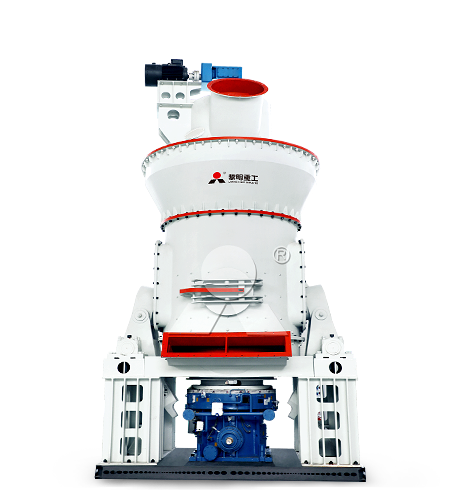
The LM Vertical Slag Mill is designed for grinding industrial residues into powder. Its process layout combines drying, grinding, powder selection, and conveying, which can reduce the number of transfer points and auxiliary machines required in a conventional multi-stage grinding line.
| System Section | Primary Function | Effect on GGBS Production |
|---|---|---|
| Feed system | Delivers a stable quantity of prepared slag to the mill | Helps maintain a uniform grinding bed and stable mill operation |
| Grinding table | Spreads material beneath the rollers | Creates the working surface for continuous material-bed grinding |
| Grinding rollers | Apply hydraulic pressure to the slag layer | Reduces granulated slag to fine powder through compression |
| Hot-air system | Supplies thermal energy and gas transport | Removes feed moisture while carrying fine particles to the classifier |
| Dynamic classifier | Separates fine powder from coarse material | Controls product fineness and returns oversized particles for regrinding |
| Dust collector | Separates GGBS from process gas | Recovers finished powder and supports clean process-gas discharge |
| Finished-product silo | Stores qualified GGBS before dispatch | Protects powder quality and supports continuous loading operations |
Main Advantages for GGBS Grinding
Integrated Process Flow
The most important advantage is the integration of multiple functions. The LM Vertical Slag Mill can dry wet feed, grind it, classify the powder, and pneumatically convey fine material in one process route. This can simplify plant layout and reduce the need for separate dryers, external separators, and additional material-transfer equipment.
Strong Adaptability to Wet Slag
Granulated blast-furnace slag is commonly produced by water quenching, so moisture is an unavoidable production condition. A vertical mill with a properly designed hot-gas system can handle this moisture during milling. The drying capacity must still be matched to the maximum expected feed moisture, desired throughput, and available gas temperature.
When incoming slag moisture rises—for example, after outdoor storage in rainy weather—the operating team can coordinate feed rate, hot-gas temperature, gas volume, and mill outlet temperature. This helps maintain stable drying while protecting the required GGBS output and fineness.
Adjustable Product Fineness
GGBS is sold to meet specific fineness and performance requirements. The vertical mill’s classifier enables operators to adjust the particle cut point during operation. This allows the plant to produce different slag-powder grades without changing the basic grinding equipment.
Vertical roller mills are also recognized for supporting product uniformity and better control of particle-size distribution, which is particularly relevant when the GGBS will be used in controlled cement or concrete formulations.
Efficient Use of Grinding Energy
Because the rollers grind a stable material bed under pressure, the vertical mill directs energy into the grinding zone instead of relying mainly on impact. Liming Heavy Industry describes its slag vertical mill as using a material-bed grinding approach that can be 30–50% more energy-efficient than traditional ball-mill systems under comparable conditions. Actual savings depend on feed properties, target fineness, drying demand, system configuration, and operating practice.
Compact Plant Layout
Combining drying, grinding, classification, and conveying inside a single vertical mill can reduce the physical footprint of a GGBS plant. This is valuable where available land is limited or where an existing cement, steel, or port facility has restricted installation space.
A compact layout can also reduce the number of conveyors, transfer towers, and material-handling points. Fewer transfer points can help lower maintenance demand and reduce opportunities for dust leakage or material buildup.
Stable Operation and Easier Process Control
Operators can control the grinding process by coordinating feed rate, roller pressure, grinding-table speed, hot-gas volume, gas temperature, classifier speed, mill differential pressure, and vibration. These variables allow the mill to respond to changes in slag moisture, grindability, and required product fineness.
The LM Vertical Slag Mill is intended for integrated process operation, making it possible to monitor the key conditions that affect drying, grinding, and separation together rather than treating each function as a separate process step.
Operating Conditions to Monitor
A vertical roller mill provides its best performance when the process remains within a stable operating window. The following controls should be monitored continuously:
Feed rate: Must match the available drying and grinding capacity.
Feed moisture: Determines the hot-gas requirement and can affect output.
Mill outlet temperature: Indicates whether the drying balance is stable.
Grinding pressure: Influences particle breakage, power consumption, and vibration.
Separator speed: Has a direct effect on powder fineness and coarse-particle residue.
Airflow and differential pressure: Affect drying, particle transport, classification, and internal material circulation.
Mill vibration: Helps indicate the stability of the material bed and mechanical loading condition.
Finished-powder moisture and fineness: Confirm whether the product meets the intended GGBS specification.
For example, if the final powder becomes too coarse while the feed condition remains unchanged, operators may review classifier speed, airflow, grinding pressure, and mill loading. Increasing separator speed can reject more coarse particles for regrinding, but it should be done within the mill’s stable operating range because excessive internal circulation may reduce throughput.
Choosing the Right System
The correct LM Vertical Slag Mill configuration should be determined from the actual production requirement. Required output, target fineness, slag moisture, material grindability, available heat source, power supply, site layout, and finished-product storage capacity all affect the final equipment selection.
Before selecting the mill, it is useful to confirm:
Hourly and annual GGBS production targets
Normal and maximum moisture of the granulated slag
Required specific surface area, sieve residue, and particle-size distribution
Slag chemical composition and variability from the source furnace
Available hot-gas temperature, volume, and heat source
Requirements for dust collection, product storage, bulk loading, or packing
Maintenance access, wear-part planning, and automation requirements
A properly sized vertical roller mill can turn wet granulated slag into consistent GGBS powder in a streamlined process. With the LM Vertical Slag Mill from Liming Heavy Industry, drying, material-bed grinding, dynamic classification, and powder conveying are combined to support efficient, controlled slag-powder production.
Related GGBS Grinding Plant


LIMING at MiningMetals Uzbekistan 2026 | Booth B94
2026-10-22

LIMING Heavy Industry at MINEXPO Africa 2026 | Booth 133
2026-10-22
Liming Heavy Industry to Exhibit at bauma CHINA 2026 – Visit Us at Booth E6.510
2026-10-15
Meet Liming Heavy Industry at the 140th Canton Fair 2026
2026-10-13
Liming Heavy Industry to Attend the 140th Canton Fair
2026-09-25
Complete Mineral Processing Solutions
Convenient Reliable Professional Efficient Get Your Quote
Please feel free to submit your inquiry information to us. We will contact with you as soon as possible.
Our team will contact you as soon as possible.