


S95 and S105 are GGBS grades that indicate different levels of strength activity. S105 GGBS is generally finer and more reactive than S95, so it can contribute more strongly to early and later strength development when used in an appropriate cement or concrete mix; S95 is commonly selected for general-purpose applications where balanced performance and grinding economy are the priority.
The “S” refers to slag powder, while the number identifies the grade’s required activity level under the applicable Chinese GGBS standard. These grades should not be compared directly with ASTM Grade 80, 100, or 120, because the test methods and classification systems are different.
Quick Comparison
| Property | S95 GGBS | S105 GGBS |
|---|---|---|
| General grade position | Standard high-activity GGBS grade | Higher-activity GGBS grade |
| Strength activity index | Typically associated with an activity index of at least 95% | Typically associated with an activity index of at least 105% |
| Minimum specific surface area | About 4,000 cm²/g, equivalent to 400 m²/kg | About 5,000 cm²/g, equivalent to 500 m²/kg |
| Particle-size profile | Fine, with a comparatively broader or coarser overall distribution | Finer, generally with a higher proportion of small particles |
| Reactivity | Good latent hydraulic reactivity | Higher potential reaction rate, particularly at earlier ages |
| Grinding demand | Lower than S105 under comparable slag conditions | Higher because of the finer target |
| Typical selection focus | General blended cement, ready-mix concrete, and durability-oriented applications | Higher-performance concrete, tighter strength schedules, and applications needing finer powder control |
The commonly cited minimum fineness levels for GB/T 18046 grades are 4,000 cm²/g for S95 and 5,000 cm²/g for S105. Because 1 cm2/g=0.1 m2/kg, those values correspond to 400 m²/kg and 500 m²/kg, respectively.
The Main Difference: Activity
The key distinction is not color, source, or simply the label on the silo—it is the slag’s verified performance in a standardized strength-activity test. The activity index compares the compressive strength of a mortar containing slag and reference cement with the strength of a reference mortar made with cement alone.
In simplified form:
Strength Activity Index=Strength of slag–cement reference mortar/Strength of reference cement mortar×100%
An S95 product must demonstrate the activity level required for its grade, whereas S105 must achieve a higher level. This is why S105 is generally viewed as the higher-performance grade. Finer grinding often supports higher activity because it increases the available surface area, but fineness alone does not guarantee that a slag will meet S105 requirements. Slag chemistry, glass content, moisture history, storage conditions, and particle-size distribution also matter.
Why S105 Is Usually Finer
Granulated blast-furnace slag has latent hydraulic properties. In a cementitious system, its reaction is activated by the alkaline environment created during cement hydration. Grinding slag more finely exposes more particle surface to the pore solution, which can accelerate its contribution to strength development.
S105 is therefore normally produced at a higher Blaine fineness than S95. A commonly used reference point is approximately 400–450 m²/kg for S95 and 500 m²/kg or above for S105, although the final target should always be set by the applicable standard, the actual slag source, and required strength performance.
However, pushing Blaine fineness higher has a cost. It generally requires more grinding energy, increases wear on mill components, can reduce hourly output, and may increase the amount of very fine material in the final powder. A producer should target the grade requirement and desired concrete performance—not maximum fineness without a defined application need.
Choosing Between S95 and S105
S95 is usually the appropriate choice when the project requires dependable GGBS for common concrete and cement applications, particularly where later-age strength, lower permeability, and durability are important but rapid early strength is not the main objective.
S105 is more appropriate when the concrete producer needs a finer, more active slag powder to support higher strength performance, tighter production schedules, or a greater contribution from GGBS at earlier ages. It may be considered for high-strength structural concrete, precast operations, and mixes where performance requirements justify the added grinding demand.
Choose S95 for stable general-purpose production, standard blended cement, ready-mix concrete, and projects that prioritize balanced performance and production efficiency.
Choose S105 for demanding performance targets, higher reactivity requirements, controlled particle-size specifications, or concrete mixes where early-age contribution is particularly important.
Neither grade is automatically better in every situation. A concrete mix using S95 can outperform one using S105 if the cement type, dosage, water-to-binder ratio, admixtures, curing conditions, and replacement level are better matched to the project requirement.
Production Considerations
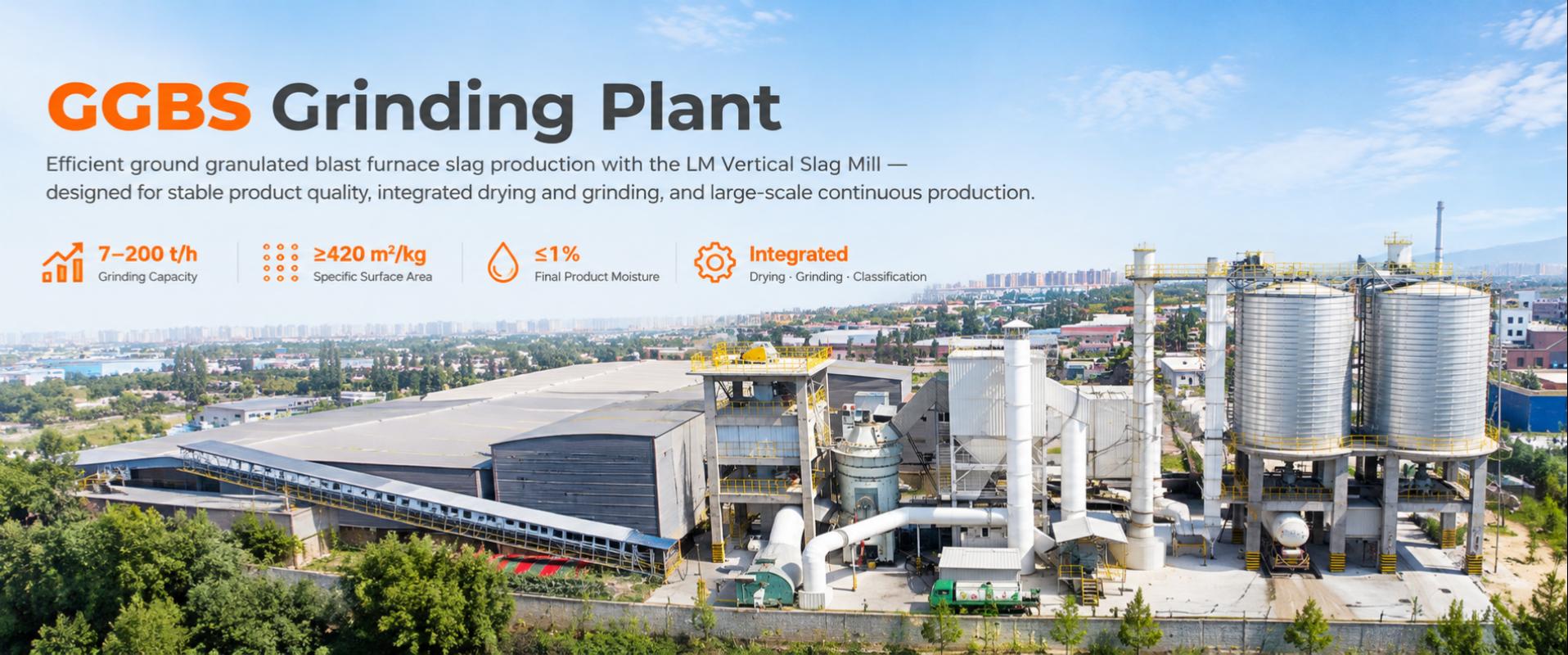
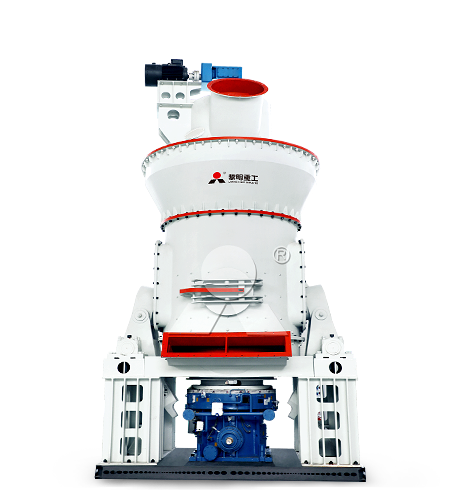
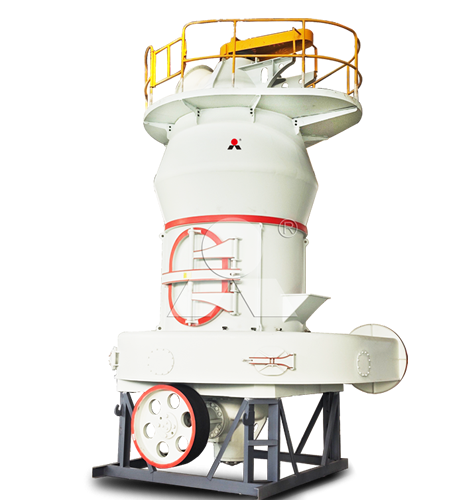
For a producer using an LM Vertical Slag Mill from Liming Heavy Industry, the transition from S95 to S105 primarily involves tighter control of grinding and classification rather than a change in the fundamental process route.
Increase classifier speed carefully to reject more coarse particles for regrinding.
Maintain a stable material bed and appropriate roller pressure to support finer grinding.
Control feed moisture and hot-gas conditions so that drying does not limit classifier performance.
Track Blaine fineness, sieve residue, and particle-size distribution together.
Confirm activity index through scheduled laboratory testing; do not release S105 based on Blaine fineness alone.
Allow for lower throughput and higher specific power consumption when producing the finer grade.
For example, increasing separator speed may raise the Blaine result from an S95 operating range toward an S105 target. But if the mill does not have enough grinding capacity at the new setting, coarse material will circulate internally, mill differential pressure may rise, and output can fall. The correct operating point is the one that consistently meets S105 fineness, residue, moisture, and activity requirements at stable mill conditions.
Verify the Applicable Standard
S95 and S105 terminology is most closely associated with Chinese GGBS classifications under GB/T 18046, which covers ground granulated blast-furnace slag used in cement, mortar, and concrete. The 2008 edition has been superseded, so project specifications should identify the current local standard, testing method, contractual quality limits, and acceptance procedure before production or purchase decisions are made.
International buyers may instead request GGBS under EN 15167-1, ASTM C989, AASHTO M 302, or another local standard. ASTM, for example, classifies GGBFS as Grades 80, 100, and 120 according to strength-activity-index criteria, not S95 and S105.
Summary
S95 is a high-quality, general-purpose GGBS grade with a minimum specific surface area commonly cited at 400 m²/kg. S105 is a finer, higher-activity grade commonly associated with at least 500 m²/kg and a higher strength-activity requirement.
For reliable grade production, use the LM Vertical Slag Mill to control grinding intensity and classification, then verify the finished powder through Blaine testing, sieve residue, particle-size analysis, moisture testing, and standardized activity-index testing. The correct choice between S95 and S105 should be based on the required concrete performance and governing specification rather than fineness alone.
Related GGBS Grinding Plant


LIMING at MiningMetals Uzbekistan 2026 | Booth B94
2026-10-22

LIMING Heavy Industry at MINEXPO Africa 2026 | Booth 133
2026-10-22
Liming Heavy Industry to Exhibit at bauma CHINA 2026 – Visit Us at Booth E6.510
2026-10-15
Meet Liming Heavy Industry at the 140th Canton Fair 2026
2026-10-13
Liming Heavy Industry to Attend the 140th Canton Fair
2026-09-25
Complete Mineral Processing Solutions
Convenient Reliable Professional Efficient Get Your Quote
Please feel free to submit your inquiry information to us. We will contact with you as soon as possible.
Our team will contact you as soon as possible.