


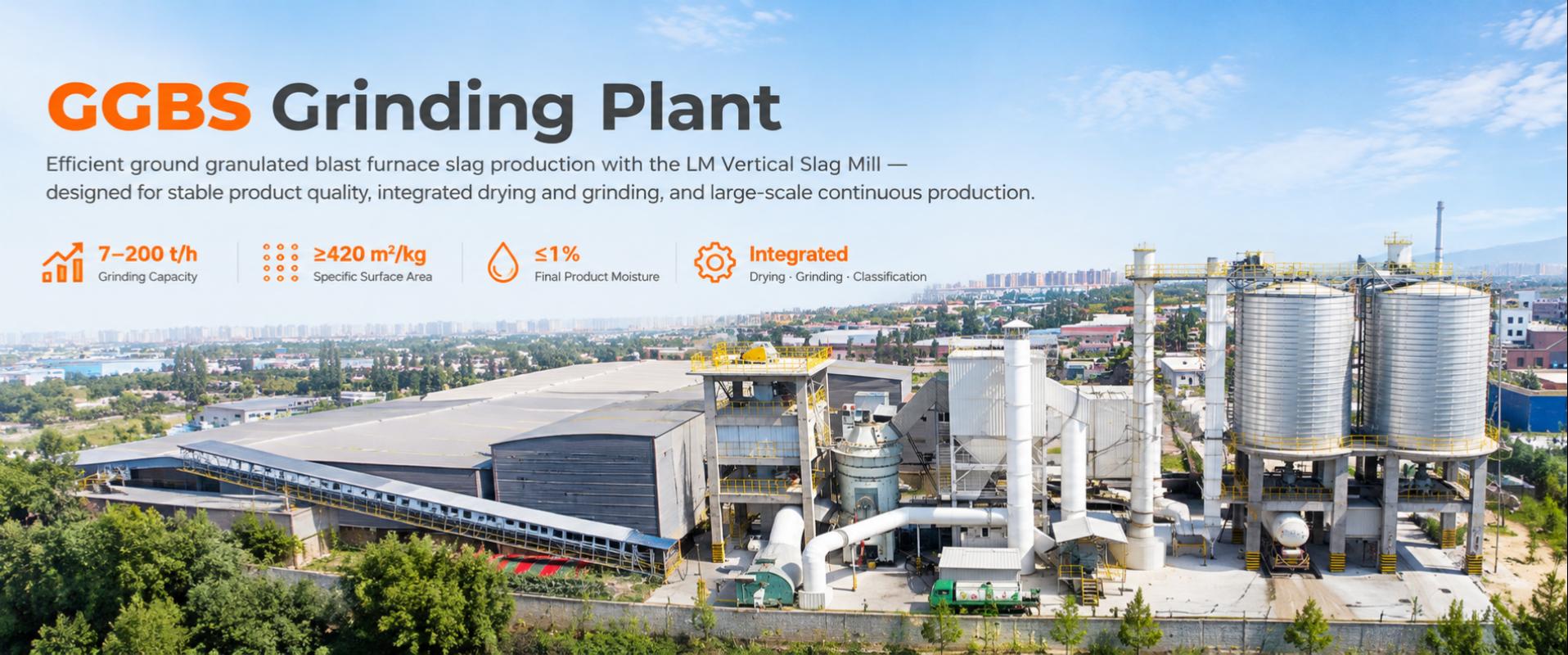
GGBS fineness describes how finely granulated blast-furnace slag has been ground, while Blaine fineness is a widely used air-permeability measurement of its specific surface area. In practical terms, a higher Blaine value usually means a finer powder with more available surface for reaction, but the best GGBS is not automatically the finest one—it is the product that meets the required activity, particle-size, workability, and production-cost targets.
For GGBS producers, fineness is one of the most important controllable product properties. It influences early-age strength development, grinding power consumption, mill throughput, particle-size distribution, and the consistency of the finished powder supplied to cement and concrete users.
What Does Blaine Mean?
Blaine fineness is the specific surface area of a powder, normally expressed in square metres per kilogram (m²/kg). It is measured with an air-permeability method: air is passed through a compacted powder bed, and the resistance to airflow is used to calculate the surface area.
A finer powder generally has more total particle surface area per unit mass. For example, a GGBS product with a Blaine fineness of 450 m²/kg has a greater measured surface area than one at 350 m²/kg. However, Blaine is an indirect measurement of fineness. It does not show the complete particle-size distribution, particle shape, degree of agglomeration, or chemical reactivity by itself.
| Term | Meaning | Why It Matters |
|---|---|---|
| Fineness | The overall degree to which GGBS has been ground into small particles | Influences reaction rate, powder packing, water demand, and performance in cementitious systems |
| Blaine specific surface area | Surface area estimated by the air-permeability test, expressed in m²/kg | Provides a practical production-control index for mill adjustment and product release |
| Particle-size distribution | The proportion of coarse, intermediate, and fine particles in the powder | Helps explain how the material performs beyond its single Blaine number |
| Sieve residue | The portion of material retained on a specified sieve | Identifies an excessive coarse fraction that may not be visible from average fineness alone |
| Activity index | Strength performance of GGBS in a defined mortar or cement combination | Confirms whether the powder provides the expected cementitious contribution |
Typical GGBS Fineness Levels
There is no single Blaine value that is correct for every GGBS project. Required fineness depends on the governing standard, the slag chemistry and glass content, the desired concrete performance, the binder composition, and local customer specifications.
EN 15167-1 specifies a minimum Blaine specific surface area of 275 m²/kg for ground granulated blast-furnace slag used as a type II addition in concrete. The same standard uses activity-index requirements to ensure that the GGBS performs adequately when combined with a defined test cement.
| Indicative Fineness Range | Typical Production Focus | Key Consideration |
|---|---|---|
| 275–350 m²/kg | Standard-compliance-focused GGBS where moderate fineness is acceptable | Verify activity and coarse-particle residue; meeting the minimum Blaine value alone is not enough |
| 350–450 m²/kg | Common range for many cement and concrete applications | Often provides a workable balance between reactivity, mill output, and energy consumption |
| 400–500 m²/kg | Finer GGBS for applications requiring stronger early-age contribution or tighter powder control | Usually requires more grinding energy and tighter classifier control |
| Above 500 m²/kg | Specialized finer slag powders and performance-focused applications | Requires careful evaluation of power demand, throughput, particle distribution, and user requirements |
Published studies commonly discuss GGBS in the 400–500 m²/kg range and report that greater specific surface area can accelerate hydration. Actual concrete results still depend on the slag source, replacement ratio, cement composition, curing temperature, water-to-binder ratio, admixtures, and mix design.
Commercial GGBS products may be considerably finer than the standard minimum. For example, published conformity information for one GGBS product reports a fineness of 540 m²/kg against the EN 15167-1 minimum of 275 m²/kg, illustrating that the standard establishes a lower threshold rather than a universal operating target.
Why Fineness Affects GGBS Performance
GGBS has latent hydraulic properties. Its reaction is supported by the alkaline environment and hydration products created when it is used with Portland cement or another suitable activator. Finer grinding increases the exposed surface area of the slag particles, which can make more material available for reaction at an earlier stage.
Early-age development: Finer GGBS can contribute more rapidly to early strength than a coarser product of the same chemistry.
Later-age strength: GGBS can continue to react over time, contributing to a denser hardened matrix when the overall binder system is properly designed.
Particle packing: Fine particles can fill voids between larger cement particles, although the actual packing effect depends on the complete particle-size distribution.
Workability response: The effect on water demand and flow depends on particle size, shape, surface condition, cement type, admixtures, and total powder content.
Grinding energy: Higher Blaine targets require more grinding work and can lower mill throughput.
Production economics: The financial value of a finer grade should justify its additional power use, wear, heat demand, and potentially lower hourly output.
Fineness should therefore be viewed as a performance-control lever, not as an isolated quality goal. A 450 m²/kg product is not automatically better than a 400 m²/kg product if both meet the required activity and the coarser product provides more stable production or better suitability for the customer’s mix design.
Blaine Versus Particle-Size Distribution
Two GGBS products can have the same Blaine value but behave differently. One may contain more ultrafine particles and a wider coarse tail; another may have a narrower, more uniform particle-size distribution. Since the Blaine method estimates surface area through airflow resistance, it cannot fully distinguish these differences.
For this reason, good GGBS quality control typically combines several measurements:
Blaine specific surface area for routine fineness control
Sieve residue to monitor coarse particles
Laser particle-size analysis where detailed distribution control is required
Finished-product moisture testing
Chemical composition and glass-content assessment of the slag source
Strength-activity testing in accordance with the applicable standard
Research comparing fresh and weathered blast-furnace slag found that materials with similar Blaine fineness could still show different particle-size characteristics and activity. In that study, weathered slag had lower 28-day activity than fresh slag despite being ground to approximately the same Blaine range, showing why Blaine results should be considered alongside raw-material condition and performance testing.
Controlling Blaine in an LM Vertical Slag Mill
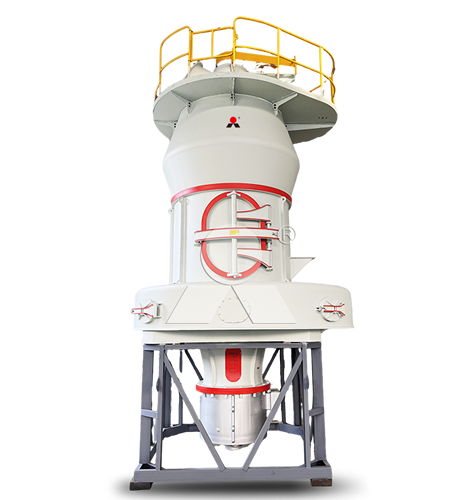
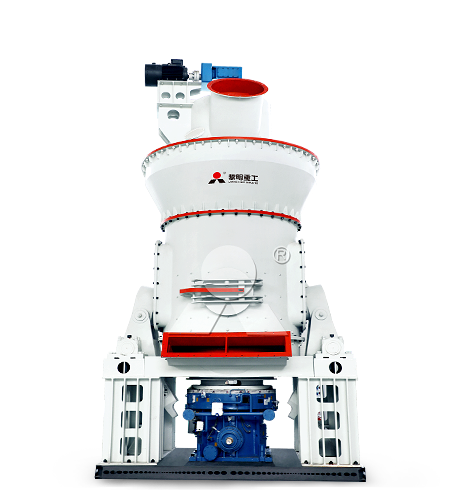
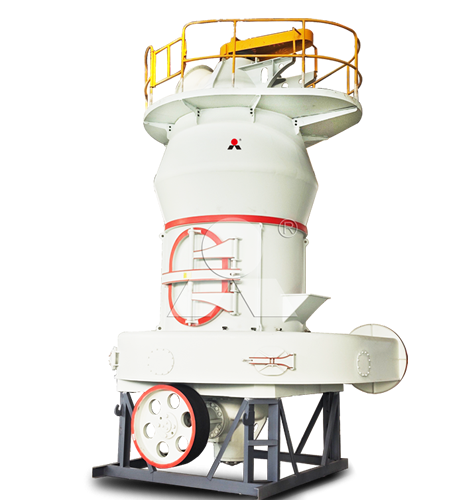
In an LM Vertical Slag Mill from Liming Heavy Industry, GGBS fineness is controlled primarily through the balance between grinding intensity and classification. The mill dries the feed, forms a stable grinding bed on the rotating table, applies roller pressure to reduce particle size, and separates qualified powder through its internal classifier.
The most important operating variables are:
Separator speed: Increasing speed generally produces a finer product because more coarse particles are rejected for regrinding.
Grinding pressure: Adequate roller pressure improves particle breakage, but excessive pressure can increase vibration, wear, and power demand.
Mill feed rate: Excessive feed can reduce residence time and leave a higher coarse fraction in the final powder.
Airflow: Affects drying, powder transport, classifier performance, and the amount of material circulating inside the mill.
Feed moisture and hot-gas condition: Insufficient drying can impair grinding and separation, leading to unstable fineness.
Mill differential pressure: Changes can indicate altered internal circulation, material buildup, airflow imbalance, or an unstable operating condition.
A practical adjustment example is a gradual increase in classifier speed when the product Blaine result falls below target. The operator should then verify sieve residue, mill differential pressure, vibration, and output. If the separator is accelerated too far without enough grinding capacity, internal circulation can rise sharply and reduce throughput. The objective is a stable fineness range, not a short-term high Blaine reading.
Quality Control and Product Release
Finished GGBS should be released based on a defined quality plan rather than a Blaine result alone. Under EN 15167-1, the material must meet requirements for chemical and physical properties as well as conformity-control procedures. The standard specifies a minimum specific surface area of 275 m²/kg and includes activity-index requirements of at least 45% at 7 days and 70% at 28 days when tested in the prescribed combination.
A useful production-control sequence includes:
Test incoming granulated slag for moisture, chemical consistency, and physical condition.
Monitor mill feed rate, hot-gas temperature, outlet temperature, grinding pressure, airflow, vibration, and classifier speed.
Test each production period for Blaine fineness and sieve residue.
Use particle-size analysis at scheduled intervals or when Blaine and residue results do not explain product behavior.
Confirm finished-powder moisture before silo transfer and dispatch.
Perform routine activity and chemical testing according to the applicable standard and customer specification.
Finding the Right Fineness Target
The right GGBS fineness is the lowest stable operating target that reliably delivers the required product performance. Increasing Blaine fineness can support faster reaction and finer powder characteristics, but it also raises grinding energy, wear, and the likelihood of reduced mill output.
For a GGBS plant using an LM Vertical Slag Mill, the best approach is to establish the target through raw-slag testing, customer product requirements, trial production, and ongoing performance feedback. Control Blaine with the classifier and grinding conditions, verify the full particle-size distribution and activity, and treat the finished product as a balance of fineness, reactivity, consistency, and operating efficiency.
Related GGBS Grinding Plant


LIMING at MiningMetals Uzbekistan 2026 | Booth B94
2026-10-22

LIMING Heavy Industry at MINEXPO Africa 2026 | Booth 133
2026-10-22
Liming Heavy Industry to Exhibit at bauma CHINA 2026 – Visit Us at Booth E6.510
2026-10-15
Meet Liming Heavy Industry at the 140th Canton Fair 2026
2026-10-13
Liming Heavy Industry to Attend the 140th Canton Fair
2026-09-25
Complete Mineral Processing Solutions
Convenient Reliable Professional Efficient Get Your Quote
Please feel free to submit your inquiry information to us. We will contact with you as soon as possible.
Our team will contact you as soon as possible.