


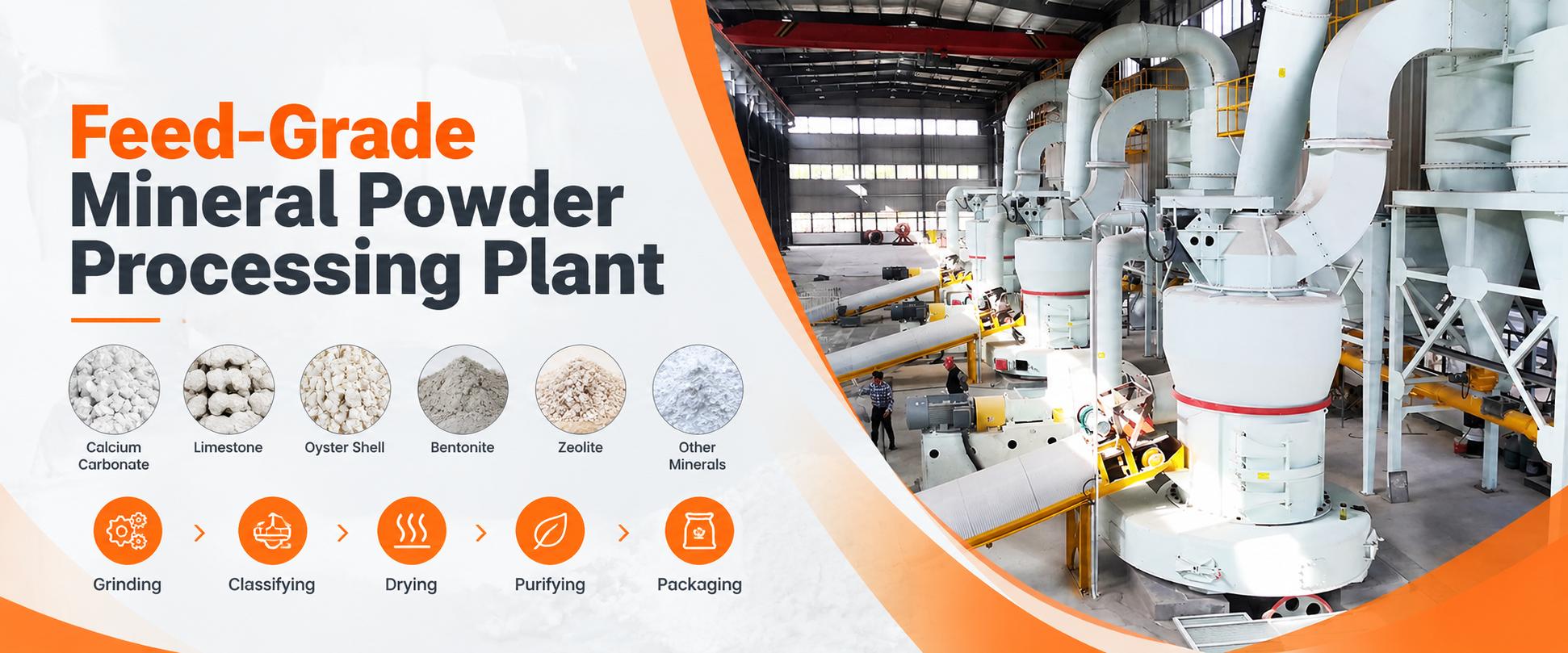
Reducing iron contamination in mineral powder processing requires three coordinated measures: prevent avoidable metal entry, control equipment wear, and remove magnetically responsive particles at suitable points in the line. Installing a magnet only at the raw-material inlet is not enough, because crushing, grinding, conveying, and maintenance can introduce metal farther downstream.
For feed-grade mineral powders such as limestone, bentonite, and zeolite, begin by identifying what “iron contamination” means in the product specification. Loose steel fragments, fine wear particles, rust, and naturally occurring iron-bearing minerals are different problems. They should not be treated as one impurity with one removal method.
First Distinguish Foreign Metal from Naturally Occurring Iron
The most useful starting point is diagnosis. Before purchasing separation equipment, determine whether the problem is foreign metallic material, iron associated with the mineral source, or a combination of both.
| Type of Iron-Related Material | Possible Origin | Approach to Investigate |
|---|---|---|
| Large ferrous objects | Loose fasteners, tools, scrap metal, or material-handling incidents | Receiving controls and upstream tramp-metal removal |
| Fine metallic particles | Wear in crushers, mills, conveyors, or other product-contact equipment | Wear investigation and downstream fine-particle separation |
| Rust and scale | Corroded surfaces or poorly controlled storage and maintenance | Corrosion inspection, moisture control, and appropriate magnetic separation |
| Iron-bearing mineral particles | The natural deposit | Mineralogical analysis and representative separation trials |
| Weakly magnetic or nonmagnetic metal fragments | Stainless steel or other equipment components | Material identification and an assessment of detection and separation options |
Magnetic separators remove materials that respond sufficiently to the applied magnetic field. Rare-earth magnets can capture fine ferrous contamination and some weakly magnetic material, including certain work-hardened stainless steel particles. They do not provide universal removal of every metal or every form of iron.
A total-iron laboratory result alone does not reveal the contamination mechanism. If total iron is a contractual limit, ask the laboratory and mineral specialist to establish how much is associated with removable particles and how much belongs to the mineral itself before setting a removal guarantee.
Find Where Contamination Enters the Line
Investigate the process in stages instead of assuming that the grinding mill is responsible for every metal particle. Even chutes can introduce contamination when dry material scrapes against steel surfaces.
Use a sampling plan that compares material at relevant locations:
Incoming mineral before plant processing.
After preliminary crushing.
At the mill feed.
After grinding and classification.
After finished-powder conveying.
At packing or bulk loading.
Keep the sampling and analytical methods consistent. Record the raw-material lot, operating conditions, recent maintenance, and separator-cleaning history so that differences can be interpreted meaningfully.
Also inspect material recovered from magnets. Changes in the amount or appearance of captured metal can provide useful warning signs, but visual observations should be followed by investigation rather than treated as definitive proof of a particular failure.
Remove Large Metal Before Crushing and Grinding
Upstream protection serves two purposes: it reduces the chance of equipment damage and prevents large tramp metal from being broken into smaller particles during size reduction. Fine iron is generally more demanding to separate than a large bolt or steel fragment.
Review raw-material receiving, stockpile handling, loader practices, and conveyor transfer points. Where the contamination risk justifies it, evaluate a separator positioned before the crusher or mill.
Plate magnets and other upstream arrangements can capture larger ferrous objects, but their effectiveness depends on the installation and material presentation. A device chosen for occasional bolts in a shallow stream should not automatically be expected to remove fine metal from a deep bed of mineral.
Include maintenance access and a safe cleaning method in the design. A magnet that cannot be inspected or cleaned conveniently is difficult to manage as a reliable process control.
Choose Fine-Powder Separation Around the Way the Material Flows
The strongest advertised magnet is not automatically the best separator for the process. Powder flow, layer thickness, particle exposure, operating temperature, and cleaning arrangements all affect performance. A thin material layer close to the magnetic surface generally provides a better opportunity for capture than a thick layer passing farther away.
| Material-Handling Situation | Separator Arrangement to Evaluate | Main Concern |
|---|---|---|
| Free-flowing powder falling through a chute | Grate, drawer, or tube-magnet arrangement | Whether the complete stream receives adequate exposure to the magnetic surfaces |
| Powder prone to bridging or packing | Rotating grate arrangement or another tested anti-bridging design | Maintaining flow without creating bypass paths or unacceptable hold-up |
| Mineral moving on a belt or vibratory feeder | Plate or drum arrangement suited to the duty | Bed depth, feed distribution, and the required capture distance |
| Fine powder requiring additional magnetic cleaning | High-strength or high-gradient separation tested with the actual product | Separation performance, capacity, cleaning cycle, and product loss |
Rotating grate magnets can help with materials that bridge across conventional stationary grates. For demanding fine-powder duties, electromagnetic matrix systems are another option, but their suitability should be demonstrated with representative material.
Do not specify a separator using surface gauss alone. Ask the supplier to explain the working geometry, expected exposure of the product stream, operating limits, and the test conditions behind the proposed performance.
Control Wear Instead of Relying Only on Removal
Magnetic separation is a protective measure, not permission to ignore deteriorating equipment. Review product-contact components throughout the line, including crusher parts, grinding components, classifier components, screw conveyors, chutes, and discharge devices.
The inspection plan should address:
Wear against the equipment manufacturer’s acceptance limits.
Loose or damaged fasteners and guards.
Unintended contact between moving and stationary components.
Damaged liners, rough repairs, and exposed welds.
Corrosion on surfaces above or within the product path.
Changes in vibration, noise, or recovered-metal quantities.
Match operating conditions to the material. Liming Heavy Industry notes, for example, that excessive material hardness accelerates roller and ring wear in its MTW6X guidance. That makes representative material testing and appropriate equipment selection relevant to contamination prevention as well as production performance.
Review Grinding Equipment as Part of the Complete Control Plan
For projects evaluating a Liming Heavy Industry grinding system, request a review of wear-part materials, inspection access, maintenance intervals, and downstream separation provisions.
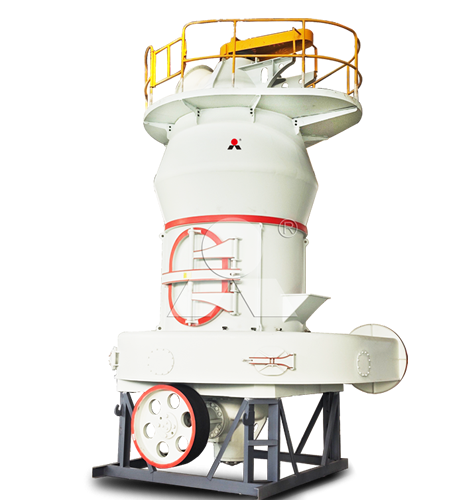
Liming Heavy Industry describes the LM Vertical Grinding Mill as using a material bed between the grinding roller and table rather than direct roller-to-table contact during normal grinding. However, that design feature is not an iron-free guarantee for the complete process. Raw-material contamination and wear elsewhere in the line still require control.
Compare proposed mill configurations using the same mineral, fineness, output target, and maintenance assumptions. Require any product-purity commitment to state its test method and operating conditions.
Place the Final Control After the Relevant Contamination Sources
A separator at the mill outlet cannot remove metal introduced later by a conveyor or packing system. Review the entire route to dispatch before choosing the final separation location.
A practical arrangement to evaluate is:
Upstream tramp-metal removal before size reduction.
Fine magnetic separation after grinding where required.
A final control near packing or loading, positioned after relevant downstream wear sources.
The number and location of separators should follow the risk assessment and plant layout, not a fixed rule that every line needs the same devices.
Where nonferrous or insufficiently magnetic fragments are credible hazards, assess a suitable metal-detection and rejection system alongside magnetic separation. Confirm its capability with the actual product, package, opening size, and operating conditions rather than assuming it will detect every small fragment.
Make Magnet Cleaning a Documented Operating Task
Captured metal must be removed without allowing it to return to the product stream. Build a cleaning procedure around safe isolation, controlled removal, inspection, and recording.
The operating record should identify:
The separator and its location.
The cleaning date, time, and responsible operator.
The quantity and appearance of recovered material, where practical.
Any unusual findings or equipment damage.
The action taken before restarting production.
Set the cleaning interval using actual operating observations. A heavily loaded receiving magnet and a lightly loaded final powder magnet may need different schedules. Reassess the interval after a raw-material change, maintenance event, or increase in captured metal.
Keep recovered contamination segregated. Do not return magnetic rejects to production merely because some saleable mineral is mixed with them.
Validate Removal Performance with Representative Powder
Ask separator suppliers to test the actual material at conditions that represent production. Fine-powder separation depends on how the powder moves through the equipment, so a trial at a low feed rate or unusually shallow bed may not demonstrate performance at the proposed plant capacity.
The acceptance protocol should define:
The contaminant type or measurable quality parameter being controlled.
The incoming material condition and throughput.
The separator configuration and operating settings.
The sampling method before and after separation.
The analytical or inspection method.
The acceptance limits and treatment of rejected material.
Keep physical foreign-metal control separate from a total-iron specification. They may require different measurements and cannot be assumed to improve by the same amount.
Use Contamination Findings to Improve the Process
If iron contamination rises, investigate in a defined order: confirm the result, identify the material, compare upstream and downstream samples, inspect likely wear locations, and review separator condition and operating rate.
A stronger magnet may be appropriate, but it should not be the automatic first response. The more durable solution may be a repaired conveyor, a revised chute, improved receiving controls, a shorter cleaning interval, or replacement of a worn component.
The most effective mineral powder line combines prevention, suitable separation, and evidence-based verification. That approach gives feed-grade mineral suppliers a defensible way to manage foreign-metal risk while keeping product specifications and equipment performance clearly defined.
Related Feed Mineral Processing


Liming Heavy Industry to Exhibit at bauma CHINA 2026 – Visit Us at Booth E6.510
2026-10-15

Meet Liming Heavy Industry at the 140th Canton Fair 2026
2026-10-13
Liming Heavy Industry to Attend the 140th Canton Fair
2026-09-25
Liming Heavy Industry at bauma CONEXPO INDIA 2026 | Booth 5-C6
2026-09-07
Turnkey Raw Mill Cement Plant in Saudi Arabia: Design and Installation
2026-09-03
Complete Mineral Processing Solutions
Convenient Reliable Professional Efficient Get Your Quote
Please feel free to submit your inquiry information to us. We will contact with you as soon as possible.
Our team will contact you as soon as possible.