


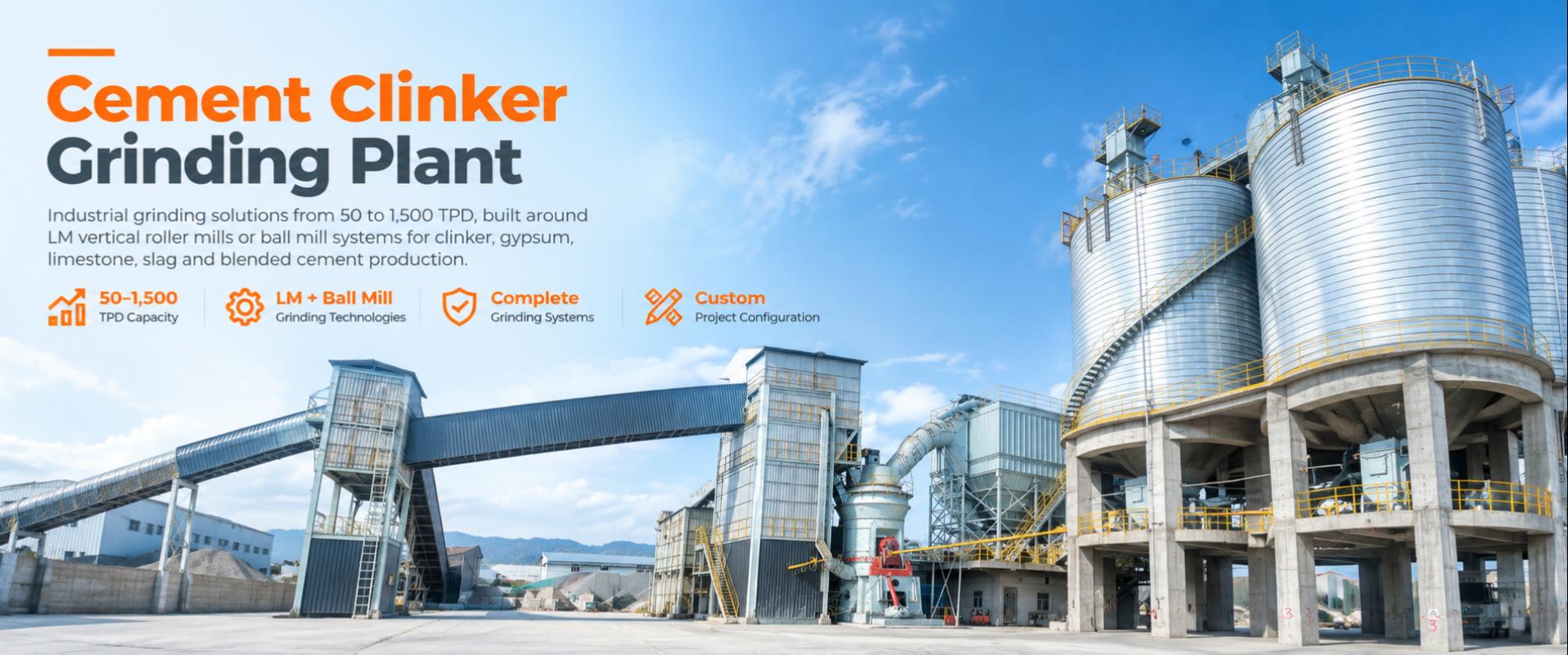
The operating cost of a cement grinding plant is determined by the complete production system, not only by the grinding mill. Electricity, grinding media or wear parts, labor, maintenance, dust collection, material conveying, quality control, spare parts, and clinker logistics all contribute to the cost of producing one tonne of finished cement.
For most cement grinding operations, power consumption is one of the most important controllable costs. Clinker finish grinding is energy-intensive, and the selection of an LM vertical roller mill or ball mill has a direct effect on specific power consumption, maintenance planning, plant availability, and long-term cost per tonne.
Main Operating Cost Categories
A complete operating-cost analysis should include both direct production costs and supporting plant expenses. The exact cost structure will vary according to local electricity prices, clinker source, cement type, production scale, moisture conditions, labor costs, and the required level of automation.
| Cost Category | Main Cost Drivers | Typical Management Focus |
|---|---|---|
| Electricity | Grinding mill, separator, fans, elevators, conveyors, filters, packing line | Reduce specific power consumption and avoid unstable operation |
| Wear parts | Grinding media, liners, rollers, grinding tables, separator parts | Select suitable materials and plan replacement intervals |
| Maintenance | Mechanical inspection, lubrication, gearbox service, drives, bearings, hydraulics | Prevent unplanned shutdowns and extend equipment life |
| Labor | Operators, maintenance personnel, laboratory staff, packing and dispatch teams | Use automation and standardized operating procedures |
| Raw-material handling | Clinker unloading, storage, gypsum and additive handling, conveying | Reduce material loss, dust, spillage, and equipment idle time |
| Dust collection | Bag filters, process fans, compressed air, filter bags, dust conveyors | Maintain emissions compliance and stable process ventilation |
| Quality control | Laboratory testing, sampling, fineness control, chemical analysis | Maintain consistent cement strength and product specifications |
| Logistics and dispatch | Cement silos, packing, truck loading, bulk loading, bag handling | Match dispatch capacity with grinding output |
Electricity Cost and Specific Power Consumption
Electricity is usually the largest variable operating cost in a cement grinding plant. The grinding circuit consumes power through the main mill drive, separator, process fan, bag filter fan, bucket elevators, conveyors, feeders, pumps, compressors, and finished-cement handling equipment.
The cement mill is commonly one of the largest individual electricity consumers in the plant. Industry references indicate that finish grinding may consume more than 25 kWh per tonne of cement in many operating conditions, while total cement production electricity consumption can range from approximately 80 to 130 kWh per tonne of cement depending on plant configuration and process efficiency. Grinding of cement, raw materials, and fuel can account for a large share of total electrical demand. [14]
For a typical closed-circuit ball mill system, clinker finish grinding power consumption may be in the range of approximately 33 to 40 kWh per tonne of cement, depending on clinker hardness, cement fineness, separator performance, grinding media condition, circulation load, and mill ventilation. A well-operated ball mill remains a reliable solution, but electrical cost must be considered carefully when evaluating long-term production economics. [15]
An LM vertical roller mill integrates grinding and classification in a compact process arrangement. For suitable clinker and blended cement applications, vertical roller mill systems can operate with lower specific power consumption than conventional ball mill circuits. Industry comparisons commonly report approximately 20 to 23 kWh per tonne for vertical roller mill finish grinding under comparable conditions, compared with approximately 33 to 40 kWh per tonne for conventional ball mill circuits. Actual results depend on raw materials, required cement fineness, moisture, additives, operating practice, and equipment configuration. [15]
LM Vertical Roller Mill Operating Cost
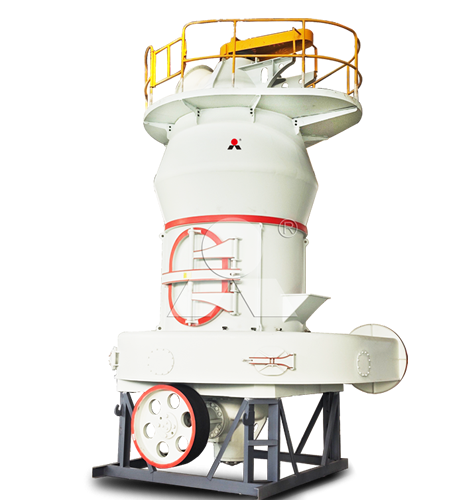
The LM vertical roller mill is designed for efficient grinding of cement clinker and blended cement materials. Its vertical configuration combines grinding, classification, and, where suitable, drying capability in one coordinated process system. This can reduce the number of separate machines required in the grinding circuit and support a compact plant layout.
The main operating-cost advantages of an LM vertical roller mill are generally related to lower power demand, integrated classification, reduced grinding-media consumption, and simplified material flow. Unlike a ball mill, a vertical roller mill does not use a large quantity of steel grinding balls as its main grinding mechanism. This can reduce recurring grinding-media purchasing and handling costs.
However, LM vertical roller mill operating costs must also include planned inspection and replacement of grinding rollers, grinding tables, hydraulic components, gearbox components, separator wear parts, and other high-wear areas. Good operating practice is essential because stable feed rate, correct grinding pressure, controlled material bed thickness, appropriate separator speed, and suitable process-air volume all influence power consumption and equipment life.
For suitable cement grinding projects, a vertical roller mill may reduce finish-grinding energy demand by approximately 20% to 38% compared with a conventional ball mill circuit. The actual saving should be calculated using the project’s expected throughput, local electricity tariff, clinker properties, cement fineness target, and operating hours rather than relying only on general industry figures. [16]
Ball Mill Operating Cost
A ball mill is a proven solution for cement clinker grinding and remains widely used in conventional closed-circuit grinding systems. The process generally includes the ball mill, separator, bucket elevator, conveying equipment, dust collector, process fans, and finished-cement storage system.
The most important recurring operating costs for a ball mill system are electricity, grinding media, mill liners, separator maintenance, lubrication, mechanical inspections, and replacement parts. Grinding media gradually wears during operation, so plant operators need to monitor ball size distribution, ball charge volume, material flow, and grinding efficiency to maintain output and cement quality.
Ball mill liners and diaphragms also influence performance. Worn liners can change the grinding trajectory of the media and reduce grinding efficiency. Blocked diaphragm slots, incorrect ventilation, poor separator performance, or excessive material circulation can increase power consumption and reduce production capacity.
A properly designed and well-maintained ball mill circuit can offer stable operation, strong adaptability, and a practical solution for projects with existing ball mill infrastructure. In some total-cost-of-ownership comparisons, a simple and well-designed closed-circuit ball mill has been identified as a competitive option because of its reliability, flexibility, and high availability. The best solution still depends on the complete project condition rather than a single energy-consumption figure. [14]
Maintenance and Wear-Part Cost
Maintenance cost is not limited to the price of spare parts. It also includes planned shutdown time, labor, lifting equipment, inventory management, production losses during repairs, and the risk of emergency failures. A preventive maintenance plan is usually less costly than responding to unexpected shutdowns.
| Equipment Type | Main Wear or Maintenance Items | Operating-Cost Consideration |
|---|---|---|
| LM Vertical Roller Mill | Grinding rollers, grinding table, separator parts, hydraulic system, gearbox, lubrication system | Requires condition monitoring and planned wear-part maintenance |
| Ball Mill | Grinding balls, liners, diaphragms, bearings, gearbox, separator, lubrication system | Requires ongoing grinding-media management and liner replacement planning |
| Bag Filter | Filter bags, cages, pulse valves, compressed-air system, screw conveyors | Poor filter performance can affect ventilation, emissions, and production stability |
| Separator | Rotor, guide vanes, bearings, drive system, air seals | Separator efficiency directly affects grinding load and product fineness |
| Conveying System | Belts, rollers, chains, buckets, screws, bearings, transfer chutes | Small conveying failures can stop the complete grinding system |
For ball mills, maintaining an appropriate grinding-media charge is especially important. Worn or incorrectly graded grinding media can reduce mill efficiency and increase electricity consumption. Regular liner inspection, diaphragm cleaning, separator maintenance, and ventilation control can help avoid unnecessary power losses. Industry guidance identifies media-charge management, separator maintenance, diaphragm cleaning, and liner replacement as high-impact actions for ball mill energy performance. [15]
For LM vertical roller mills, roller and grinding-table wear should be monitored before it affects throughput, product fineness, vibration, or power demand. Operators should also maintain the hydraulic system, lubrication system, classifier, fan, and mill feed system to support stable operation.
Raw Material and Logistics Cost
Although the grinding system is the central production unit, clinker and additive logistics can strongly affect the final cost per tonne of cement. A stand-alone grinding plant commonly purchases clinker from an integrated cement producer, terminal, port, railway connection, or external supplier. The delivered cost of clinker is often a major component of total cement production cost.
Gypsum, limestone, slag, fly ash, and other mineral additives also affect operating cost. Their market price, transport distance, moisture content, storage requirements, and handling characteristics should be included in the cost model. For example, a moist slag material may require additional drying capacity or process-gas management, while a dry limestone additive may require a simpler handling arrangement.
Material losses should be controlled throughout unloading, storage, conveying, grinding, silo transfer, packing, and dispatch. Spillage, dust leakage, incorrect dosing, silo contamination, and packing losses can reduce profitability even when the grinding mill itself is operating efficiently.
Labor, Automation, and Quality Control
Labor cost depends on the plant size, operating schedule, automation level, maintenance strategy, packing requirement, and local staffing conditions. A highly automated grinding plant can improve consistency and reduce manual intervention, but it still requires trained operators, maintenance personnel, electrical technicians, laboratory staff, and production management.
Automation can reduce operating cost by stabilizing feed rate, controlling material proportions, maintaining target fineness, managing separator speed, monitoring power consumption, and detecting abnormal equipment conditions. A PLC-based control system can also improve traceability by recording production data, alarm history, material consumption, and energy performance.
Quality control is essential because a plant must meet cement strength, setting time, fineness, chemical composition, and consistency requirements. Producing cement outside the required specification can lead to rejected material, customer complaints, reprocessing costs, and lost production time. Regular sampling and laboratory testing help operators balance product quality with grinding efficiency.
How to Calculate Cost Per Tonne
A useful way to evaluate operating performance is to calculate the total production cost per tonne of finished cement. This allows plant managers to compare different shifts, cement types, raw-material sources, mill operating conditions, and equipment configurations.
The basic calculation is:
Operating Cost per Tonne = Total Operating Cost During the Period ÷ Finished Cement Production During the Same Period
Total operating cost should include electricity, grinding media, wear parts, maintenance labor, spare parts, lubricants, filter bags, compressed air, laboratory expenses, packing materials where applicable, material losses, internal logistics, and other direct plant expenses.
For example, if a plant produces 100,000 tonnes of cement in one month and its direct grinding-plant operating expenses total US$1,500,000 during the same period, the direct operating cost is US$15 per tonne of cement. The calculation should then be reviewed by cost category to identify whether electricity, maintenance, material loss, labor, or logistics is the main improvement opportunity.
How to Reduce Cement Grinding Cost
Operating-cost reduction should focus on stable, measurable improvements rather than reducing maintenance or quality-control activities. The goal is to lower cost per tonne while maintaining cement quality, plant reliability, and environmental performance.
Match the LM vertical roller mill or ball mill capacity to the actual production requirement.
Maintain a stable clinker, gypsum, and additive feed rate.
Control cement fineness according to the required product specification and avoid unnecessary overgrinding.
Optimize separator performance to reduce circulation load and improve grinding efficiency.
Maintain correct mill ventilation and process-fan operation.
Inspect grinding media, liners, diaphragms, rollers, grinding tables, and separator parts on schedule.
Use preventive maintenance to avoid extended unplanned shutdowns.
Monitor specific power consumption in kWh per tonne of cement.
Reduce material loss during storage, conveying, silo transfer, packing, and dispatch.
Use automation to stabilize process parameters and identify abnormal operating conditions early.
Rotary Kiln and Calcining Kiln Operating Costs
For integrated cement projects, clinker production adds another major operating-cost area. Liming Heavy Industry also provides rotary kiln and calcining kiln solutions for suitable clinker production and industrial calcination applications. Compared with a stand-alone grinding station, an integrated clinker production line requires additional fuel, raw-material preparation, high-temperature process control, clinker cooling, emission control, and kiln maintenance.
Rotary kiln operating costs are heavily influenced by fuel consumption, raw-material chemistry, kiln thermal efficiency, preheater and calciner performance, refractory condition, production stability, dust-control systems, and clinker cooler efficiency. Because clinker production is a thermal process, fuel cost can become one of the largest cost components in an integrated cement plant.
When planning a project that includes both kiln and grinding systems, it is important to evaluate the complete cost chain from raw-material preparation and calcination to clinker storage, cement grinding, packing, and dispatch. A coordinated solution can help balance kiln capacity, clinker inventory, grinding output, energy demand, and final cement production requirements.
Conclusion
Cement grinding plant operating cost depends on electricity, maintenance, wear parts, labor, material logistics, dust collection, product quality, and production stability. The lowest equipment purchase price does not always produce the lowest long-term cost per tonne of cement.
Liming Heavy Industry can provide LM vertical roller mill and ball mill solutions for cement clinker and blended cement grinding. An LM vertical roller mill may be suitable for projects seeking a compact integrated grinding configuration and lower specific power demand, while a ball mill remains a reliable option for conventional cement grinding circuits and projects with compatible existing infrastructure.
For an accurate operating-cost estimate, evaluate the required capacity, clinker properties, additive ratio, target fineness, local electricity tariff, annual operating hours, maintenance capability, and complete plant scope. A project-specific technical solution provides the most reliable basis for comparing LM vertical roller mill and ball mill operating costs.
Related Cement Clinker Grinding Plant


LIMING at MiningMetals Uzbekistan 2026 | Booth B94
2026-10-22

LIMING Heavy Industry at MINEXPO Africa 2026 | Booth 133
2026-10-22
Liming Heavy Industry to Exhibit at bauma CHINA 2026 – Visit Us at Booth E6.510
2026-10-15
Meet Liming Heavy Industry at the 140th Canton Fair 2026
2026-10-13
Liming Heavy Industry to Attend the 140th Canton Fair
2026-09-25
Complete Mineral Processing Solutions
Convenient Reliable Professional Efficient Get Your Quote
Please feel free to submit your inquiry information to us. We will contact with you as soon as possible.
Our team will contact you as soon as possible.