


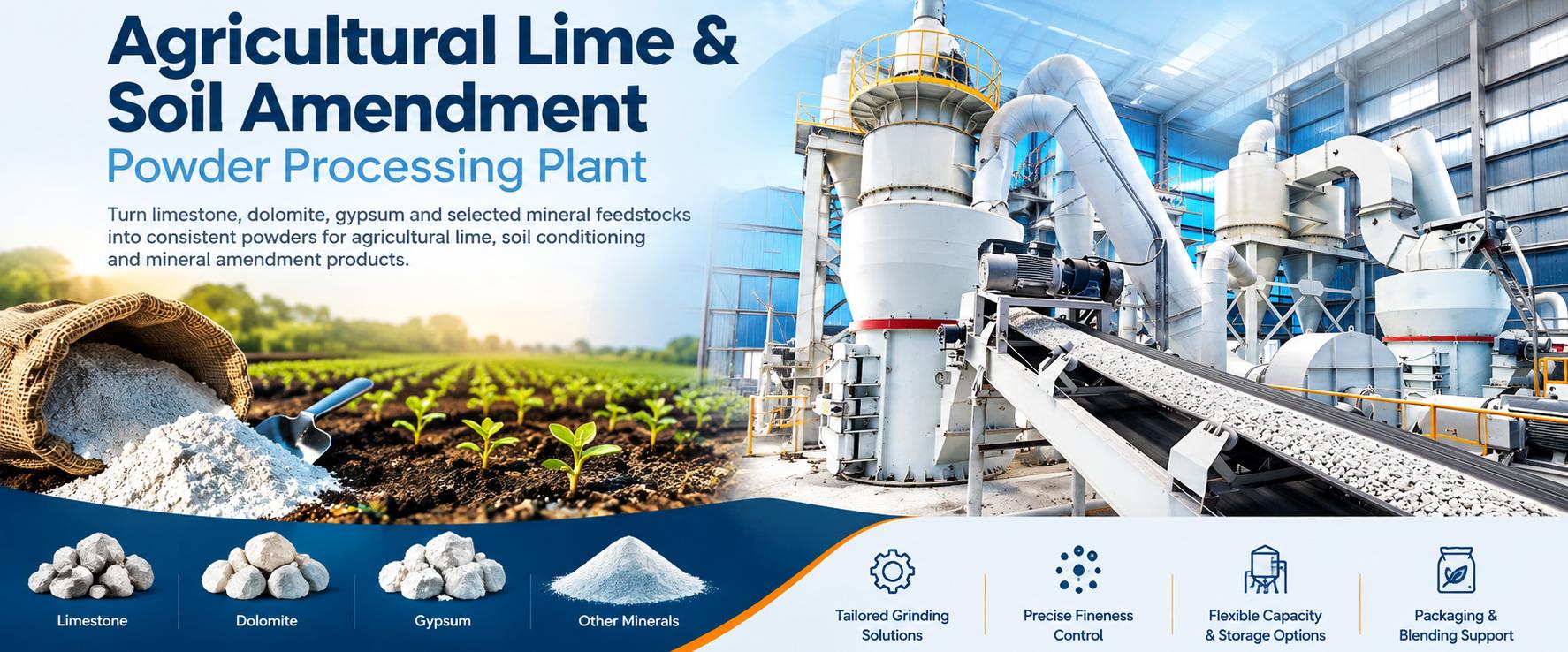
Selecting the right grinding mill is a critical step in establishing an agricultural lime powder production line. The equipment must process limestone efficiently, achieve the required product fineness, and maintain a stable output that meets agricultural product specifications. A mill that performs well in one application may not be the most suitable choice for another, especially when raw material characteristics, production capacity, and final particle size differ.
For agricultural lime manufacturers, the best equipment selection begins with the finished product requirements and works backward through the entire processing process. Raw material properties, target fineness, hourly capacity, energy consumption, and plant layout should all be considered before a grinding system is finalized.
1. Start with the Required Agricultural Lime Specifications
Before comparing grinding mills, define the properties that the finished agricultural lime must achieve. These requirements determine the grinding technology and supporting equipment needed for the production line.
Important specifications include:
Product fineness: The required particle size expressed in mesh or microns, together with the acceptable particle-size distribution.
Chemical composition: Calcium carbonate content, magnesium content where applicable, and the required neutralizing capacity.
Production capacity: The expected finished-product output in metric tons per hour.
Product consistency: The permitted variation in fineness and chemical properties between batches.
Application requirements: Whether the product is intended for general soil acidity correction, a specialized agricultural application, or a particular regional product standard.
Fineness deserves particular attention because it affects both product performance and grinding costs. Finer particles generally react more rapidly in suitable soil conditions, but producing unnecessarily fine powder can increase energy consumption and reduce throughput.
2. Evaluate the Limestone Before Choosing the Mill
Not all limestone deposits behave the same way during grinding. Differences in hardness, mineral composition, moisture, and feed size can significantly affect equipment performance.
Feed Particle Size
The maximum size of the limestone entering the grinding system determines whether additional crushing is required. If the raw material is too large for the selected mill, a suitable crushing stage should be included in the plant design.
Hardness and Grindability
Harder or less easily ground limestone may require different operating conditions and more energy to achieve the same fineness. A representative sample should be evaluated before estimating production capacity or selecting a specific mill model.
Moisture Content
Excessive moisture can cause feeding difficulties, material buildup, and unstable grinding performance. The need for drying or other raw material preparation should be determined from actual moisture measurements and the requirements of the selected equipment.
Impurities and Mineral Composition
Clay, silica, and other associated minerals can affect product quality and processing behavior. Chemical analysis helps establish whether the limestone is suitable for the intended agricultural product and whether raw material blending or additional preparation is necessary.
3. Match the Grinding Mill to the Required Fineness
Different grinding technologies are designed for different particle-size ranges and production requirements. The objective is to select equipment that achieves the target fineness reliably without unnecessary overgrinding.
Conventional Agricultural Lime Powder
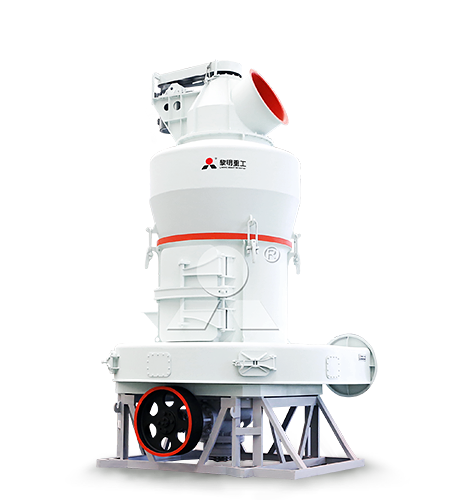
For products requiring conventional limestone powder fineness, a Raymond Mill may be a suitable option to evaluate. The appropriate model depends on the feed characteristics, target particle size, and required output.
Fine Limestone Powder
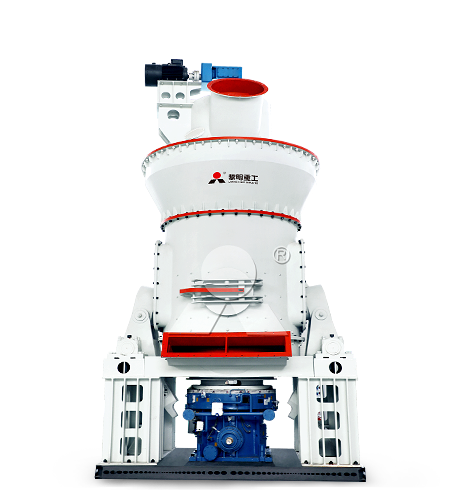
When finer product specifications or higher production demands are involved, the MTW Series Trapezium Mill from Liming Heavy Industry can be considered. Its suitability should be assessed against the raw material properties and the required finished-product distribution.
Higher-Capacity Grinding Systems
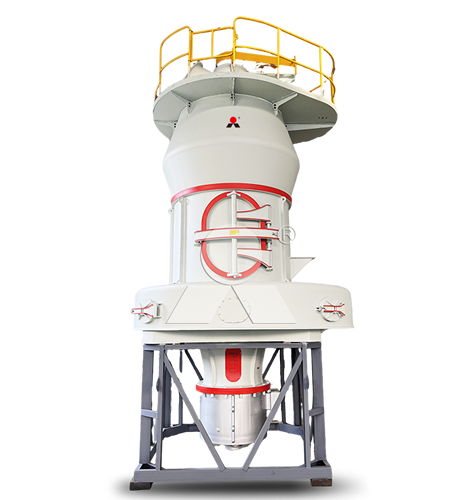
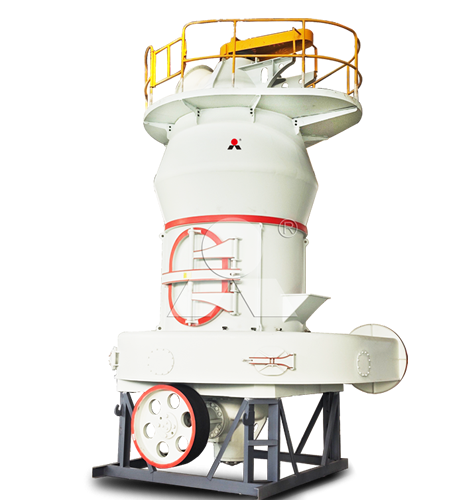
For larger production projects, the LM Vertical Grinding Mill from Liming Heavy Industry may be worth evaluating. The final configuration should be based on the required throughput, feed size, limestone grindability, and target fineness.
For products requiring particularly fine or ultrafine particles, manufacturers should first confirm whether the intended agricultural application justifies the additional processing cost. Equipment designed for conventional powder production should not automatically be assumed to meet ultrafine specifications.
4. Understand the Relationship Between Capacity and Fineness
Grinding capacity is not a fixed value independent of operating conditions. The same mill may produce different amounts of finished powder depending on the raw material and the fineness required.
In general, producing finer powder requires more intensive grinding and classification. As the target particle size decreases, the achievable throughput may also decrease, depending on the equipment and material characteristics.
For preliminary planning, agricultural lime projects using non-metallic minerals can be evaluated within the following production ranges:
60–325 mesh: A minimum target capacity of approximately 2 metric tons per hour.
325–3,250 mesh: A minimum target capacity of approximately 0.5 metric tons per hour, subject to the actual fineness required and suitable equipment configuration.
These are preliminary project targets, not guaranteed capacities for every mill model. The finer end of a range can require specialized equipment, and achievable output must be confirmed against the exact product specification and raw material properties.
When requesting an equipment proposal, specify the required finished-product capacity rather than only the quantity of raw limestone entering the plant. This distinction helps account for classification, material handling, and other process losses where applicable.
5. Compare Energy Consumption and Operating Costs
The purchase price of a grinding mill is only one part of the total investment. Electricity, wear parts, maintenance, dust collection, labor, and downtime also influence the long-term cost of agricultural lime production.
When comparing equipment options, manufacturers should consider:
Specific energy consumption under the required operating conditions.
Expected output at the target finished-product fineness.
Wear-part service life and replacement requirements.
Maintenance accessibility and the availability of spare parts.
Dust collection efficiency and finished-product recovery.
Requirements for crushing, drying, classification, and conveying.
A mill with a lower purchase price may not provide the lowest long-term production cost if its output is insufficient or its maintenance requirements are high. Conversely, investing in a system with more capacity than the market requires may increase capital and operating costs without delivering a meaningful benefit.
6. Choose Between Raymond, MTW, and LM Grinding Mills
Liming Heavy Industry offers several grinding mill series for limestone and other non-metallic mineral processing applications. The appropriate choice depends on the project rather than the equipment name alone.
| Grinding Mill | When to Consider It | Key Selection Factors |
|---|---|---|
| Raymond Mill | Conventional limestone powder production | Required fineness, feed size, and output |
| MTW Series Trapezium Mill | Fine limestone powder production and continuous processing | Particle-size distribution, capacity, and operating conditions |
| LM Vertical Grinding Mill | Projects requiring a higher-capacity grinding system | Raw material grindability, plant layout, and production targets |
This comparison is intended as an initial screening guide. Final selection should be based on the exact model specifications and a technical assessment of the material. If the product requires a particle size outside a mill's suitable operating range, a different grinding technology should be evaluated.
7. Consider the Complete Production Line, Not Just the Mill
A grinding mill operates as part of a larger processing system. Even a suitable mill may fail to achieve its intended production performance if the feeding, classification, conveying, or dust collection equipment is incorrectly sized.
A typical agricultural lime powder production line may include the following components:
Raw material receiving and storage: Provides a reliable supply of limestone to the process.
Primary crushing: Reduces large limestone pieces to a suitable feed size where required.
Feeding system: Controls the material flow entering the grinding mill.
Grinding and classification: Produces powder within the specified particle-size range.
Dust collection: Captures airborne powder and helps reduce material losses.
Conveying and storage: Transfers finished powder to silos, storage facilities, or packaging equipment.
Packaging or bulk loading: Prepares the finished product for transport and distribution.
The actual arrangement depends on the feed size, moisture content, product specifications, and operating requirements. If the raw limestone is already sufficiently small, additional crushing may not be necessary. Similarly, drying should only be included when the material and process conditions justify it.
8. Dust Control and Plant Layout
Agricultural lime powder can generate airborne dust during grinding, classification, conveying, and packaging. Appropriate dust collection helps maintain a cleaner workplace, reduce product loss, and support compliance with applicable environmental requirements.
The plant layout should provide sufficient space for equipment installation, routine inspections, maintenance, and material transfer. Dust collection points should be considered during the initial design rather than added only after operating problems appear.
Finished-product storage also deserves attention. Agricultural lime should be protected from contamination and unsuitable moisture conditions to preserve its handling properties and maintain consistent quality before dispatch.
9. Common Mistakes When Selecting a Grinding Mill
Several avoidable mistakes can lead to excessive investment or disappointing production performance.
Selecting equipment based only on rated capacity: Confirm the achievable output at the actual target fineness and with the specified raw material.
Ignoring raw material variability: Differences in hardness, moisture, and mineral composition can affect grinding performance.
Choosing excessive fineness: The smallest possible particle size is not necessarily the most economical or appropriate for agricultural use.
Overlooking supporting equipment: Feeding, classification, dust collection, and conveying can limit the performance of the complete line.
Failing to define finished-product quality: Mesh size alone may not describe all the chemical and physical properties required by the customer.
Ignoring future operating requirements: Maintenance access, spare parts, available power, and planned production growth should be considered before installation.
10. Information Needed for a Grinding Mill Recommendation
To identify a suitable grinding solution for agricultural lime production, prepare the following project details:
Raw material type and chemical composition.
Maximum feed particle size.
Raw material moisture content.
Required finished-product fineness in mesh or microns.
Target finished-product capacity in metric tons per hour.
Required chemical specifications and applicable agricultural standards.
Available installation space and power supply.
Packaging method and preferred level of automation.
These details provide a more reliable basis for selecting the grinding mill, determining whether additional crushing or drying is required, and planning the supporting equipment.
Developing an Efficient Agricultural Lime Grinding Plant
The right grinding mill is the one that consistently produces agricultural lime powder to the required specification at a suitable operating cost. Selecting equipment requires a balance between particle size, production capacity, raw material characteristics, energy consumption, and the needs of the finished product.
Liming Heavy Industry offers Raymond, MTW, and LM grinding mill solutions for different limestone processing requirements. By evaluating the feed size, moisture content, target fineness, and production capacity, manufacturers can identify a suitable equipment configuration for their agricultural lime project.
If you are planning a new production line or upgrading an existing plant, begin by defining the finished-product specifications and providing representative raw material information. This makes it easier to evaluate the appropriate grinding technology and develop a processing system suited to your actual production needs.
Related Agricultural Lime & Soil Amendment


Meet Liming Heavy Industry at the 140th Canton Fair 2026
2026-10-13

Liming Heavy Industry to Attend the 140th Canton Fair
2026-09-25
Liming Heavy Industry at bauma CONEXPO INDIA 2026 | Booth 5-C6
2026-09-07
Turnkey Raw Mill Cement Plant in Saudi Arabia: Design and Installation
2026-09-03
Cement Raw Mill Supplier in Indonesia: Cost and Configuration Analysis
2026-09-01
Complete Mineral Processing Solutions
Convenient Reliable Professional Efficient Get Your Quote
Please feel free to submit your inquiry information to us. We will contact with you as soon as possible.
Our team will contact you as soon as possible.