


For decades, calcium carbonate (CaCO₃) was widely regarded as a low-value industrial mineral mainly used in cement, plastics, paper, paints, and construction materials. Few people imagined that this common mineral would one day become part of the global new energy revolution.
Today, advanced material engineering is redefining the value of calcium carbonate. Through nano-scale processing, surface modification, and functional material design, calcium carbonate is rapidly transforming from a traditional filler into a high-performance material used across the battery industry.
From lithium-ion batteries and solid-state batteries to energy storage systems and fuel cells, calcium carbonate is now playing an increasingly important role in electrochemical performance, thermal safety, recycling efficiency, insulation systems, and carbon management.
As global battery manufacturers pursue higher energy density, better safety, lower cost, and greener production, calcium carbonate is emerging as one of the most versatile mineral materials in the new energy supply chain.
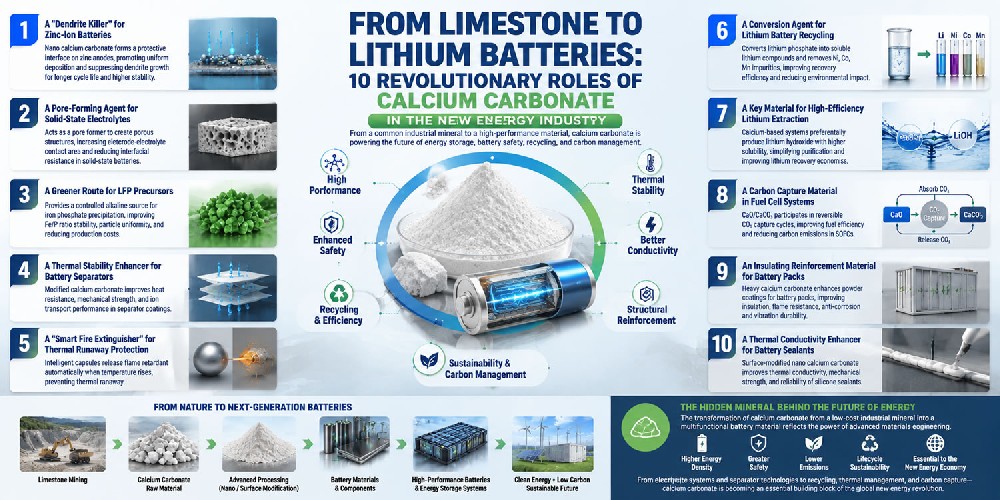
1. A “Dendrite Killer” for Zinc-Ion Batteries
One of the biggest challenges in aqueous zinc-ion batteries is zinc dendrite growth, which can cause internal short circuits and significantly shorten battery life.
Nano calcium carbonate is now being used in organic-inorganic hybrid electrolyte additives that help create a protective interface on zinc anodes. This functional layer promotes uniform zinc deposition, suppresses hydrogen evolution reactions, and reduces dendrite formation.
As a result, batteries can achieve improved Coulombic efficiency, longer cycle life, and enhanced stability, making calcium carbonate highly promising for next-generation low-cost energy storage systems.
2. A Pore-Forming Agent for Solid-State Electrolytes
Solid-state batteries are widely considered the future of high-safety energy storage, but poor solid-solid interface contact remains a major technical challenge.
In porous oxide solid electrolytes, calcium carbonate can function as a controlled pore-forming material. After calcination and removal processes, it leaves behind a highly porous structure that increases electrode-electrolyte contact area and reduces interfacial resistance.
This approach helps improve ionic conductivity, rate performance, and overall battery efficiency, particularly in advanced ceramic-based solid-state battery systems.
3. A Greener Route for Lithium Iron Phosphate (LFP) Precursors
As global demand for lithium iron phosphate batteries continues to grow, manufacturers are actively seeking cleaner and more cost-effective precursor synthesis methods.
Calcium carbonate is increasingly being explored as a controlled alkaline source in iron phosphate precipitation systems. Compared with traditional liquid alkalis or ammonia-based processes, it enables more uniform particle formation, improves Fe/P ratio stability, and reduces side reactions.
The result is higher-quality LFP precursor materials with better electrochemical consistency and lower manufacturing costs.
4. A Thermal Stability Enhancer for Battery Separators
Battery separators must maintain both ionic conductivity and thermal stability under demanding operating conditions.
Modified calcium carbonate particles are now being integrated into separator coating systems to improve heat resistance, mechanical strength, and dimensional stability. Certain modified calcium carbonate structures can also enhance ion transport performance.
This enables a balance between battery safety and high-rate performance, a critical requirement in modern lithium battery design.
5. A “Smart Fire Extinguisher” for Thermal Runaway Protection
Thermal runaway remains one of the most serious safety risks in lithium-ion battery systems.
To address this challenge, researchers are developing intelligent fire-suppression capsules using calcium carbonate-modified polymer shells filled with flame-retardant materials. Under normal operation, the capsule remains stable and does not interfere with electrochemical performance.
Once the battery temperature rises beyond a critical point, the shell melts and releases the flame retardant automatically, helping prevent catastrophic battery failure.
6. A Conversion Agent for Lithium Battery Recycling
Battery recycling is becoming a critical part of the global energy transition, especially for nickel-cobalt-manganese (NCM) batteries.
In lithium recovery systems, calcium carbonate-derived compounds can help convert lithium phosphate into more soluble lithium compounds while simultaneously removing metallic impurities such as nickel, cobalt, and manganese.
This integrated conversion-and-purification approach reduces chemical consumption, improves recovery efficiency, and lowers environmental impact.
7. A Key Material for High-Efficiency Lithium Extraction
Traditional hydrometallurgical lithium recovery processes often face challenges related to impurity separation and water treatment costs.
Calcium-based conversion systems offer an alternative route by preferentially generating lithium hydroxide, a compound with significantly higher solubility than lithium carbonate. This simplifies downstream purification and improves overall lithium recovery economics.
As battery recycling capacity expands worldwide, calcium-based processing technologies are expected to gain increasing importance.
8. A Carbon Capture Material in Fuel Cell Systems
In solid oxide fuel cell systems, calcium oxide and calcium carbonate can participate in reversible carbon capture cycles.
By absorbing CO₂ generated during fuel reforming and releasing it under controlled conditions, these materials help improve system thermal balance, enhance fuel efficiency, and reduce carbon emissions.
This technology represents a promising intersection between energy storage and carbon management.
9. An Insulating Reinforcement Material for Battery Packs
Battery pack protection requires coatings with strong insulation, flame resistance, anti-corrosion properties, and vibration durability.
Heavy calcium carbonate is increasingly being used in powder coating systems for battery modules and energy storage enclosures. As a reinforcing filler, it improves coating stability while helping maintain electrical insulation and long-term structural reliability.
This application is especially important in electric vehicles and large-scale energy storage systems operating under harsh environmental conditions.
10. A Thermal Conductivity Enhancer for Battery Sealants
Modern EV battery packs require advanced thermal management and highly reliable sealing systems.
Surface-modified nano calcium carbonate is now being incorporated into thermally conductive silicone sealants to improve mechanical strength, heat dissipation, curing performance, and dimensional stability.
These materials help battery systems withstand vibration, temperature fluctuations, and demanding operating environments while maintaining excellent bonding performance.
Conclusion: The Hidden Mineral Behind the Future of Energy
The transformation of calcium carbonate from a low-cost industrial mineral into a multifunctional battery material reflects a broader trend in advanced materials engineering: turning abundant natural resources into high-value technological solutions.
As the global battery industry moves toward higher energy density, greater safety, lower emissions, and full lifecycle sustainability, calcium carbonate is proving to be far more than a simple filler.
From electrolyte systems and separator technologies to recycling, thermal management, and carbon capture, this once-overlooked mineral is quietly becoming an essential building block of the global new energy economy.
In the future, the journey from “stone” to “battery cell” may become one of the most remarkable stories in modern material science.
Related Industry News


Liming Heavy Industry to Attend the 140th Canton Fair
2026-09-25

Liming Heavy Industry at bauma CONEXPO INDIA 2026 | Booth 5-C6
2026-09-07
Turnkey Raw Mill Cement Plant in Saudi Arabia: Design and Installation
2026-09-03
Cement Raw Mill Supplier in Indonesia: Cost and Configuration Analysis
2026-09-01
Liming Heavy Industry to Exhibit at the 24th Global Gypsum Conference & Exhibition in Turkey
2026-08-31
Complete Mineral Processing Solutions
Convenient Reliable Professional Efficient Get Your Quote
Please feel free to submit your inquiry information to us. We will contact with you as soon as possible.
Our team will contact you as soon as possible.