


Hematite powder processing prepares high-density iron oxide for use as a weighting material in drilling and completion fluids. Compared with barite, hematite has a higher specific gravity, so it can increase drilling-fluid density with a lower solids volume in demanding high-pressure applications.
A successful hematite powder line must control more than fineness. The raw ore must have sufficient iron oxide content and density, while the finished powder requires stable particle-size distribution, low moisture, controlled soluble impurities, and reliable batch consistency. Grinding cannot increase the inherent density of hematite, so ore selection and beneficiation should be confirmed before the fine-grinding plant is designed.
Why Hematite Is Used in Drilling Fluids
Hematite is primarily iron oxide, Fe2O3. It is used when drilling fluids require higher density than can be efficiently achieved with conventional barite or when the fluid program aims to limit solids volume. Its high specific gravity allows mud engineers to raise fluid weight while adding less mineral volume than a lower-density weighting material.
High-density hematite products are particularly relevant in deep, high-pressure, and high-temperature wells, as well as selected oil-based, synthetic-based, water-based, completion, and workover-fluid systems. SLB states that its FER-OX hematite weighting agent has a specific gravity of 5.0 or above and can be used to increase the density of drilling and completion fluids to 25 lbm/galUS, or 3.0 specific gravity.
| Characteristic | Hematite Powder | Importance in Drilling Operations |
|---|---|---|
| Primary composition | Iron oxide, Fe2O3 | High iron oxide content supports stable density and suitable weighting performance. |
| Specific gravity | Typically about 4.7–5.0 or higher, depending on grade | Enables high mud weights with a lower solids volume than barite-based systems. |
| Physical form | Red-brown to black, dense mineral powder | Must remain free-flowing for controlled mixing and bulk handling. |
| Particle-size distribution | Micronized and closely controlled | Influences suspension, settling tendency, rheology, abrasion, and mixing performance. |
| Impurity level | Low soluble salts and limited unwanted gangue minerals | Supports compatibility with drilling-fluid systems and reduces variation between batches. |
Hematite may be used alone or in a carefully engineered fluid formulation. However, if the well plan requires hematite from the beginning, the weighting strategy should be designed early because the particle-size distribution, density, solids loading, and rheological behavior differ from a conventional barite-based fluid system. Some hematite suppliers specifically advise avoiding the late addition of hematite into an established barite-weighted system when minimizing total solids is the objective.
Typical Hematite Quality Targets
API Specification 13A covers physical properties and test procedures for drilling-fluid materials, including hematite. The exact product specification should be confirmed with the end user and the applicable edition of the standard, but commonly published drilling-grade hematite data show the importance of high density and controlled coarse and ultrafine fractions.
Typical drilling-grade hematite products are commonly specified with a specific gravity around 5.0 or higher, although some market grades are supplied at 4.7 or above depending on ore source and product requirement. Published examples also use tight wet-screen limits, such as a maximum 1.5% retained above 75 μm, a maximum 15% retained above 45 μm, and a maximum 15% below 6 μm.
| Quality Parameter | Typical Control Target | Processing Significance |
|---|---|---|
| Specific gravity | Commonly 4.7–5.0 or higher, depending on product grade | Confirms the weighting efficiency of the raw ore and finished powder. |
| Iron oxide content | High Fe2O3 content; some commercial grades specify 95% or more | Helps reduce lower-density gangue minerals and supports stable powder quality. |
| Residue above 75 μm | Closely controlled; published products may target 1.5–2.0% maximum | Limits oversize particles that may settle and create inconsistent fluid properties. |
| Residue above 45 μm | Closely controlled; published products may target 12–15% maximum | Provides an additional control point for the upper end of the particle-size distribution. |
| Particles below 6 μm | Controlled; published products may target 15% maximum | Prevents excessive ultrafines that can increase viscosity and fluid-treatment demand. |
| Water-soluble components | Maintained at a low level | Supports predictable compatibility with drilling-fluid chemistry. |
| Moisture | Low and stable; some commercial products specify 1% maximum | Supports free-flowing storage, accurate dosing, efficient mixing, and dry bulk loading. |
A commercial hematite drilling-grade data sheet, for example, lists Fe2O3 content of at least 95%, specific gravity of at least 4.70, 98% passing 75 μm, 85% passing 45 μm, moisture of no more than 1%, and water-soluble solids of no more than 0.05%. These values illustrate the level of particle-size and moisture control required in a practical hematite powder plant.
From Ore to Weighting Powder
Hematite processing often requires stronger attention to ore upgrading and wear protection than ordinary non-metallic mineral grinding. The ore may contain quartz, clay, magnetite, limonite, carbonate minerals, or other gangue. If these materials reduce density or introduce excessive contamination, the raw feed may need beneficiation before fine grinding.
Ore receiving and laboratory evaluation. Representative hematite samples should be tested for iron oxide content, specific gravity, moisture, silica, sulfur, phosphorus, soluble salts, hardness, abrasiveness, and particle-size distribution. These results determine whether the ore can be processed directly or requires washing, magnetic separation, gravity separation, screening, or other upgrading steps.
Crushing and screening. Large hematite ore is reduced to a stable feed size for the grinding mill. Crushing should be designed to produce consistent material rather than excessive fines. Oversized feed can disturb mill loading, increase wear, and make the final particle-size distribution more difficult to control.
Drying. If feed moisture is high, drying may be required before or during grinding. Dry material flows more reliably through hoppers, elevators, feeders, classifiers, filters, and finished-product silos. Moisture control is especially important because hematite powder is dense and can compact in storage when water content is excessive.
Fine grinding and air classification. The prepared hematite is ground into drilling-fluid powder. An air classifier separates qualified material from oversize particles. Coarse particles return to the grinding zone, while finished powder moves to the collection system.
Dust collection and product storage. The process air carries fine hematite powder to a high-efficiency dust collector. The collected product is transferred to sealed storage silos before bulk loading or bagging. Enclosed handling helps prevent dust loss, moisture pickup, and cross-contamination with other mineral products.
Final inspection. Finished hematite powder should be tested for specific gravity, Fe2O3 content, particle-size distribution, screen residue, moisture, and soluble components. Batch records and retained samples should connect the finished shipment with the raw-material source and production conditions.
LM Vertical Roller Mill for High-Capacity Processing
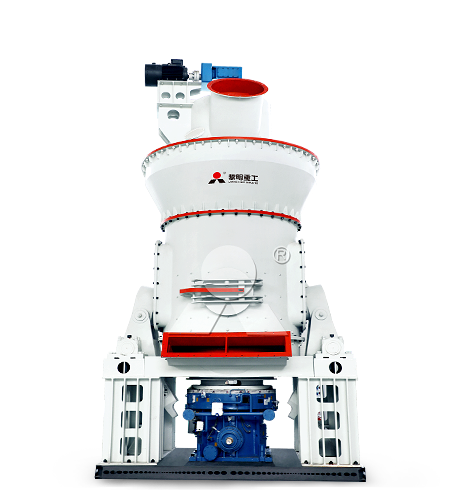
The LM Vertical Roller Mill is suitable for large-scale hematite powder projects requiring continuous production, integrated drying, centralized control, and a compact process layout. It can combine grinding, drying, classification, and pneumatic conveying in one main system, reducing intermediate material transfers and supporting a stable high-capacity process flow.
Prepared hematite feed enters the mill and falls onto the grinding table. Rollers apply pressure to grind the material, while airflow carries the ground powder toward the internal classifier. Qualified fine powder moves to the dust-collection system, and coarse particles return to the grinding table for additional size reduction.
For hematite, the wear condition of grinding rollers, table liners, separators, and conveying components must be monitored closely. Iron oxide ore can be abrasive, especially when it contains quartz or other hard gangue minerals. The final equipment configuration should therefore include suitable wear-resistant materials and a maintenance plan based on the actual abrasiveness of the feed.
The LM Vertical Roller Mill is particularly appropriate for projects requiring high throughput of micronized hematite, integrated control of feed moisture, and stable classification performance. The classifier should be adjusted according to verified laboratory data so that the plant controls both coarse residue and excessive ultrafine generation.
MTW European Grinding Mill for Flexible Production
The MTW European Grinding Mill is suitable for hematite powder projects with moderate output requirements or a need for flexible production scheduling. It uses a roller-and-ring grinding structure with an air-classification circuit. Prepared material is fed evenly into the mill, ground between rollers and the grinding ring, lifted by airflow, and separated into qualified powder and coarse material for regrinding.
For a hematite line, the MTW European Grinding Mill can be combined with crushing equipment, a controlled feeder, hot-air drying where necessary, a classifier, pulse dust collector, finished-product silo, and packing or bulk-loading equipment. This arrangement provides a practical route for producing controlled hematite powder for drilling-fluid applications.
| Selection Factor | LM Vertical Roller Mill | MTW European Grinding Mill |
|---|---|---|
| Suitable production scale | Large, continuous hematite powder production. | Flexible small-to-medium capacity production. |
| Core process arrangement | Integrated grinding, drying, classification, and pneumatic conveying. | Roller-and-ring grinding with air classification and downstream powder collection. |
| Feed moisture conditions | Suitable for projects requiring drying during the milling process. | Suitable for prepared dry feed; a hot-air system can be configured when needed. |
| Plant layout | Compact integrated arrangement for centralized high-output operations. | Practical arrangement for regional supply, staged expansion, and controlled output planning. |
| Main technical focus | Mill loading, thermal balance, classifier performance, and abrasion-resistant design. | Stable feeding, roller-and-ring wear, airflow control, and separator adjustment. |
The selection between the two mills should be based on actual feed size, moisture, hardness, abrasiveness, target particle-size distribution, required hourly output, installation space, and delivery format. A laboratory grinding test using representative hematite ore provides the best basis for final configuration.
Controlling Wear, Fineness, and Density
Hematite production requires close coordination between grinding efficiency and product quality. If the material is insufficiently ground, the finished powder may contain too much coarse fraction. Coarse hematite particles can settle more rapidly, create uneven mud density, and increase the difficulty of maintaining stable drilling-fluid rheology.
If grinding is too aggressive, the line may generate excessive ultrafine material. Very fine particles have a larger surface area and may increase fluid viscosity, alter gel strength, or require additional chemical treatment. The best operating point is therefore a balanced particle-size distribution rather than the maximum possible fineness.
Control feed quality: Separate hematite ore by density and iron oxide grade before blending or grinding.
Limit silica-bearing gangue: Quartz and other hard impurities can reduce product density and accelerate wear in the grinding circuit.
Maintain uniform feed size: Stable crusher discharge supports steady mill loading and consistent powder fineness.
Monitor moisture: Use appropriate drying capacity to prevent buildup, poor classification, and storage problems.
Inspect wear parts: Check rollers, grinding rings or tables, classifier components, ducts, and conveying equipment according to a planned schedule.
Control the classifier: Use particle-size test results to adjust airflow and separation conditions rather than relying on nominal mesh values alone.
Test every batch: Verify density, iron oxide content, moisture, coarse residue, and fine-particle content before product release.
Protect the finished powder: Use enclosed conveying, dry storage, and clearly identified silos to prevent moisture pickup and cross-contamination.
Hematite is a valuable drilling-fluid weighting mineral where high density and solids-volume control are required. With suitable ore selection, impurity removal, controlled grinding, efficient classification, and rigorous laboratory testing, an LM Vertical Roller Mill or MTW European Grinding Mill line can produce consistent hematite powder for drilling and completion-fluid applications.
The final plant design should always be based on representative ore analysis and finished-product testing. This ensures that the selected process delivers the required density and particle-size distribution under real production conditions, not only under nominal mill-capacity conditions.
Related Oil & Gas Mineral Processing


Liming Heavy Industry at bauma CONEXPO INDIA 2026 | Booth 5-C6
2026-09-07

Turnkey Raw Mill Cement Plant in Saudi Arabia: Design and Installation
2026-09-03
Cement Raw Mill Supplier in Indonesia: Cost and Configuration Analysis
2026-09-01
Liming Heavy Industry to Exhibit at the 24th Global Gypsum Conference & Exhibition in Turkey
2026-08-31
Complete Calcium Carbonate Grinding and Coating Plant Solution
2026-08-29
Complete Mineral Processing Solutions
Convenient Reliable Professional Efficient Get Your Quote
Please feel free to submit your inquiry information to us. We will contact with you as soon as possible.
Our team will contact you as soon as possible.