


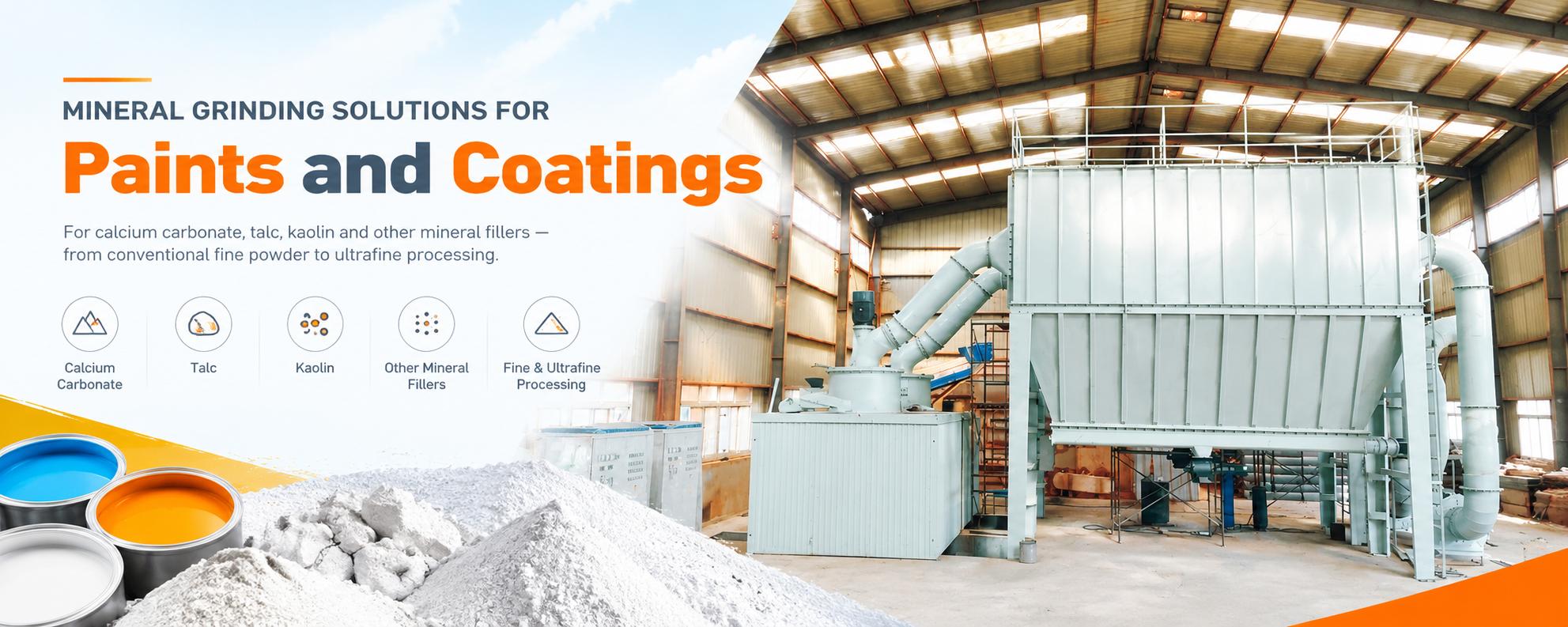
Selecting a kaolin grinding mill starts with a question that equipment specifications alone cannot answer: what must the powder do in the finished paint? A kaolin used in a smooth semi-gloss coating has different requirements from one intended to improve dry hiding in a matte wall paint. The correct processing route depends on the mineral grade, its condition before grinding, and the properties required after dispersion.
For coating-grade kaolin, successful production means more than achieving a nominal mesh size. The line must control coarse particles, maintain color consistency, and produce powder that disperses predictably without excessive viscosity or visible film defects.
First Decision: Hydrous Kaolin or Calcined Kaolin?
Hydrous and calcined kaolin are not interchangeable products, and grinding alone cannot convert one into the other. Hydrous kaolin retains the mineral's chemically bound hydroxyl groups. Calcined kaolin has undergone controlled thermal treatment that changes its structure and coating behavior. Removing ordinary feed moisture in a grinding system is not the same as calcination.
In coating formulations, fine hydrous kaolin can help separate titanium dioxide particles and support their optical efficiency. Selected grades are used in gloss and semi-gloss paints where limited disruption of surface smoothness is important. Calcined kaolin is commonly used in matte and eggshell coatings, where its engineered structure can contribute to dry hiding and gloss control. The actual result depends on grade selection and formulation.
| Product route | Processing priority | Important coating checks |
|---|---|---|
| Hydrous kaolin powder | Prepare or finish a suitably purified mineral while controlling particle size, residue, and agglomeration | Dispersion, viscosity, sheen, surface smoothness, and pigment compatibility |
| Calcined kaolin powder | Coordinate feed preparation, controlled calcination, and any required post-calcination finishing | Dry hiding, sheen, oil absorption, dispersion, and film properties |
| Purchased kaolin requiring final milling | Determine whether the task is genuine particle-size reduction, deagglomeration, or removal of an unacceptable coarse fraction | Whether finishing improves the paint without damaging useful product characteristics |
This distinction should be settled before requesting equipment. A line intended to grind raw kaolin ore is not necessarily suitable for finishing an already purified, fine coating pigment.
What a Grinding Mill Can—and Cannot—Correct
A mill can reduce particle size and, when paired with a suitable classifier, control the finished distribution. It cannot reliably remove iron-bearing discoloration, separate every quartz particle, or make a low-purity deposit equivalent to a beneficiated coating grade.
If the feed contains unacceptable impurities, beneficiation may be necessary before final grinding. Depending on the ore, this can involve washing, screening, separation, or other treatment established through mineral testing. These operations should not be replaced by more intensive milling.
Before designing the line, examine:
Mineral composition, including kaolinite content and associated minerals.
Quartz and other abrasive components that may affect wear and coarse residue.
Iron- and titanium-bearing impurities that may influence color.
Incoming particle-size distribution and the presence of soft agglomerates.
Moisture content and its expected variation.
Powder brightness, whiteness, and color undertone under agreed test methods.
Brightness and whiteness should not be treated as identical measurements. Supplier and customer need to agree on the test method and acceptance limits, particularly for white and pastel coatings.
Define the Product Before Defining the Machine
The most useful equipment brief is built around an approved powder sample or a measurable specification. A request for “ultrafine kaolin” leaves too much uncertainty about both performance and capacity.
Specify the full particle-size requirement
The particle-size distribution describes more than the median size. D50 identifies the midpoint of the reported distribution, while D97 helps characterize its coarse end. Neither value alone guarantees the absence of isolated oversize particles.
Include an agreed coarse-residue test where surface defects are a concern. This is especially important for thin or smooth coatings, in which a small quantity of hard particles can matter more than a modest change in the median size.
Also specify the measurement procedure. Kaolin results can change with sample dispersion conditions, and a poorly dispersed agglomerate may be measured as a coarse particle. Use consistent preparation methods when comparing feed, trial powder, and production batches.
Include properties that influence formulation behavior
Two kaolin powders with similar particle-size results may have different oil absorption, particle morphology, or surface characteristics. These differences can affect wetting, dispersant demand, and coating viscosity.
A useful specification therefore combines particle measurements with moisture, color, oil absorption, and application testing. For sensitive formulations, slurry pH and conductivity may also be relevant and should be agreed with the customer.
Matching Liming Heavy Industry Equipment to the Grinding Duty
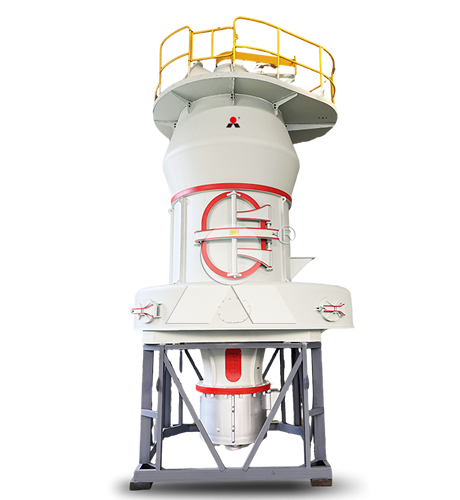
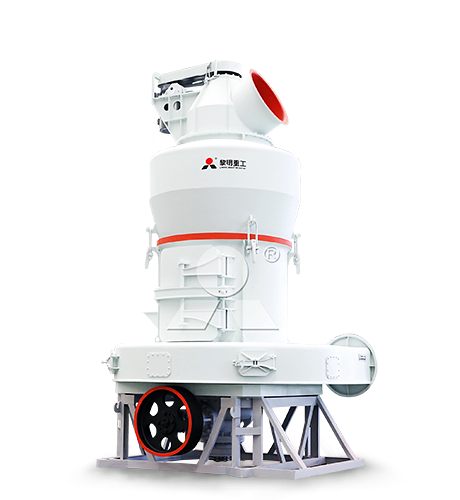
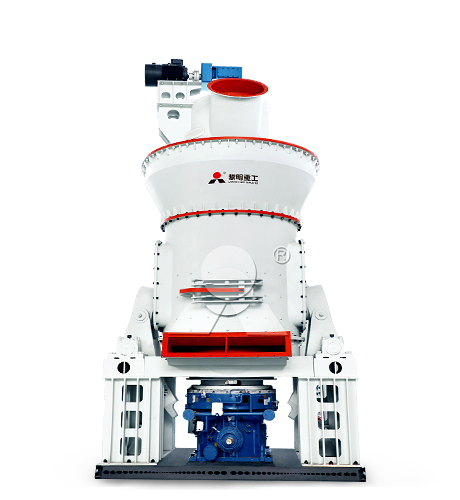
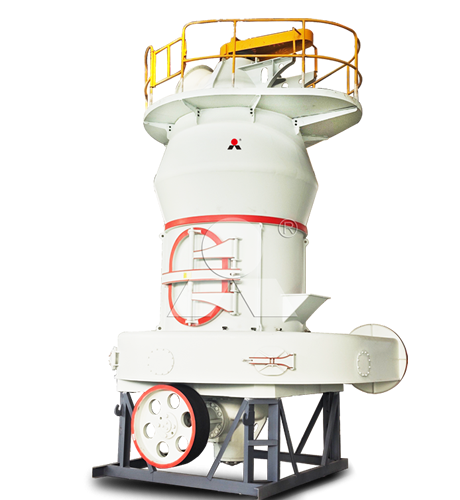
Liming Heavy Industry offers MTW European Grinding Mill, LM Vertical Mill, and MW Micro Powder Mill options for kaolin processing. These systems should be evaluated according to the actual feed and finished-product requirements rather than treated as interchangeable routes to every coating grade.
MTW European Grinding Mill: assess for appropriate fine-grinding duties
The MTW European Grinding Mill is a candidate when the required product falls within its verified operating range and the project does not demand a specialty ultrafine pigment beyond that range.
For a coating application, confirm both the main particle population and coarse residue through testing. A satisfactory mesh description is not enough to establish suitability for a smooth paint film.
LM Vertical Mill: assess where drying and throughput are important
The LM Vertical Mill is worth evaluating when the project requires a coordinated drying, grinding, and classification arrangement. Feed moisture, drying duty, and required saleable output must be considered together.
For hydrous kaolin, distinguish free-moisture removal from structural thermal treatment. Specify appropriate operating conditions for the intended product, and do not assume that drying in the mill produces calcined kaolin.
MW Micro Powder Mill: assess for finer dry-powder targets
The MW Micro Powder Mill is an option to investigate when a finer dry kaolin product is required. Testing should establish whether the proposed configuration can achieve the target distribution and coarse-residue limit at a commercially useful output.
Where the target is a specialty pigment with very fine primary particles or tightly controlled morphology, confirm that dry milling is the appropriate route. A dry grinding system should not be assumed to reproduce the properties of a wet-processed or delaminated grade.
Three Feed Conditions, Three Different Line Designs
Dry, beneficiated kaolin
This feed may require controlled feeding, grinding or deagglomeration, classification, collection, and packaging. Establish whether existing particles need further size reduction or whether the main problem is clusters formed during drying and storage.
If deagglomeration is the real task, excessive grinding may add energy consumption without producing a better coating pigment.
Moist kaolin or filter cake
A wet feed changes the project substantially. Determine whether preliminary drying, feed conditioning, or another preparation stage is necessary before the selected mill can operate reliably.
Calculate the drying requirement from representative moisture data and the required production rate. A capacity estimate based only on dry mineral mass can overlook the thermal and airflow demands of moisture removal.
Calcined kaolin requiring finishing
Calcination can produce agglomerated material that requires subsequent finishing. The task is to achieve usable dispersion and residue control without unnecessarily altering the structure responsible for the pigment's intended performance.
Assess finished samples in the actual coating. A finer laboratory result does not, by itself, demonstrate improved dry hiding or lower formulation demand.
Commissioning: Prove the Powder, Not Just the Running Equipment
A stable mill is only part of a successful startup. Commissioning should demonstrate that the complete line produces acceptable powder repeatedly under normal operating conditions.
Establish a reference sample and agreed laboratory methods before the trial.
Run representative feed long enough to reach stable grinding and classification conditions.
Take timed samples to evaluate variation rather than relying on one favorable result.
Measure particle-size distribution, coarse residue, moisture, color, and other critical properties.
Prepare coating samples using a controlled mixing procedure and consistent formulation.
Confirm sustained saleable output, operating consumption, and repeatability before final acceptance.
Keep retained powder and coating samples from the approved run. These provide a practical reference when investigating later changes in ore supply, operating settings, or customer performance.
Questions That Often Decide the Final Configuration
Will finer kaolin always improve hiding?
No. Hiding depends on the complete pigment and binder system, not simply kaolin fineness. Hydrous and calcined grades contribute differently, and changing the distribution can also affect viscosity, particle packing, and sheen. Compare dry-film performance at controlled application thickness.
Can additional grinding solve poor dispersion?
Sometimes particle reduction helps, but poor dispersion may instead result from unsuitable wetting, dispersant selection, addition sequence, or mixing conditions. First distinguish hard oversize particles from soft agglomerates. The correct remedy may be in the coating process rather than the grinding line.
Can one line produce several grades?
Potentially, but each grade must be verified at its required output. Include classifier adjustment, stabilization time, cleaning, transition material, and separate storage in the production plan. A broad adjustable fineness range does not guarantee equally efficient operation at every target.
Prepare a Project Brief That Leads to a Usable Powder
Provide Liming Heavy Industry with a representative kaolin sample, its processing history, feed moisture range, required hourly output, target particle-size distribution, coarse-residue limit, and intended paint applications. State clearly whether the feed is raw, beneficiated, hydrous, or calcined.
Where possible, include an approved reference powder and its coating-test results. This allows the proposed grinding line to be evaluated against a defined product—not just a nominal fineness—and helps connect equipment performance with the requirements of the paint manufacturer.
Related Mineral Grinding for Paints & Coatings


LIMING at MiningMetals Uzbekistan 2026 | Booth B94
2026-10-22

LIMING Heavy Industry at MINEXPO Africa 2026 | Booth 133
2026-10-22
Liming Heavy Industry to Exhibit at bauma CHINA 2026 – Visit Us at Booth E6.510
2026-10-15
Meet Liming Heavy Industry at the 140th Canton Fair 2026
2026-10-13
Liming Heavy Industry to Attend the 140th Canton Fair
2026-09-25
Complete Mineral Processing Solutions
Convenient Reliable Professional Efficient Get Your Quote
Please feel free to submit your inquiry information to us. We will contact with you as soon as possible.
Our team will contact you as soon as possible.