


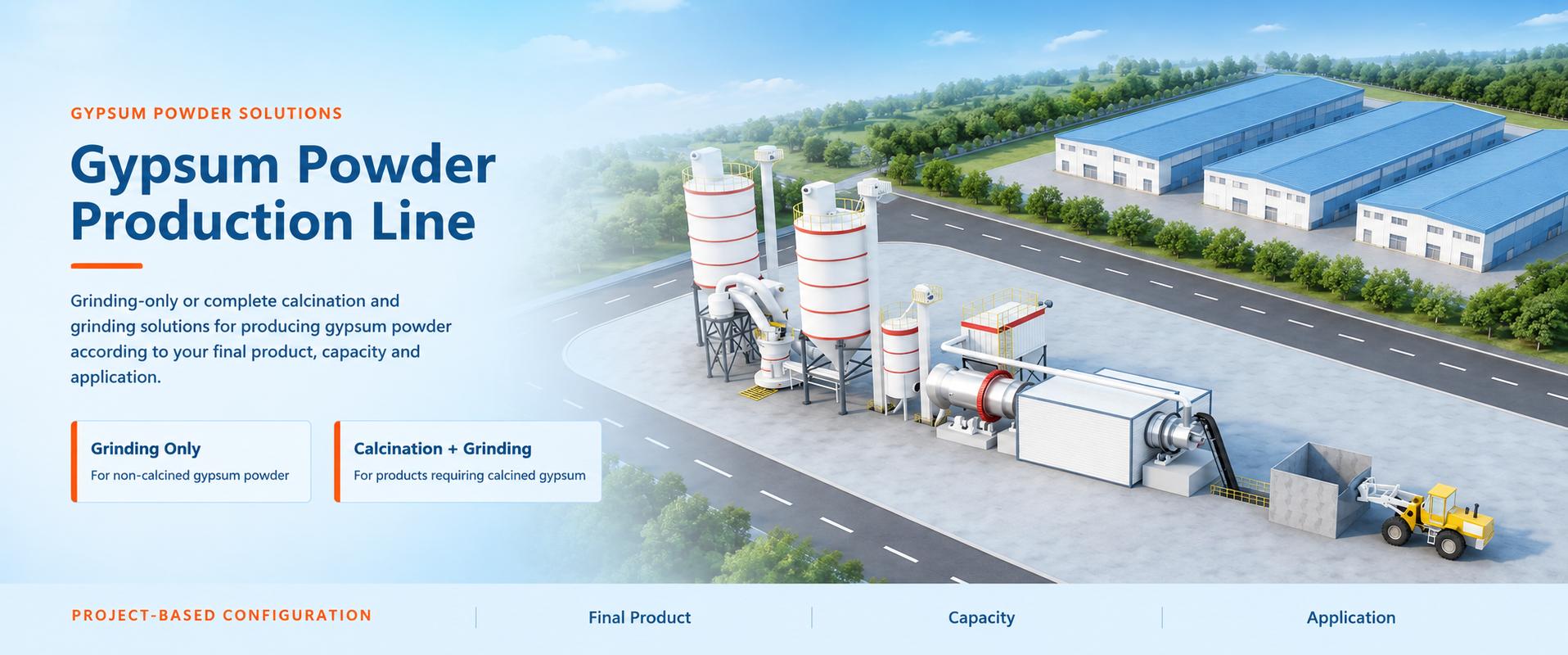
A 500 TPD gypsum powder production line is a large-scale processing system designed for continuous material flow from raw gypsum receiving to finished powder storage and packing. The process can be configured as a grinding-only line for natural gypsum powder or as a complete calcination and grinding line for construction gypsum, gypsum plaster, Plaster of Paris, gypsum board materials and other calcined gypsum products.
At 500 TPD, the plant should be designed as an integrated system rather than a group of independent machines. Raw material storage, crushing, calcination when required, cooling, grinding, classification, dust collection, conveying, product silos and packing equipment must be coordinated so that no section limits the overall output.
What a 500 TPD Plant Requires
500 TPD means a nominal finished gypsum powder output of 500 tonnes per day. The required hourly production rate depends on the operating schedule. A plant operating continuously has a lower average hourly requirement than a plant producing the same daily output in fewer hours.
| Planned Operating Time | Average Finished Powder Rate for 500 TPD |
|---|---|
| 12 hours per day | Approximately 41.7 tonnes per hour |
| 16 hours per day | 31.25 tonnes per hour |
| 20 hours per day | 25 tonnes per hour |
| 22 hours per day | Approximately 22.7 tonnes per hour |
| 24 hours per day | Approximately 20.8 tonnes per hour |
These figures indicate the average finished-product rate. Actual equipment capacity should account for material properties, product fineness, maintenance periods, planned production flexibility, raw material variation, storage capacity and any change in daily operating hours.
Process Route Selection
The main process route depends on the final gypsum powder product. The first decision is whether the material requires calcination before grinding.
| Production Line Type | Typical Process Route | Suitable Product Direction |
|---|---|---|
| 500 TPD Grinding-Only Line | Raw Gypsum → Crushing → Storage → Grinding → Classification → Dust Collection → Finished Powder Storage → Packing | Ground natural gypsum powder and non-calcined gypsum materials |
| 500 TPD Calcination and Grinding Line | Raw Gypsum → Crushing → Calcination → Cooling or Storage → Grinding → Classification → Dust Collection → Finished Powder Storage → Packing | Construction gypsum, gypsum plaster, Plaster of Paris, gypsum board powder and related calcined gypsum products |
A grinding-only line reduces natural gypsum to the required particle size. A calcination and grinding line first converts raw gypsum into calcined gypsum through controlled thermal processing, then grinds and classifies the material into finished powder.
Large-Scale Process Flow
A typical 500 TPD gypsum powder production line includes the following stages:
Raw gypsum receiving and stockpile management
Raw material feeding and pre-screening where required
Crushing and feed-size reduction
Crushed gypsum conveying and buffer storage
Controlled calcination when the final product requires calcined gypsum
Cooling, enclosed conveying and intermediate storage
Continuous grinding to the required fineness
Classification and return of coarse material
Dust collection and air-system control
Finished powder conveying and silo storage
High-capacity bagging, bulk loading or direct downstream feeding
At this scale, storage between process sections is essential. Raw material storage protects the plant from delivery variation. Crushed-material storage stabilizes the feed to calcination or grinding. Intermediate storage after calcination helps maintain steady mill feeding. Finished powder silos separate production from packing and dispatch.
Raw Gypsum Receiving and Storage Design
A 500 TPD line requires reliable raw gypsum supply and a receiving system capable of handling the planned daily material volume. Raw gypsum can be natural gypsum rock, industrial gypsum or another gypsum-bearing feed. The material should be evaluated for lump size, moisture, impurity level, flow behavior and storage condition.
At a large production scale, raw material receiving should be designed to prevent interruptions. The receiving hopper, storage area, loader arrangement, feeder and conveyor system must handle the required material flow without creating a bottleneck before the crusher.
Raw Material Conditions to Confirm
Source and type of gypsum raw material.
Maximum lump size and particle-size distribution.
Free moisture level and seasonal material variation.
Gypsum composition and impurity condition.
Presence of clay, soil, metal and other foreign materials.
Required final product: natural gypsum powder or calcined gypsum powder.
Required finished powder fineness.
Planned operating hours and annual production schedule.
Required finished-powder storage and dispatch method.
Crushing and Feed Preparation
The crushing section prepares raw gypsum for calcination or grinding. It should reduce large gypsum lumps to a feed size compatible with the next process stage. At 500 TPD, the crushing section should be designed for continuous material supply, stable discharge size and reliable operation under varying raw material conditions.
A typical arrangement includes receiving equipment, a controlled feeder, crusher, magnetic separator, screen where required, conveyors and crushed-material storage. The crushing capacity should support the required downstream rate and provide sufficient margin for short-term feed variation.
| Crushing Section Equipment | Function in a 500 TPD Plant |
|---|---|
| Receiving hopper | Accepts incoming raw gypsum and directs it to the controlled feeder. |
| Feeding equipment | Provides stable material flow to the crusher. |
| Crusher | Reduces gypsum lumps to the required downstream feed size. |
| Magnetic separator | Removes metal fragments before they reach calcination or grinding equipment. |
| Screening equipment | Controls particle size and returns oversized material where required. |
| Conveyor system | Transfers crushed gypsum continuously to storage or the next process section. |
| Crushed-material silo or bin | Buffers feed between crushing and calcination or grinding. |
Calcination System Design
Calcination is included when the final product requires calcined gypsum. Natural gypsum is mainly calcium sulfate dihydrate, CaSO4·2H2O. Controlled heating removes part of the chemically combined water and produces calcined gypsum, commonly including calcium sulfate hemihydrate, CaSO4·½H2O.
For a 500 TPD calcination and grinding plant, the thermal section must provide stable continuous material conversion. The calcination capacity, kiln feed system, dust collection system, cooling equipment and downstream grinding capacity should be designed as one coordinated arrangement.
At this production scale, instability in the calcination section can affect the whole plant. Variations in raw material feed, moisture, particle size, thermal condition or kiln discharge may lead to unstable mill feeding and fluctuations in finished powder condition.
Rotary Kiln Arrangement
A rotary kiln can be used for continuous gypsum calcination in a large-scale plant. The kiln is a rotating cylindrical shell installed with a slight slope. Prepared gypsum enters at the feed end and moves gradually toward the discharge end while receiving controlled heat.
The rotation of the kiln lifts and turns the material, while the kiln inclination supports movement through the thermal zone. Feed rate, kiln rotation, material size, moisture content, thermal condition and residence time all influence calcination stability.
At the kiln discharge end, calcined gypsum is transferred through cooling, conveying and storage equipment before entering the grinding system. The connection between kiln discharge and mill feed should be designed to reduce short-term fluctuations and maintain continuous material flow.
Calcination Control Requirements
| Control Requirement | Why It Matters in a 500 TPD Line |
|---|---|
| Stable feed rate | Maintains a more consistent thermal load and material residence time. |
| Uniform feed size | Supports even thermal exposure across the gypsum material. |
| Controlled raw material moisture | Reduces changes in thermal demand and material flow behavior. |
| Consistent thermal condition | Supports stable conversion from raw gypsum to calcined gypsum. |
| Reliable discharge flow | Provides steady feed for cooling, storage and grinding. |
| Dust collection and gas handling | Supports process airflow and fine-particle recovery. |
| Intermediate storage level | Buffers material flow between calcination and grinding. |
Cooling, Conveying and Intermediate Storage
After calcination, gypsum should be transferred to the grinding system under controlled conditions. The material may pass through cooling equipment, enclosed conveyors, elevators and storage bins before mill feeding. This section is especially important in a 500 TPD line because the upstream and downstream processes both operate at significant material flow rates.
Intermediate storage provides a buffer between the thermal section and the grinding section. It helps maintain consistent mill feed during short-term changes in kiln discharge or during downstream operating adjustments. The storage bin should be designed for the flow characteristics of calcined gypsum and should provide reliable discharge without material buildup.
Conveyors and transfer points should be enclosed where practical. Good sealing helps reduce dust escape and prevents unwanted air from entering the process. Stable material handling supports stable grinding and classification.
Grinding Equipment for Large-Scale Production
Grinding equipment for a 500 TPD gypsum powder line should be selected according to hourly output, target fineness, feed material condition, final application and continuous operating requirement. The grinding system should be capable of working with upstream storage, classifier circuits, dust collection and finished-powder conveying without creating a capacity bottleneck.
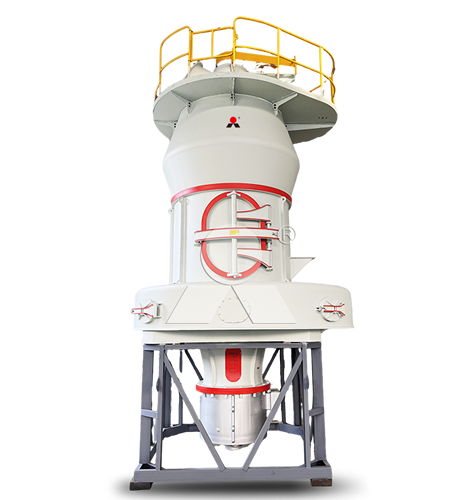
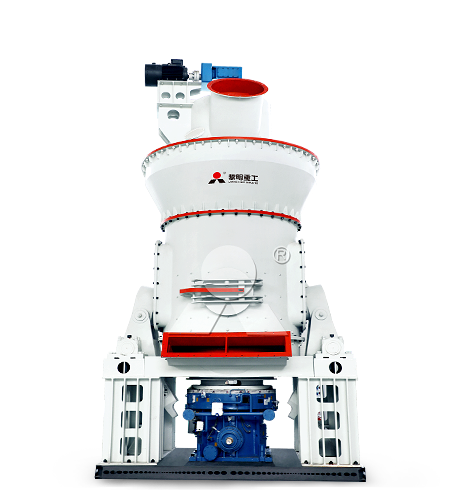
LM Vertical Grinding Mill
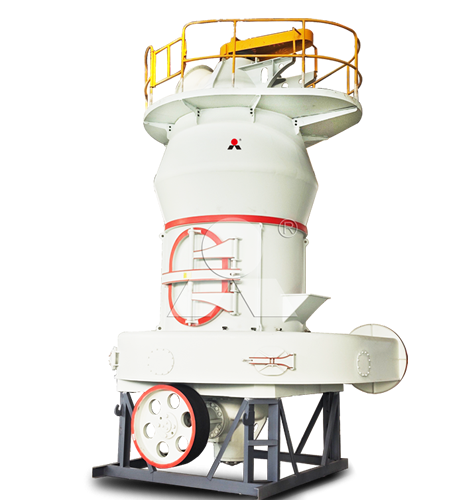
An LM vertical grinding mill can be considered for large-scale gypsum powder production requiring stable continuous operation. It is suitable for integrated systems where material feeding, grinding, classification, air handling, dust collection and powder transport operate together.
For a 500 TPD line, the LM vertical grinding mill can be connected to a stable supply of crushed natural gypsum or calcined gypsum from intermediate storage. The mill feed system, classifier, air circuit, dust collector and finished-product handling equipment should be sized around the required hourly output.
MTW European Grinding Mill
An MTW European grinding mill can be used for conventional industrial gypsum powder processing with a broad range of fineness requirements. In a large plant, it may be used where the required total output is supported by the selected process arrangement and operating schedule, or where the production capacity is divided among multiple grinding sections.
The complete configuration should include sufficient feeding, classification, air handling, dust collection and storage capacity. The actual arrangement depends on the material condition and the required finished powder grade.
LUM Ultrafine Vertical Mill
A LUM ultrafine vertical mill can be considered when the final product requires finer gypsum powder and closer particle-size control. In a 500 TPD project, fine powder processing should be designed carefully because finer target powder generally increases the importance of classification and circulating material control.
The LUM ultrafine vertical mill should be matched to the actual fine-powder output requirement rather than the nominal total plant capacity alone. Qualified fine particles are collected, while coarse particles return for further grinding through the classifier circuit.
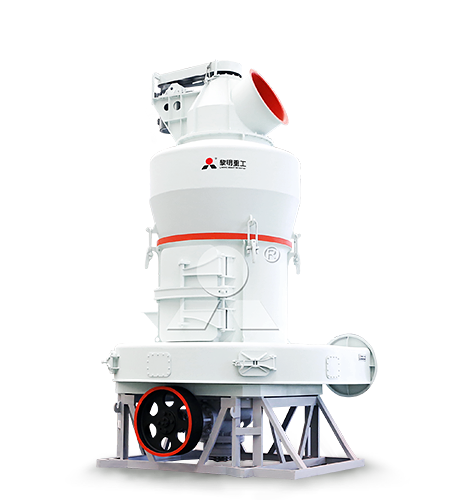
R Raymond Mill
An R Raymond mill can be used in specific large-plant arrangements where production is divided among multiple grinding units or where a separate conventional gypsum powder stream is required. Its suitability should be evaluated against the required hourly output, feed condition and target powder fineness.
Classification and Circulating Material Control
Classification is essential in a large gypsum powder production line. The classifier separates fine powder that meets the target condition from material that requires further grinding. Coarse particles return to the mill, creating a circulating material flow that must remain stable.
At 500 TPD, classification capacity and airflow balance are critical. If too much coarse material enters the finished powder, product quality may become unstable. If too much material returns to the mill, the circulating load may rise and reduce finished-product output.
| Operating Condition | Potential Effect | Process Area to Review |
|---|---|---|
| Classifier setting too coarse | More large particles may enter finished powder. | Classifier setting, airflow and target fineness. |
| Classifier setting too fine | Circulating load can increase and output can decrease. | Classifier condition, return-material flow and grinding efficiency. |
| Unstable mill feed | Powder fineness and output can fluctuate. | Intermediate storage, feeders and upstream material transfer. |
| Airflow imbalance | Powder transport and separation may become unstable. | Fan operation, ducts, filter resistance and equipment sealing. |
| Worn grinding components | Grinding efficiency may decrease and coarse material may increase. | Grinding parts, mill loading and maintenance schedule. |
Dust Collection and Air System
Dust collection is a major part of a 500 TPD gypsum powder plant. Fine gypsum particles are generated at raw material transfer points, crushing equipment, calcination equipment, cooling sections, grinding mills, classifiers, conveyors, silos and packing stations.
The air-handling system should include suitable collection hoods, ducts, filters, fans, discharge equipment and sealed transfer points. In the grinding section, airflow is also part of powder movement and classification. Changes in filter resistance, fan performance, duct leakage or sealing condition can affect both dust collection and finished powder consistency.
At this scale, dust collection should be planned section by section and as an overall plant system. The main dust collector, auxiliary collection points and packing dust control arrangement should all be matched to the actual dust load and air volume.
Finished Powder Storage and High-Capacity Packing
After classification and collection, gypsum powder is conveyed to finished-product silos. Large-scale storage is necessary because it separates grinding operation from packing, truck loading or downstream use. The silo capacity should be selected according to mill output, shipping schedule, bagging capacity and the required operating buffer.
Finished gypsum powder may be packed in bags, loaded into bulk transport equipment or transferred directly to a downstream gypsum board, plaster or dry-mix production process. The packing system should be designed to handle the expected powder flow without restricting mill operation.
| Finished Product Equipment | Main Role |
|---|---|
| Powder conveying system | Transfers qualified gypsum powder from collection to storage. |
| Finished-product silos | Provide buffer storage between production and dispatch. |
| Silo discharge equipment | Controls powder flow to packing or bulk loading. |
| Bagging system | Fills gypsum powder into finished-product bags. |
| Weighing and handling equipment | Controls package quantity and supports finished-product movement. |
| Bulk-loading system | Transfers powder to bulk transport or downstream production equipment. |
| Packing dust collector | Collects powder generated during bag filling and loading. |
Typical Equipment Configuration
| Plant Section | Typical Equipment | Main Function |
|---|---|---|
| Raw material receiving | Receiving hopper, storage yard, loader, feeder and conveyor | Receives and buffers gypsum for continuous processing. |
| Crushing and preparation | Crusher, feeder, screen, magnetic separator and conveyors | Prepares raw gypsum feed for calcination or grinding. |
| Crushed gypsum storage | Storage bin, discharge feeder and conveying system | Stabilizes feed to the next stage. |
| Calcination when required | Controlled feeder, rotary kiln, thermal system, gas handling and dust collection | Converts raw gypsum into calcined gypsum. |
| Cooling and transfer | Cooling equipment, enclosed conveyors, elevators and intermediate storage bins | Transfers calcined gypsum to the grinding section. |
| Grinding | LM vertical grinding mill, MTW European grinding mill, LUM ultrafine vertical mill or selected R Raymond mill arrangement | Produces gypsum powder at the required fineness. |
| Classification | Classifier, return-material circuit and air-handling equipment | Controls particle-size distribution. |
| Dust collection | Dust collectors, fans, ducts, filters, hoods and sealing systems | Collects fine powder and controls airflow. |
| Finished powder handling | Powder conveyors, silos, bagging equipment and bulk-loading system | Stores, packs and dispatches finished gypsum powder. |
Process Design Priorities
The design of a 500 TPD gypsum powder production line should focus on continuous operation, stable material flow, maintenance access and process flexibility. The plant layout should reduce unnecessary transfer points and provide sufficient buffer storage between major sections.
Provide raw gypsum storage that matches the delivery cycle and daily consumption.
Use a crushing system that provides stable feed size and continuous downstream supply.
Include calcination only when the final product requires calcined gypsum.
Provide intermediate storage between calcination and grinding.
Use stable mill feeding to support continuous grinding and classification.
Match classifier capacity to grinding output and target powder fineness.
Design the dust collection system around all major dust-generating points.
Provide sufficient finished-powder silo capacity before packing or bulk loading.
Ensure packing and dispatch equipment can handle the planned production rate.
Allow access for maintenance of crushers, feeders, kilns, mills, classifiers, fans, filters and conveyors.
Key Information Before Final Design
Confirm whether the finished product is ground natural gypsum powder or calcined gypsum powder.
Define the required 500 TPD output and daily operating schedule.
Determine the average hourly output required from the production line.
Confirm raw gypsum source, chemical condition, feed size, moisture and impurity level.
Define the target powder fineness and particle-size control requirement.
Confirm whether calcination is required and define the required calcined gypsum condition.
Size crushing, calcination, cooling and storage equipment for continuous material flow.
Select the grinding system according to capacity, fineness and feed condition.
Match classifiers, dust collectors, fans, conveyors and silos to the grinding output.
Define packing, bulk-loading or downstream product-feeding requirements.
Confirm site space, building height, power supply, fuel conditions and maintenance access.
Conclusion
A 500 TPD gypsum powder production line is a large-scale integrated system that can be configured for grinding-only production or for complete calcination and grinding. The final process route depends on whether the target product is natural gypsum powder or calcined gypsum powder for plaster, board, construction and industrial applications.
Reliable operation depends on the coordination of every section: raw material receiving, crushing, calcination when required, cooling, intermediate storage, grinding, classification, dust collection, finished-product storage and packing. LM vertical grinding mills are suitable for large continuous gypsum powder production, while MTW European grinding mills, LUM ultrafine vertical mills and selected R Raymond mill arrangements can be configured for different capacity, fineness and application requirements.
Related Gypsum Powder Production Line


LIMING at MiningMetals Uzbekistan 2026 | Booth B94
2026-10-22

LIMING Heavy Industry at MINEXPO Africa 2026 | Booth 133
2026-10-22
Liming Heavy Industry to Exhibit at bauma CHINA 2026 – Visit Us at Booth E6.510
2026-10-15
Meet Liming Heavy Industry at the 140th Canton Fair 2026
2026-10-13
Liming Heavy Industry to Attend the 140th Canton Fair
2026-09-25
Complete Mineral Processing Solutions
Convenient Reliable Professional Efficient Get Your Quote
Please feel free to submit your inquiry information to us. We will contact with you as soon as possible.
Our team will contact you as soon as possible.