


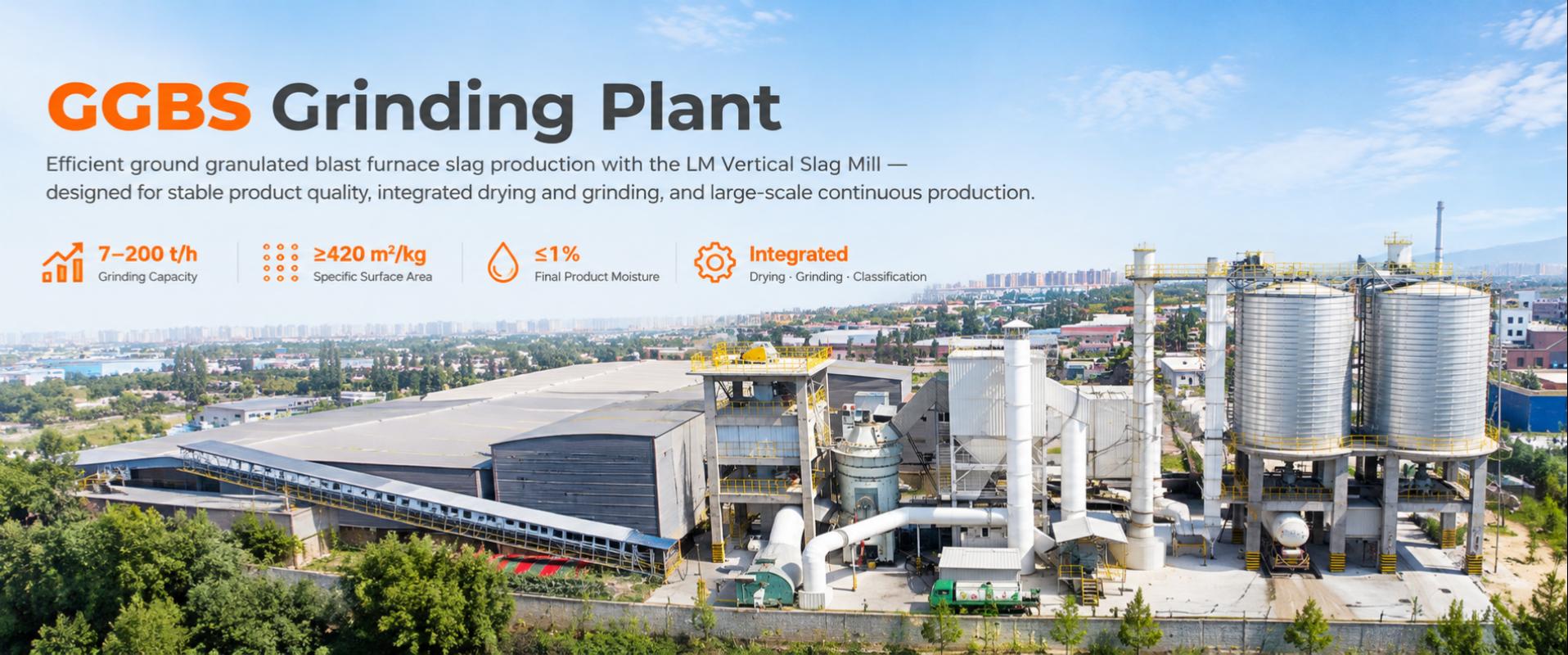
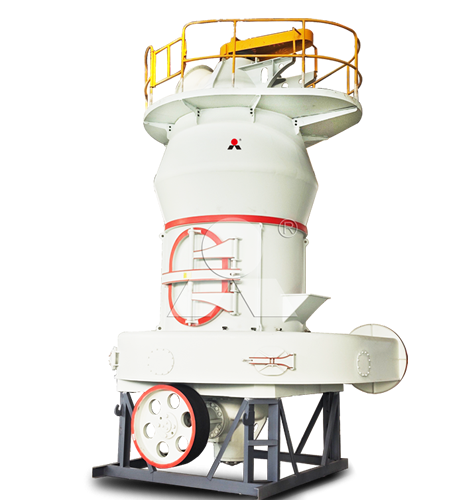
Selecting a 100,000–600,000 t/y GGBS grinding plant requires converting annual demand into a realistic hourly capacity, then sizing the mill and supporting systems for the wettest slag and finest required product. The central equipment should be an LM Vertical Slag Mill from Liming Heavy Industry, supported by properly matched raw-slag handling, hot-gas drying, powder collection, storage, and loading equipment.
The annual figure on its own is not enough. A nominal 300,000 t/y plant can require a mill rated near 42 t/h or above 50 t/h depending on operating hours, planned availability, feed moisture, and product fineness. The correct selection is based on accepted, on-specification GGBS output—not merely raw feed entering the mill.
Convert Annual Output to Hourly Capacity
Start by defining the planned annual operating hours and an achievable availability factor. Grinding plants do not operate at full nameplate capacity for every scheduled hour because planned maintenance, inspections, raw-material interruptions, product changes, and normal process stops must be considered.
Use the following planning formula:
Required mill output (t/h)=Annual GGBS target (t/y)/(Scheduled operating hours (h/y)×availability)
For preliminary plant selection, 7,000–7,500 scheduled operating hours per year and 88–92% availability are commonly useful planning assumptions. Final project values should be confirmed from the proposed maintenance strategy, slag-supply reliability, logistics plan, and desired production margin.
| Annual GGBS Target | Required Output at 7,200 h/y and 90% Availability | Practical Preliminary Design Range | Selection Focus |
|---|---|---|---|
| 100,000 t/y | 15.4 t/h | 16–20 t/h | Compact plant, local demand, flexible dispatch, controlled storage cost |
| 150,000 t/y | 23.1 t/h | 24–30 t/h | Balanced small-to-medium line with adequate moisture and capacity margin |
| 200,000 t/y | 30.9 t/h | 32–40 t/h | Stable raw-slag supply, bulk-silo capacity, and efficient loading arrangements |
| 300,000 t/y | 46.3 t/h | 48–60 t/h | High availability, stronger hot-gas system, large-silo and bulk-dispatch planning |
| 400,000 t/y | 61.7 t/h | 65–75 t/h | Large-capacity mill package, robust power supply, maintenance access, and logistics |
| 500,000 t/y | 77.2 t/h | 80–95 t/h | High-throughput raw-material handling, redundancy assessment, and dispatch efficiency |
| 600,000 t/y | 92.6 t/h | 95–115 t/h | Large-scale line, reliable slag source, high-capacity drying and loading system, expansion-ready layout |
The figures in the “Practical Preliminary Design Range” column include operating margin. They are not guaranteed capacities: actual output changes with slag grindability, feed moisture, required Blaine fineness, product grade, available hot-gas temperature, and site configuration.
Industry references show that GGBS plant packages are commonly offered around 100,000, 150,000, 200,000, and 300,000 t/y, while large vertical-mill installations are also configured at approximately 600,000 t/y.
Choose Capacity by Product Grade
The same LM Vertical Slag Mill does not produce the same hourly output at every product specification. A coarser GGBS grade requires less grinding work than a finer grade, so a mill that meets a 600,000 t/y target for one product may not meet it for a higher-Blaine, higher-activity product.
| Product Requirement | Effect on Mill Capacity | Design Response |
|---|---|---|
| Standard GGBS fineness | Supports the higher end of the achievable capacity range | Select the mill based on verified output at the specified Blaine and sieve residue |
| S95 GGBS | Requires controlled fine grinding and classification | Confirm capacity at the actual S95 fineness and activity target, not a general slag-powder figure |
| S105 GGBS | Usually reduces hourly output because of the finer target and higher circulating load | Provide additional mill-size margin, classifier capacity, and adequate motor power |
| Multiple product grades | Changes operating conditions and can increase changeover losses | Define the annual production mix and size the plant for the weighted average plus peak-grade requirement |
For example, a project may plan 400,000 t/y total production but expect 60% S95 and 40% S105. The capacity calculation should be based on the actual hourly output achievable for each grade, then weighted by the annual production plan. Selecting a mill only from the output possible at the easier S95 target can leave the line short of annual capacity once S105 production is introduced.
Size for Maximum Feed Moisture
Feed moisture has a major influence on GGBS plant capacity because water-granulated slag must be dried before it can be ground and classified efficiently. The LM Vertical Slag Mill uses hot gas to remove moisture during milling, but its final output depends on the heat available as well as grinding capacity.
A plant should define at least three raw-slag conditions:
Normal moisture: The expected average feed condition during ordinary operation.
Seasonal high moisture: Slag condition after rain, humid weather, or short drainage time.
Maximum design moisture: The highest moisture level at which the plant must still sustain its contractual production target or a defined reduced-output condition.
The hot-gas generator or available waste-heat source must be selected for the maximum design moisture. If the heat balance is undersized, mill throughput will fall even if the LM Vertical Slag Mill has sufficient grinding power. This risk becomes more significant as annual capacity increases because a small hourly shortfall accumulates into a major annual production gap.
Recommended Plant Configuration by Scale
| Annual Capacity | Recommended Configuration Approach | Priority Supporting Systems |
|---|---|---|
| 100,000–200,000 t/y | One compact LM Vertical Slag Mill line with efficient raw-slag handling and one or more finished-product silos | Covered slag storage, stable weighing feed, dependable heat source, bulk loading, practical maintenance access |
| 200,000–300,000 t/y | Medium-capacity LM Vertical Slag Mill line with expanded raw-material buffer and higher-rate powder collection | High-capacity hot-gas system, larger bag filter and fan, multiple product silos, faster tanker loading |
| 300,000–400,000 t/y | Large LM Vertical Slag Mill line designed with operating margin and future expansion space | Automated sampling, stronger power distribution, robust reclaiming system, high-capacity dispatch and quality control |
| 400,000–600,000 t/y | Large-scale LM Vertical Slag Mill installation or a phased configuration evaluated for supply and availability requirements | Reliable slag logistics, maximum-moisture drying design, large finished-silo volume, redundant critical auxiliaries where justified, multiple loading positions |
For the upper end of the range, compare a single larger mill with a two-line arrangement. A single large line can simplify the process layout and reduce duplicate equipment, while two smaller lines may provide better availability during maintenance and more flexibility when producing multiple grades. The preferred option depends on annual production commitments, outage tolerance, capital strategy, site space, and the reliability of the raw-slag supply.
Do Not Undersize Auxiliary Equipment
The LM Vertical Slag Mill is only one part of the production system. At 300,000–600,000 t/y, an undersized feeder, hot-gas system, bag filter, fan, conveyor, product silo, or loading station can become the real production bottleneck.
| System | Capacity-Selection Requirement | Typical Consequence of Undersizing |
|---|---|---|
| Raw-slag storage | Provide adequate buffer for delivery disruptions and moisture-management needs | Mill stoppages, forced use of wetter slag, or excessive rehandling |
| Reclaiming and feed system | Deliver stable feed above the maximum mill demand with suitable turndown control | Feed surges, vibration, unstable fineness, and reduced mill throughput |
| Hot-gas system | Meet the drying load at maximum design moisture and peak production rate | High product moisture, reduced mill feed, or inability to operate during wet conditions |
| Dust collector and fan | Handle required gas volume and pressure loss with adequate operating margin | Poor classification, high pressure drop, product losses, and unstable mill operation |
| Finished-product silos | Store enough GGBS to decouple mill production from dispatch variability | Mill slowdown or stoppage when loading cannot keep pace with production |
| Bulk loading | Load tankers at a rate that matches average daily output and peak dispatch demand | Vehicle queues, shipping delays, silo congestion, and lost production time |
| Electrical system | Support mill drive, fans, hot-gas equipment, conveying, and starting loads | Production limits, trips, reduced reliability, and difficulty expanding later |
As a general reference, annual grinding-plant capacity is based on the design output of installed grinding units. In real operation, however, delivered output depends on availability and system constraints, which is why all connected equipment must be sized to the same production basis.
Use Representative Slag Data
Before confirming a mill size, prepare a technical data package for the intended granulated blast-furnace slag. The package should include:
Average and maximum moisture content
Chemical composition and expected variation
Glass content and physical condition
Particle-size range and bulk-density information
Grindability test results
Metallic iron, refractory fragments, and foreign-material content
Target Blaine fineness, sieve residue, particle-size distribution, and activity index
Required finished-product moisture
Annual production split by GGBS grade
The LM Vertical Slag Mill model should then be selected based on a performance guarantee tied to this material data. A capacity figure is meaningful only when it identifies the feed moisture, target fineness, product moisture, operating conditions, and test method used to establish it.
Illustrative Selection Example
Consider a plant targeting 600,000 t/y of finished S95 GGBS. With 7,200 scheduled operating hours and 90% availability, the basic output requirement is 92.6 t/h.
If the project requires a 10% production margin to manage seasonal moisture, maintenance recovery, and short-term dispatch peaks, the preliminary mill selection target becomes:
92.6×1.10=101.9 t/h
The selected LM Vertical Slag Mill package should therefore demonstrate approximately 102 t/h or more at the specified S95 fineness, maximum expected slag moisture, defined finished-powder moisture, and available hot-gas condition. If a meaningful portion of the annual plan will be S105, capacity should be recalculated at the finer product target rather than assuming the S95 rate will remain available.
Final Capacity Checklist
Before choosing between LM Vertical Slag Mill models, confirm the following:
Annual output has been converted into hourly output using realistic operating hours and availability.
Capacity is based on finished, accepted GGBS—not raw slag feed.
The selected mill can meet output at required Blaine fineness, residue, particle-size distribution, and activity level.
The hot-gas system can dry the maximum expected feed moisture at the target output.
Raw-slag storage, reclaiming, feed equipment, dust collector, fan, silos, and loading facilities are matched to the mill’s maximum output.
The plant layout includes maintenance access, spare-parts strategy, and capacity for future expansion.
The equipment supplier’s capacity commitment is linked to representative raw-slag data and defined operating conditions.
From 100,000 to 600,000 t/y, the right GGBS plant is not necessarily the largest mill available. It is the LM Vertical Slag Mill configuration that consistently achieves the required finished-product output under the site’s real moisture, fineness, heat-source, logistics, and availability conditions. A properly balanced line will protect annual capacity, stabilize quality, and avoid costly bottlenecks outside the grinding mill.
Related GGBS Grinding Plant


LIMING at MiningMetals Uzbekistan 2026 | Booth B94
2026-10-22

LIMING Heavy Industry at MINEXPO Africa 2026 | Booth 133
2026-10-22
Liming Heavy Industry to Exhibit at bauma CHINA 2026 – Visit Us at Booth E6.510
2026-10-15
Meet Liming Heavy Industry at the 140th Canton Fair 2026
2026-10-13
Liming Heavy Industry to Attend the 140th Canton Fair
2026-09-25
Complete Mineral Processing Solutions
Convenient Reliable Professional Efficient Get Your Quote
Please feel free to submit your inquiry information to us. We will contact with you as soon as possible.
Our team will contact you as soon as possible.