


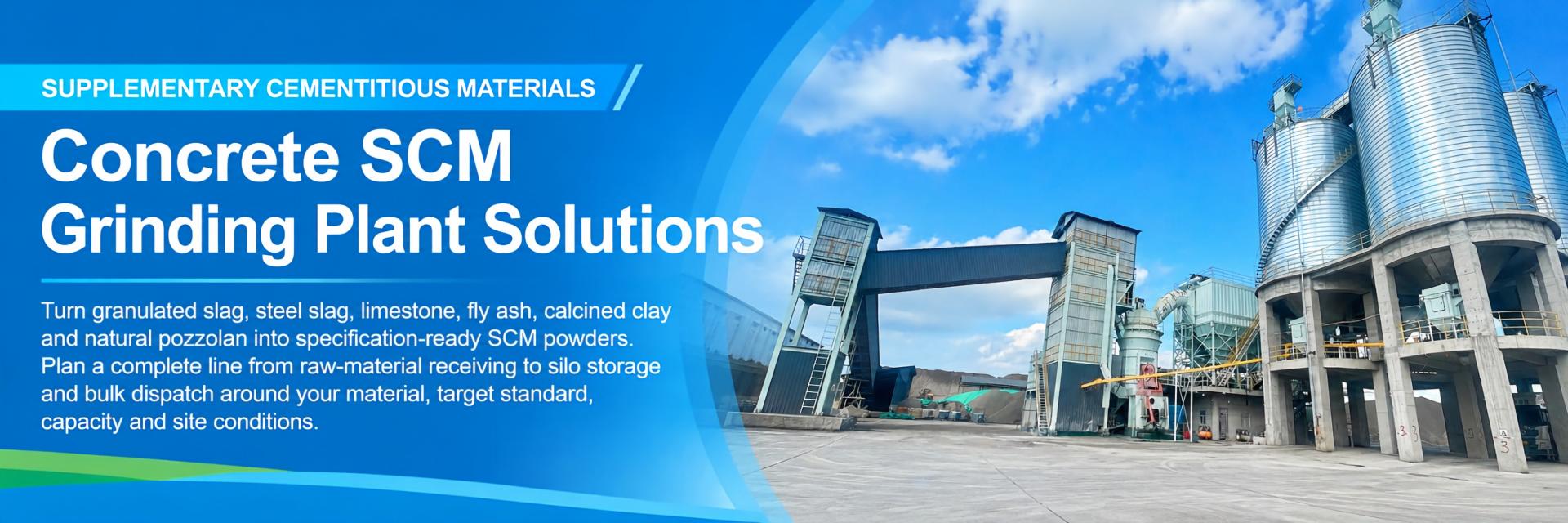
A steel slag powder plant needs more than a mill and a magnetic separator. A practical process combines source-controlled slag treatment, staged crushing and screening, repeated iron recovery, controlled grinding, and finished-product testing. The objective is to recover usable metal while producing a mineral powder with verified stability and performance.
Iron removal and stabilization solve different problems. Magnetic separation removes recoverable metal and selected magnetic particles; it does not reliably eliminate the free lime and free magnesia responsible for potentially harmful expansion. A successful plant must address both duties before its powder is approved for concrete applications.
Steel Slag Is Not the Same Material as GGBS
Ground granulated blast-furnace slag, or GGBS, comes from rapidly cooled blast-furnace slag generated during ironmaking. Steel slag comes from steelmaking processes, including basic oxygen furnaces and electric arc furnaces. These materials differ in mineralogy, metal content, reactivity, and volume-stability risks.
Even within steel slag, the furnace process and operating conditions matter. Basic oxygen furnace slag, electric arc furnace oxidizing slag, and ladle slag should not be treated as interchangeable feeds. Their suitability for a powder project must be established separately.
Consequently, a steel slag powder should not be described as ASTM C989 slag cement or EN 15167-1 GGBS merely because it achieves a similar fineness or strength result. Product acceptance must follow the specification applicable to the actual material and intended market.
A Practical Processing Route
For suitably pretreated steel slag, a preliminary dry powder-production route can include the following stages. The exact position of stabilization and separation equipment must be confirmed through material testing and the selected treatment process.
Receive, identify, and segregate slag by source and treatment history.
Complete or verify the required stabilization treatment.
Scalp oversized material and recover accessible large metal pieces.
Crush and screen in stages to liberate metal from mineral slag.
Apply magnetic separation to appropriate size fractions.
Store and meter the prepared mineral feed.
Dry, grind, and classify to the required powder specification.
Recover metal from suitable external-circulation or reject streams.
Collect, test, and segregate finished powder before release.
Industrial steel slag grinding arrangements use pretreatment, crushing, screening, and magnetic separation ahead of fine grinding. Additional separation around the grinding circuit can recover particles that were not sufficiently liberated earlier. The route should be designed around actual liberation behavior rather than a fixed number of magnets.
Why Iron Removal Works Best in Stages
Before crushing: recover accessible metal and protect equipment
Incoming slag may contain large steel pieces and metal-rich agglomerates. Removing accessible metal before size reduction reduces the amount of unnecessary material entering downstream equipment.
A receiving arrangement should provide controlled feeding, screening where appropriate, accessible collection points, and a safe procedure for handling oversized metal. A separator cannot perform consistently if the feed arrives in irregular piles or if large pieces cannot be discharged safely.
After crushing: recover newly liberated metal
Some metallic iron is enclosed within slag particles. Crushing breaks the surrounding mineral material and can expose metal that was previously difficult to recover. Separation after appropriate liberation stages is therefore more useful than relying exclusively on a magnet over the incoming feed belt.
Screening also matters. A broad mixture of coarse lumps and fine particles presents different separation conditions from a controlled size fraction. Equipment trials should establish suitable particle size, feed depth, moisture condition, and separator settings for each stream.
Around the mill: prevent uncontrolled metal recirculation
Residual metal-bearing particles can become concentrated in coarse return streams. Where the mill arrangement provides a suitable external reject or circulation stream, screening and magnetic recovery can remove recoverable metal before the mineral fraction returns to grinding. Steel slag vertical-mill processes use this type of staged recovery to manage residual metal.
Do not return every reject stream automatically. Establish its metal content, particle-size distribution, and mineral value first. A stream dominated by recoverable metal needs a different destination from one containing useful, under-ground mineral particles.
Total Iron Content Does Not Tell the Whole Story
Steel slag contains iron in several forms. These include metallic iron and iron-bearing mineral phases with different magnetic responses. Total iron analysis measures the combined iron contribution; it does not directly state how much recoverable metal remains.
| Material characteristic | Why it matters | Useful assessment |
|---|---|---|
| Metallic iron | Represents a potential recovery product and a concern for grinding-circuit management. | Metallic-iron determination, inspection, and recovery trials. |
| Strongly magnetic particles | Can report to the magnetic product along with recoverable metal. | Magnetic separation tests and mineralogical examination. |
| Weakly magnetic iron-bearing phases | May require different separation conditions and may remain intergrown with other minerals. | Size-by-size mineralogy and separation testing. |
| Fine intergrowths | Can limit clean separation even after substantial grinding. | Liberation analysis and a product-yield balance. |
Research on steel slag separation identifies fine particle size, low magnetic susceptibility, and difficult mineral separation as important challenges. Increasing magnetic field strength is therefore not a universal solution: it can change the amount and composition of both the recovered fraction and the remaining powder.
The practical target is not simply the lowest possible total iron content. It is an acceptable balance between metal recovery, mineral-powder yield, processing cost, and finished-product performance.
Stabilization Must Be Verified Separately
Free lime and free magnesia can hydrate after steel slag is incorporated into cement-based products, causing expansion and potentially cracking. Their behavior depends on the slag mineralogy, particle characteristics, and exposure conditions. Removing metallic iron does not establish volume stability.
Potential stabilization routes include controlled aging, steam treatment, and carbonation. Each requires a defined process and verification appropriate to the material. Calendar time in a stockpile is not a reliable substitute for evidence that the treated slag meets the required acceptance criteria.
Should stabilization happen before or after grinding?
There is no universal answer. Coarse-material treatment may fit a steelworks’ existing handling arrangement, while some carbonation processes benefit from the greater accessible surface of finer particles. Treatment effectiveness depends on particle size, moisture, temperature, reaction conditions, and achievable treatment depth.
However, treatment can also change subsequent cementitious behavior. More extensive carbonation is not automatically better for every powder application. The final route should be validated against both expansion control and the required binding performance.
Grinding the Prepared Mineral Fraction
Once the slag has passed the agreed feed checks, the grinding circuit must deliver consistent fineness without becoming a substitute for inadequate upstream preparation.
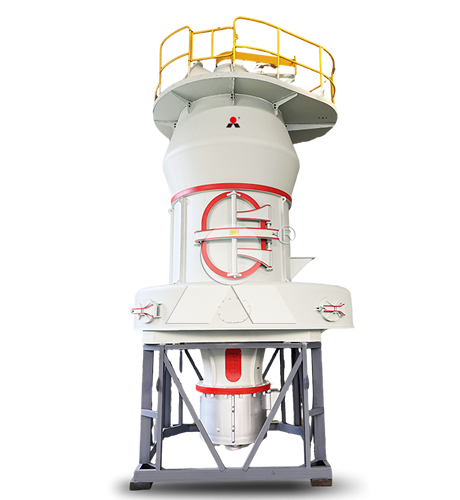
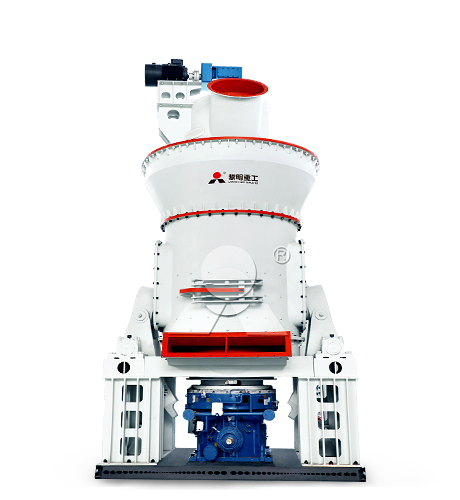
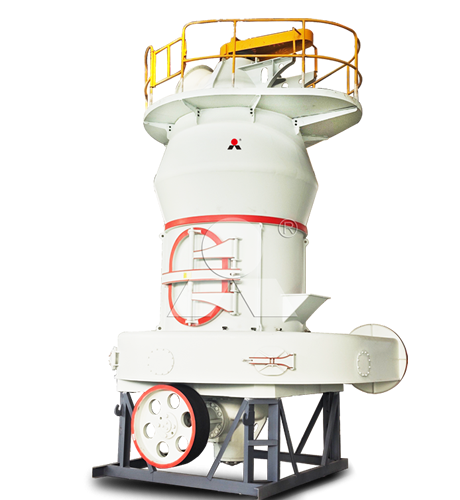
For a project-specific assessment, the Liming Heavy Industry LM Vertical Roller Mill is an option to evaluate. The LM platform integrates drying, grinding, classification, and conveying, and Liming Heavy Industry identifies metallurgical solid waste processing among its applications. The configuration must be selected for the actual steel slag, rather than copied from a GGBS project.
Define the feed envelope before selecting the model
Maximum and normal feed size.
Moisture range, including seasonal variation.
Residual metallic iron and its particle-size distribution.
Grindability and abrasive behavior.
Bulk density and feeding characteristics.
Stabilization history and acceptance results.
Steel slag can be difficult to grind, and its processing can involve substantial energy use and maintenance requirements. Representative grinding trials are therefore more useful than capacity estimates based on another mineral or a nominal mill size.
Specify the finished powder beyond a mesh number
The product requirement should include the applicable fineness measurements, coarse residue, moisture, stability criteria, and performance tests. Where the powder is intended as a cementitious component, test its contribution in the intended mixture. A fine powder is not necessarily a reactive or dimensionally stable powder.
Coordinate airflow, drying, and classification
An integrated vertical mill uses airflow for drying and material transport as well as classification support. Feed moisture and the available hot-gas conditions must therefore be included in the system design. Liming Heavy Industry’s LM arrangement combines these functions, but the required capacity still needs to be checked at the specified feed and product conditions.
Where Fine-Powder Magnetic Separation Fits
Fine-powder separation may be worth evaluating when residual magnetic phases affect the target product or when additional recovery has sufficient value. It should not be added automatically as a finishing step.
At fine sizes, separation becomes more sensitive to particle interactions, dispersion, and mineral intergrowth. Specialized air-fluidized magnetic separation has been investigated for separating magnetic or relatively inert fractions from steel slag powder, but those results do not establish a universal industrial outcome for every slag supply.
Before including a fine-separation stage, determine:
Which specific fraction the stage is intended to remove.
How much saleable powder will be lost with that fraction.
Whether the remaining powder shows a measurable performance improvement.
Whether the recovered fraction has an acceptable destination.
What additional power, collection equipment, and maintenance are required.
Common Operating Problems and What to Investigate
| Observed problem | Priority checks |
|---|---|
| Metal-rich material repeatedly returns to the mill. | Check liberation, upstream separator loading, reject composition, and the destination of external return streams. |
| Magnetic recovery changes sharply between shifts. | Review feed source, size distribution, moisture, bed depth, and separator condition. |
| Grinding energy rises at a similar fineness. | Check feed variability, residual metal, moisture, wear condition, and internal circulation. |
| The powder meets fineness requirements but fails stability testing. | Investigate free expansive phases, treatment effectiveness, stockpile segregation, and sampling. Do not assume that more grinding will solve the problem. |
| Iron recovery improves but mineral-powder yield falls excessively. | Measure entrained mineral loss and reassess liberation and separator settings. |
| Concrete performance varies despite stable Blaine results. | Check mineralogy, chemistry, particle-size distribution, treatment history, and compatibility with the other mixture materials. |
Release the Powder Against Its Intended Application
Qualification should connect the feed, treatment process, and finished product. Depending on the destination and governing requirements, the test program may need to cover:
Chemical composition and mineralogy.
Residual metallic iron.
Free lime and relevant magnesium-bearing phases.
Fineness, coarse residue, and particle-size distribution.
Volume stability using an applicable, validated method.
Strength contribution and setting behavior.
Workability and admixture compatibility.
Environmental acceptance, including leaching where required.
Steel slag variability and potential expansion and leaching concerns make source-specific assessment important. Aggregate acceptance results should not automatically be used to qualify a finely ground powder as a cementitious material; the intended use and relevant testing conditions must match.
Build the Plant Around a Verified Material Balance
A useful plant design identifies separate destinations for recovered metal, mineral feed, intermediate returns, unsuitable residues, and finished powder. This makes it possible to evaluate recovery yield, grinding load, product output, and disposal obligations together.
For a Liming Heavy Industry grinding-system assessment, provide representative steel slag samples, source and treatment records, metallic-iron data, moisture and size distributions, and the required finished-product specification. These inputs support selection of the LM Vertical Roller Mill configuration and the surrounding separation and handling route.
The strongest process is not the one with the most magnetic separators or the highest grinding fineness. It is the one that consistently recovers useful metal, controls expansion risk, and produces a powder qualified for its actual customer application.
Related Concrete SCM Grinding Plant Solutions


Liming Heavy Industry to Showcase Crushing and Grinding Solutions at bauma CHINA 2026
2026-11-02

LIMING Heavy Industry to Participate in SIREXE 2026 in Abidjan, Côte d'Ivoire
2026-10-26
LIMING at MiningMetals Uzbekistan 2026 | Booth B94
2026-10-22
LIMING Heavy Industry at MINEXPO Africa 2026 | Booth 133
2026-10-22
Liming Heavy Industry to Exhibit at bauma CHINA 2026 – Visit Us at Booth E6.510
2026-10-15
Complete Mineral Processing Solutions
Convenient Reliable Professional Efficient Get Your Quote
Please feel free to submit your inquiry information to us. We will contact with you as soon as possible.
Our team will contact you as soon as possible.