


Selecting a barite grinding mill begins with the finished powder requirement, not with the machine itself. The same barite ore may need to become drilling-grade weighting material, a fine filler for coatings and plastics, or a mineral ingredient for chemical processing. Each application places different demands on particle size, particle-size distribution, moisture, purity, capacity, and production stability.
For barite powder projects, the practical choice is usually between an LM Vertical Mill for larger, highly integrated production lines and an MTW European Trapezium Mill for flexible fine-powder production. The correct selection depends on actual raw-material conditions and the customer’s powder specification.
Start with the Finished Powder
The first question is: what must the finished barite powder achieve after grinding? “200 mesh” or “325 mesh” alone is not enough information for proper mill selection. The required particle-size distribution, production volume, powder moisture, bulk density, whiteness, and chemical composition should all be considered.
For oil and gas drilling fluids, barite serves as a weighting agent. In this application, the powder must meet a controlled particle-size distribution rather than simply being made as fine as possible. API-grade barite is generally required to have a specific gravity of at least 4.20; no more than 3% by mass may remain above 75 μm, and no more than 30% may be below 6 μm. Excess coarse material can create settling concerns, while excessive ultrafine powder can increase drilling-fluid viscosity.
This illustrates an important point for every barite project: overgrinding is not always beneficial. A mill should deliver the required fineness range consistently, with limited oversize particles and controlled ultrafine content.
| Finished-Powder Requirement | What It Means for Mill Selection |
|---|---|
| Target fineness | The mill and classifier must reliably produce the specified mesh or micron range. |
| Particle-size distribution | The separation system must limit both coarse particles and excessive fines. |
| Output requirement | The selected model must achieve the required tonnes per hour under real barite conditions. |
| Moisture requirement | The grinding circuit may need hot-air drying and moisture-control capability. |
| Powder purity | Feed preparation, iron removal, clean conveying, and dust collection become essential. |
| Product consistency | Stable feeding, automatic control, classification, and collection must work as one system. |
Evaluate the Raw Barite First
Barite is primarily barium sulfate, but commercial ore quality varies considerably from one deposit to another. Before deciding on a grinding solution, the plant should test representative material samples rather than rely only on a supplier’s nominal ore description.
The key raw-material questions include:
What is the barium sulfate content?
What is the specific gravity of the ore and the planned finished powder?
What is the feed size after crushing?
What is the natural moisture content?
Does the material contain clay, quartz, calcite, iron-bearing minerals, or other impurities?
How abrasive is the ore?
Does the feed quality vary between mining areas or supply batches?
High moisture may require hot-air drying during grinding. Material containing clay can become sticky and may affect feeding, airflow, and powder discharge. Abrasive impurities can accelerate wear on grinding rollers, grinding rings, tables, liners, and classifier components. If the ore contains metal fragments from mining or crushing, magnetic separation should be considered before the mill feed stage.
Barite intended for drilling applications also requires quality control before grinding. A high-quality milling system cannot correct insufficient mineral density or poor chemical quality in the raw ore. When the finished product must meet drilling-fluid specifications, the feedstock should be assessed for specific gravity, soluble alkaline-earth metals, particle-size performance after grinding, and the consistency of the incoming ore supply.
Choose by Production Scale
Capacity is one of the clearest factors in selecting between the LM Vertical Mill and the MTW European Trapezium Mill. The target should be based on sustained operating output, not only a maximum nameplate figure. A plant designed for 20 tonnes per hour should account for raw-material variation, routine maintenance, product changes, system losses, and future production expansion.
LM Vertical Mill for Large-Scale Production
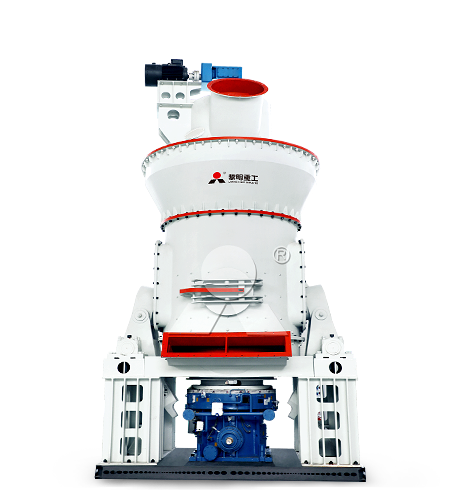
The LM Vertical Mill is a strong option for larger barite powder plants requiring continuous operation and a compact integrated process. It combines drying, grinding, powder separation, and pneumatic conveying in one system. Material is ground on the rotating table under roller pressure, and airflow transports fine particles to the internal separator. Qualified powder moves to the collection system, while coarse particles return to the grinding zone.
This arrangement is especially valuable when the project has a substantial annual demand, limited installation space, or a need to reduce intermediate conveying stages. Liming Heavy Industry describes the LM Vertical Roller Mill as an integrated system for drying, grinding, powder selection, and conveying, with listed capacity coverage of 10–400 t/h depending on material and configuration.
An LM Vertical Mill is generally the better choice when the barite plant requires:
High and stable hourly output.
Continuous production over long operating periods.
Integrated drying for feed containing moisture.
Centralized control of grinding, classification, and conveying.
A compact process arrangement for a large production line.
Potential capacity expansion within a larger powder-processing facility.
For example, a barite producer supplying large volumes to regional drilling-fluid blenders may prioritize stable output, tightly controlled fineness, low material-transfer losses, and automated operation. In this situation, an LM Vertical Mill can form the core of a centralized, high-capacity powder line.
MTW European Trapezium Mill for Flexible Fine Powder
The MTW European Trapezium Mill is suitable for many standard and medium-scale barite grinding projects. It is particularly practical for producers that require conventional fine powder grades, flexible operating capacity, and a proven closed-circuit grinding process.
Crushed barite enters the grinding chamber at a controlled rate. Grinding rollers and the grinding ring reduce the material through pressure and friction. Airflow lifts the resulting powder to the classifier, where qualified particles proceed to collection and oversized particles return to the grinding chamber for further processing.
For drilling-mud barite, Liming Heavy Industry identifies MTW European Trapezium Mills as a common choice for standard 200–325 mesh output. A recent barite project description from the company also shows a process based on uniform feeding, crushing, elevator conveying, MTW grinding, classification, and dust collection, designed for stable fine-powder production.
An MTW European Trapezium Mill is generally the better choice when the project requires:
Medium-scale barite powder production.
Common fine-powder grades such as 200–325 mesh.
Flexible production for more than one finished-powder specification.
A practical process layout with separate but coordinated grinding, classification, and collection sections.
A measured initial investment aligned with a staged production plan.
Reliable operation for local or regional industrial-powder supply.
Compare LM and MTW Solutions
| Selection Factor | LM Vertical Mill | MTW European Trapezium Mill |
|---|---|---|
| Best production scale | Large-capacity and centralized powder plants | Medium-scale and flexible fine-powder plants |
| Core process arrangement | Integrated drying, grinding, classification, and conveying | Grinding with air classification and external powder collection |
| Moisture handling | Well suited to integrated hot-air drying requirements | Can incorporate hot air when feed moisture requires drying |
| Operating mode | Continuous, high-throughput production | Stable production with practical capacity flexibility |
| Fineness control | Internal separator returns coarse particles for regrinding | Classifier separates qualified powder from material requiring further grinding |
| Plant layout | Compact integrated layout with fewer intermediate process links | Clear modular layout for grinding, classification, collection, and packing |
| Typical barite application | Large-volume industrial and drilling-grade powder supply | Standard fine barite powder and 200–325 mesh drilling-mud production |
Do Not Select by Mesh Alone
Two barite projects may both request 325 mesh powder but require very different grinding systems. One may operate eight hours per day for local sales, while another may run continuously to supply multiple drilling-fluid plants. One may receive dry, uniform barite chips, while another may process damp ore with varying hardness and impurity content.
As a result, mill selection should consider the complete production target:
Required output in tonnes per hour and tonnes per year.
Number of planned operating hours per day.
Feed particle size after crushing.
Raw ore moisture and drying demand.
Required mesh and particle-size distribution.
Whether the powder is intended for drilling fluids, fillers, coatings, plastics, rubber, or other applications.
Requirements for whiteness, purity, and iron-content control.
Available site area, building height, power supply, fuel source, and environmental conditions.
Packaging method, including bags, jumbo bags, or bulk tanker loading.
Expected future expansion of production capacity.
A mill that is oversized for the real requirement may create unnecessary capital and operating costs. A mill that is too small may run continuously at its limit, struggle to maintain fineness, and leave no room for future demand. The best selection is the mill that reaches the desired output and quality range with a stable operating margin.
Build the Mill into a Complete System
A barite grinding mill should not be evaluated as an isolated machine. Finished powder quality depends on the entire production route, from ore receiving through packaging. The supporting equipment must match the mill’s capacity and process characteristics.
A complete barite powder line commonly includes the following sections:
Raw-material receiving and storage.
Crushing and screening to prepare suitable mill feed.
Magnetic separation or metal removal before grinding.
Buffer storage and controlled feeding.
Hot-air supply when drying is required.
LM Vertical Mill or MTW European Trapezium Mill.
Air classification for fineness control.
Cyclone and pulse dust collection.
Finished-powder storage silos.
Automatic bagging, jumbo-bag filling, or bulk loading equipment.
Dust collection deserves particular attention. A properly matched pulse dust collector improves product recovery, supports stable system pressure, reduces powder loss, and keeps the plant cleaner. It is also important to ensure that conveyors, valves, silos, and packing equipment are designed for dense, fine barite powder rather than selected only by nominal throughput.
Questions to Answer Before Final Selection
Before confirming an LM Vertical Mill or MTW European Trapezium Mill configuration, prepare a project data sheet with the following information:
| Item | Information Required |
|---|---|
| Raw material | Barite source, chemical analysis, specific gravity, hardness, moisture, impurity content, and feed-size distribution |
| Finished powder | Target mesh, micron range, particle-size distribution, moisture limit, whiteness requirement, and applicable product standard |
| Capacity | Required hourly output, annual production target, operating hours, and expansion plan |
| Site conditions | Installation area, building height, local climate, power supply, fuel availability, and transport access |
| Process configuration | Crushing arrangement, drying requirement, dust control, powder storage, and packaging method |
| Final application | Drilling fluid, coating, plastic, rubber, chemical, glass, or another industrial use |
With this information, the grinding system can be sized around real production conditions rather than assumptions. For high-capacity integrated barite powder production, the LM Vertical Mill provides a strong foundation. For flexible fine-powder production, especially standard 200–325 mesh barite, the MTW European Trapezium Mill offers an efficient and practical route. The final decision should always be based on material testing, required powder quality, sustainable output, and the complete production flow.
Related Barite Powder Processing


Liming Heavy Industry at bauma CONEXPO INDIA 2026 | Booth 5-C6
2026-09-07

Turnkey Raw Mill Cement Plant in Saudi Arabia: Design and Installation
2026-09-03
Cement Raw Mill Supplier in Indonesia: Cost and Configuration Analysis
2026-09-01
Liming Heavy Industry to Exhibit at the 24th Global Gypsum Conference & Exhibition in Turkey
2026-08-31
Complete Calcium Carbonate Grinding and Coating Plant Solution
2026-08-29
Complete Mineral Processing Solutions
Convenient Reliable Professional Efficient Get Your Quote
Please feel free to submit your inquiry information to us. We will contact with you as soon as possible.
Our team will contact you as soon as possible.