


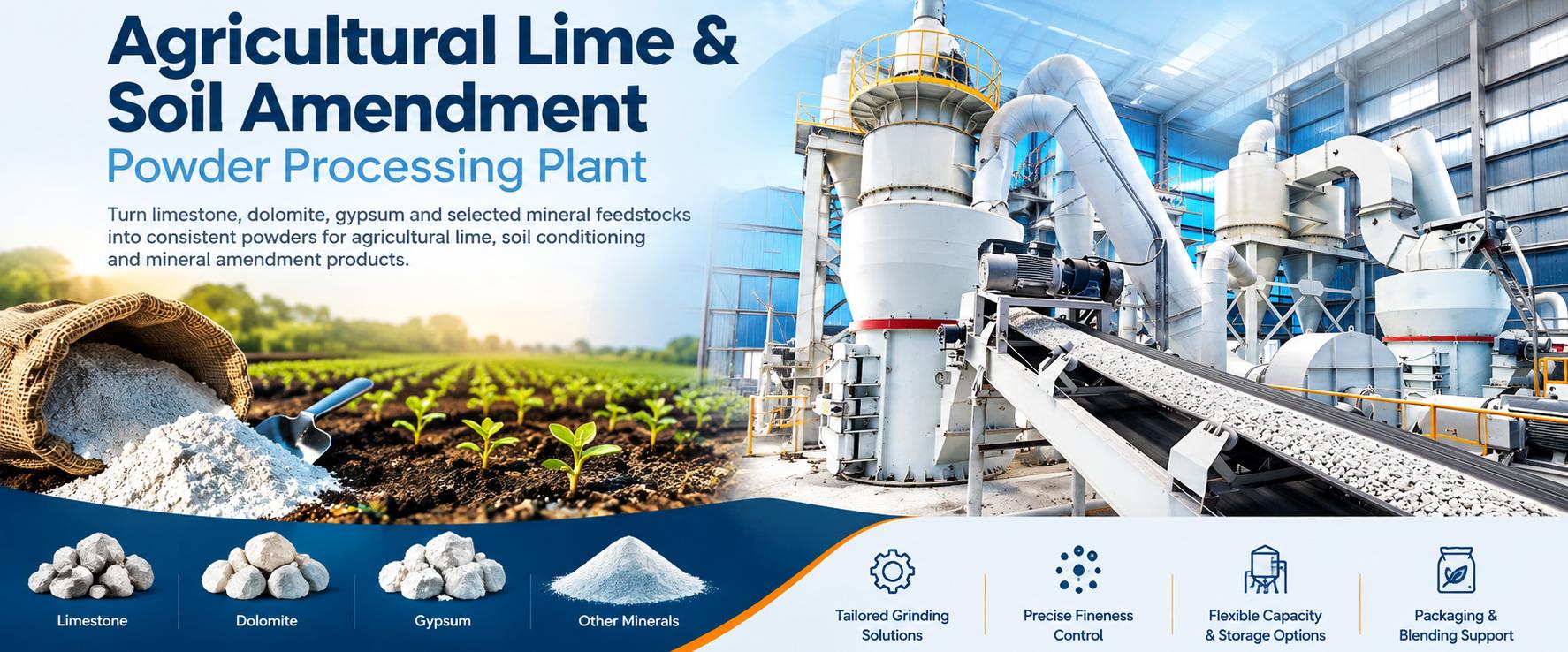
Agricultural lime is widely used to improve acidic soils, adjust soil pH, and create more favorable conditions for crop growth. However, the effectiveness of agricultural lime depends not only on its chemical composition but also on its particle size. Even when processed from the same limestone deposit, products with different particle sizes can react at different rates after being applied to soil.
For agricultural lime manufacturers, selecting the right grinding process is essential for producing consistent powder, meeting different customer requirements, and balancing product performance with production costs.
Why Particle Size Matters in Agricultural Lime
When agricultural lime is applied to soil, its mineral components react with moisture and acidic substances in the soil. Particle size affects the amount of material surface exposed to these reactions.
For the same mass of material, finer particles generally provide a larger total surface area than coarser particles. This allows them to react more quickly under suitable soil conditions. Coarser particles usually react more slowly and may remain in the soil for a longer period.
However, grinding agricultural lime as finely as possible is not always the most economical solution. The appropriate fineness depends on the raw material, soil conditions, application method, product specifications, and intended market.
Choosing the Right Fineness for Different Applications
Coarse and Medium-Ground Agricultural Lime
Coarser products may be suitable for applications where immediate soil pH adjustment is not the only objective and a longer reaction period is acceptable. Depending on the raw material and equipment configuration, this approach may help reduce grinding energy consumption and simplify the production process.
Fine-Ground Agricultural Lime
Fine-ground lime is often selected when a faster reaction rate is required. Its smaller particles provide more surface area for contact with the soil environment, making it a practical option for manufacturers producing agricultural lime with controlled fineness specifications.
For commercial production, manufacturers should define the target particle size and acceptable particle-size distribution rather than relying solely on general descriptions such as fine powder.
Ultrafine Agricultural Lime
Ultrafine grinding may be considered for specialized products that require particularly small particles. Nevertheless, the additional processing cost must be justified by the intended application and customer requirements.
Higher fineness can increase electricity consumption and place greater demands on classification, dust collection, and product handling. Before investing in ultrafine grinding equipment, manufacturers should evaluate whether the additional fineness provides a meaningful benefit for their target market.
Mesh and Microns: Understanding Powder Fineness
Particle size in mineral processing is commonly expressed in mesh or microns (µm). Mesh refers to the number of openings per unit length in a screening system, while microns directly express particle size in a unit of length.
These two measurement systems are related, but their interpretation depends on the applicable screening standard and measurement method. A product described by a particular mesh size does not necessarily contain particles of identical dimensions.
When evaluating agricultural lime quality, manufacturers should consider the target fineness, the distribution of particle sizes, and the proportion of oversized particles. These factors help determine whether the finished powder meets the required specifications consistently.
Other Factors That Affect Agricultural Lime Performance
Particle size is important, but it is not the only factor determining how effectively agricultural lime improves soil conditions.
Mineral composition: Calcium carbonate, magnesium carbonate, and other mineral components influence the characteristics of the finished product.
Neutralizing value: Products with similar particle sizes may perform differently because their chemical compositions and neutralizing capacities are not the same.
Raw material moisture: Excessive moisture can affect feeding, grinding efficiency, and classification performance.
Soil conditions: Soil acidity, moisture content, texture, and existing mineral composition influence the actual response to lime application.
Application method: Proper spreading and incorporation into the soil can improve contact between the lime and the soil environment.
For these reasons, agricultural lime manufacturers should evaluate particle size together with chemical composition and the intended application instead of treating fineness as the only quality indicator.
Selecting Grinding Equipment for Agricultural Lime Production
A suitable grinding system should meet the required product fineness and production capacity while maintaining stable operation and reasonable energy consumption. Raw material feed size, moisture content, grindability, and the required final particle-size distribution must all be considered during equipment selection.
Liming Heavy Industry offers several grinding mill solutions for limestone and other non-metallic mineral processing applications.
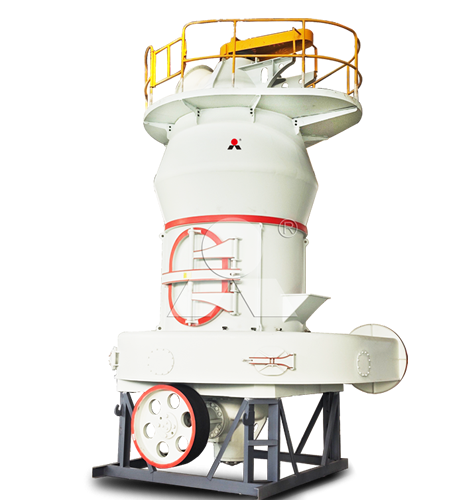
Raymond Mill
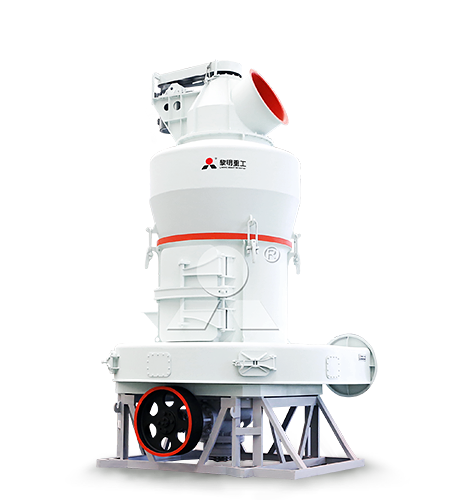
The Raymond Mill is worth considering for agricultural lime production where the required product fineness falls within conventional mineral powder specifications. It can be evaluated for facilities producing limestone powder for general agricultural applications, depending on the raw material and required output.
MTW Series Trapezium Mill
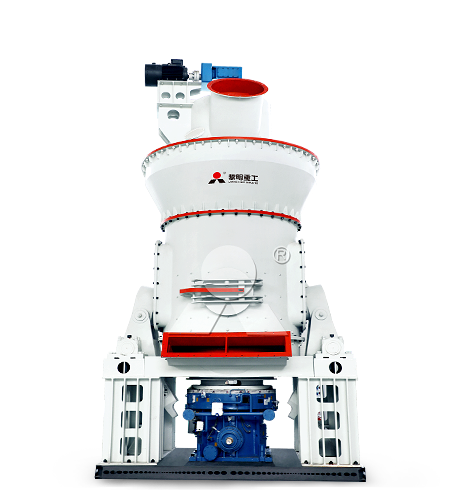
The MTW Series Trapezium Mill from Liming Heavy Industry is an option for producers seeking a balance between grinding capacity, product fineness, and continuous operation. The appropriate model should be selected according to the required throughput, feed particle size, raw material moisture, and finished powder specifications.
LM Vertical Grinding Mill
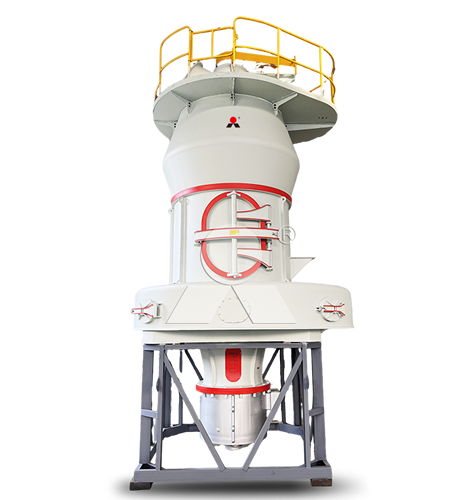
The LM Vertical Grinding Mill is worth evaluating for projects that require higher production capacity and an integrated mineral powder processing system. Its suitability depends on the characteristics of the limestone, the target product fineness, and the configuration of the complete production line.
In addition to the main grinding mill, a production line may require feeding equipment, powder classification, dust collection, conveying systems, and finished-product storage. Proper coordination between these components helps maintain consistent product quality and reduce material losses during operation.
What Information Is Needed Before Selecting a Grinding Mill?
Before choosing equipment for agricultural lime production, manufacturers should prepare the following project information:
Raw material: Limestone, dolomite, or another carbonate-bearing mineral.
Feed size: The maximum particle size entering the grinding system.
Moisture content: The moisture level of the raw material under normal operating conditions.
Required fineness: The target mesh size or particle size in microns.
Production capacity: The required output in metric tons per hour.
Product specifications: Chemical composition, particle-size distribution, and acceptable coarse-particle content.
Plant conditions: Available space, power supply, conveying arrangements, and automation requirements.
Providing these details makes it easier to evaluate the appropriate grinding mill and supporting equipment. It also helps reduce the risk of selecting a system that cannot consistently meet the required capacity or product quality.
Balancing Product Reactivity and Production Efficiency
Successful agricultural lime production is not simply a matter of making the powder as fine as possible. The objective is to produce material with the appropriate particle size and chemical properties for its intended soil application while maintaining reliable production and manageable operating costs.
With a properly selected grinding system, manufacturers can control product fineness, improve batch-to-batch consistency, and adapt their output to different agricultural lime specifications.
Liming Heavy Industry can evaluate limestone grinding solutions based on the raw material characteristics, target fineness, and required production capacity of each project. Information about feed size, moisture content, finished powder specifications, and hourly output helps identify a suitable mill and production line configuration.
If you are planning a new agricultural lime powder plant or upgrading an existing facility, defining your product specifications before selecting the grinding equipment is an important step toward building an efficient and reliable production process.
Related Agricultural Lime & Soil Amendment


Meet Liming Heavy Industry at the 140th Canton Fair 2026
2026-10-13

Liming Heavy Industry to Attend the 140th Canton Fair
2026-09-25
Liming Heavy Industry at bauma CONEXPO INDIA 2026 | Booth 5-C6
2026-09-07
Turnkey Raw Mill Cement Plant in Saudi Arabia: Design and Installation
2026-09-03
Cement Raw Mill Supplier in Indonesia: Cost and Configuration Analysis
2026-09-01
Complete Mineral Processing Solutions
Convenient Reliable Professional Efficient Get Your Quote
Please feel free to submit your inquiry information to us. We will contact with you as soon as possible.
Our team will contact you as soon as possible.