


Calcium hydroxide (Ca(OH)2), commonly known as hydrated lime or slaked lime, is one of the world's most widely used industrial minerals. Produced by adding water to quicklime (calcium oxide), this fine white alkaline powder has supported human civilization for thousands of years and continues to play a critical role in modern manufacturing, environmental protection, agriculture, food processing, and advanced materials.
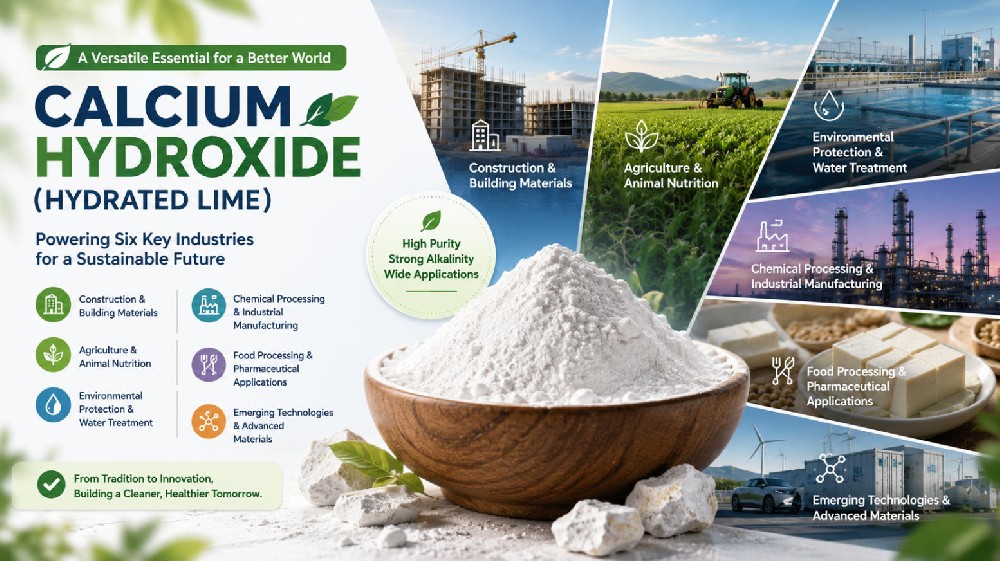
Its combination of high alkalinity, strong chemical reactivity, low production cost, abundant raw material supply, and environmental compatibility makes calcium hydroxide an indispensable material across countless industries. From restoring historic buildings to treating industrial wastewater, from improving agricultural soils to manufacturing pharmaceuticals, hydrated lime delivers practical and cost-effective solutions that remain highly relevant in today's sustainability-driven economy.
This article provides a comprehensive overview of the six primary application sectors where calcium hydroxide creates value worldwide.
1. Construction and Building Materials
The construction industry has been the largest consumer of calcium hydroxide for centuries, and its importance continues to grow with modern infrastructure development.
Lime Mortars and Plasters
Hydrated lime is an essential ingredient in traditional lime mortar, lime plaster, and masonry applications. When exposed to air, calcium hydroxide gradually reacts with carbon dioxide to form calcium carbonate through a process known as carbonation. This natural reaction continuously strengthens masonry structures over time while maintaining excellent breathability.
Major benefits include:
Excellent workability during construction
Improved water retention
Superior adhesion to masonry surfaces
Reduced cracking
Long-term durability
Compatibility with historic buildings
Because of these properties, hydrated lime remains the preferred material for restoring historical architecture and cultural heritage structures worldwide.
Cement and Concrete Production
In cement manufacturing and reinforced concrete, calcium hydroxide contributes to maintaining a highly alkaline environment that protects steel reinforcement from corrosion, extending the service life of concrete structures.
Modern Building Materials
Calcium hydroxide also serves as a key raw material for manufacturing:
Autoclaved aerated concrete (AAC)
Calcium silicate bricks
Dry-mix mortar
Tile adhesives
Wall putty
Decorative coatings
These products benefit from improved strength, better water resistance, enhanced dimensional stability, and easier application.
Soil Stabilization
Infrastructure projects frequently use hydrated lime to improve weak or clay-rich soils. Through ion exchange and pozzolanic reactions, calcium hydroxide significantly increases soil bearing capacity, reduces plasticity, minimizes swelling, and enhances long-term stability.
As a result, lime stabilization has become a widely adopted solution for highways, railways, airports, industrial foundations, and large-scale civil engineering projects.
2. Agriculture and Animal Nutrition
Agriculture is another major global market for calcium hydroxide due to its ability to improve soil quality and support healthy crop production.
Soil pH Improvement
Intensive fertilizer use often causes soil acidification, reducing nutrient availability and limiting crop yields. Hydrated lime effectively neutralizes acidic soils while supplying calcium, an essential plant nutrient.
Regular soil treatment with calcium hydroxide helps:
Increase soil pH
Improve nutrient absorption
Enhance microbial activity
Reduce soil compaction
Promote stronger root development
Crop Protection
Calcium hydroxide is an important component of Bordeaux mixture, a traditional fungicide produced by combining hydrated lime with copper sulfate. It remains widely used to protect vineyards, orchards, and vegetable crops against fungal diseases.
Tree trunks are also coated with lime during winter to reduce sunscald, minimize frost damage, and eliminate overwintering insects and pathogens hiding within bark crevices.
Animal Feed
Food-grade and feed-grade calcium hydroxide provides an effective calcium supplement for livestock, poultry, and aquaculture. Adequate calcium intake supports bone development, eggshell formation, skeletal health, and overall animal growth.
3. Environmental Protection and Water Treatment
Environmental applications represent one of the fastest-growing markets for calcium hydroxide as governments and industries strengthen environmental regulations worldwide.
Industrial Wastewater Treatment
Hydrated lime plays a central role in industrial wastewater treatment by adjusting pH and promoting contaminant removal.
Typical applications include:
Neutralizing acidic wastewater
Removing heavy metals
Eliminating fluoride
Reducing phosphate concentrations
Improving sludge dewatering
Heavy metals such as lead, cadmium, and chromium can be converted into insoluble hydroxides, allowing efficient separation before discharge or disposal.
Municipal Water Treatment
Municipal drinking water facilities use calcium hydroxide to stabilize water chemistry, control corrosion, optimize coagulation processes, and improve overall water quality.
Flue Gas Desulfurization (FGD)
One of the largest industrial applications of hydrated lime is flue gas desulfurization.
Power plants, steel mills, cement factories, and waste incineration facilities inject hydrated lime into exhaust gas streams where it reacts with sulfur dioxide and sulfur trioxide to form calcium sulfite and gypsum.
Properly designed dry and semi-dry FGD systems commonly achieve sulfur removal efficiencies exceeding 90%, making hydrated lime one of the most cost-effective desulfurization reagents available.
Hazardous Waste Stabilization
Hydrated lime is widely used to stabilize fly ash and hazardous industrial waste by immobilizing heavy metals and reducing leaching potential before landfill disposal or resource recovery.
4. Chemical Processing and Industrial Manufacturing
Calcium hydroxide serves as a fundamental raw material throughout the global chemical industry.
Chemical Production
Hydrated lime is used in the manufacture of:
Calcium hypochlorite
Bleaching powder
Precipitated calcium carbonate (PCC)
Precipitated calcium carbonate is widely used as a functional filler in paper, plastics, paints, coatings, sealants, and rubber products.
Metallurgy
Steel mills and metal processing plants utilize calcium hydroxide for acid neutralization, pH adjustment, impurity removal, and surface treatment.
Petroleum Industry
Applications include drilling fluid conditioning, lubricant additives, corrosion control, and prevention of sludge formation during petroleum processing.
Sugar Refining
In sugar production, calcium hydroxide removes organic acids and suspended impurities, producing higher purity sugar and improving product quality.
Paper Manufacturing
The paper industry relies on hydrated lime during chemical recovery, pulp processing, and bleaching operations to remove lignin and improve paper brightness and strength.
5. Food Processing and Pharmaceutical Applications
Only high-purity food-grade or pharmaceutical-grade calcium hydroxide is suitable for these highly regulated industries.
Food Processing
In food manufacturing, calcium hydroxide functions as:
Acidity regulator
Processing aid
Firming agent
Calcium fortification ingredient
It is commonly used during the production of tofu, preserved eggs, sugar, beverages, and specialty starch products.
In many countries, hydrated lime is also essential for nixtamalization, the traditional alkaline treatment of corn that improves nutritional value and processing performance for tortilla and corn flour production.
Pharmaceutical and Dental Applications
Calcium hydroxide is recognized as one of the most important materials used in modern endodontic treatment.
Its high alkalinity, typically around pH 12.5, enables it to:
Destroy harmful bacteria
Neutralize bacterial toxins
Reduce inflammation
Stimulate dentin bridge formation
Common dental applications include root canal medication, pulp capping, and apexification procedures.
In pharmaceutical manufacturing, calcium hydroxide may also be used as an antacid ingredient and as a processing aid during tablet production.
6. Emerging Technologies and Advanced Materials
Beyond its traditional markets, calcium hydroxide is increasingly finding applications in advanced manufacturing and emerging technologies.
Energy Storage
Researchers continue exploring hydrated lime for use in lead-acid batteries, lithium extraction processes, battery material modification, and resource recovery technologies.
Advanced Refractory Materials
Calcium hydroxide improves the thermal stability and high-temperature strength of silica-based refractory products used in steelmaking, glass production, and high-temperature industrial furnaces.
Cultural Heritage Conservation
Nano-sized calcium hydroxide dispersions have become valuable materials for preserving stone monuments, historical buildings, ancient murals, and archaeological artifacts because they penetrate porous materials while maintaining compatibility with original substrates.
Specialty Industrial Applications
Additional uses include:
Carbon dioxide absorbents
Leather processing
Laboratory reagents
Fine chemical synthesis
Specialty disinfectant formulations
As manufacturing technology advances, ultra-fine and nano-scale calcium hydroxide products continue to expand into high-value applications requiring greater surface area, higher purity, and enhanced reactivity.
Why Calcium Hydroxide Continues to Matter
Despite being one of humanity's oldest industrial chemicals, calcium hydroxide remains indispensable because its fundamental chemistry solves modern industrial challenges.
Its versatility is built upon four essential mechanisms:
Acid neutralization
Contaminant precipitation
Carbonation for long-term strength development
Calcium supply for biological and industrial systems
These core functions enable a single material to support industries ranging from construction and agriculture to environmental protection, chemical manufacturing, food processing, healthcare, and advanced materials.
As global industries continue pursuing lower emissions, cleaner production, and circular economy practices, demand is steadily shifting toward high-purity, ultra-fine, and application-specific hydrated lime products. Manufacturers are investing in advanced grinding, classification, and processing technologies to produce calcium hydroxide with tighter particle size distribution, higher specific surface area, and superior reactivity.
Whether strengthening buildings, restoring soil health, purifying water, reducing industrial emissions, improving food production, or supporting next-generation materials, calcium hydroxide remains one of the most versatile and valuable mineral-based products in the modern industrial economy.
Related Industry News


Liming Heavy Industry to Attend the 140th Canton Fair
2026-09-25

Liming Heavy Industry at bauma CONEXPO INDIA 2026 | Booth 5-C6
2026-09-07
Turnkey Raw Mill Cement Plant in Saudi Arabia: Design and Installation
2026-09-03
Cement Raw Mill Supplier in Indonesia: Cost and Configuration Analysis
2026-09-01
Liming Heavy Industry to Exhibit at the 24th Global Gypsum Conference & Exhibition in Turkey
2026-08-31

Complete Mineral Processing Solutions
Convenient Reliable Professional Efficient Get Your Quote
Please feel free to submit your inquiry information to us. We will contact with you as soon as possible.
Our team will contact you as soon as possible.